
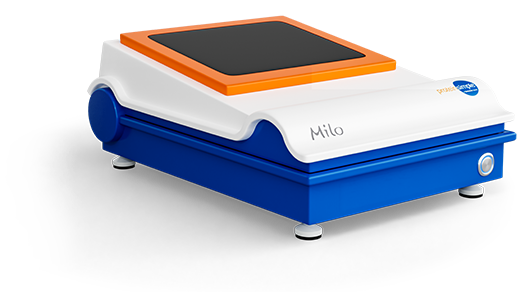
Single-Cell Western Blot System
Single Cell Protein Analysis with Milo
Milo is the world’s first Single Cell Western blotting platform that measures protein expression in ~1,000 single cells per run using conventional Western blot antibodies. Simply load your cell suspension on a scWest chip, then Milo performs lysis, SDS-PAGE separation, and UV-induced immobilization of each single cell lysate on-chip in a matter of minutes. Probe the scWest chip with conventional Western blot antibodies and use a microarray scanner to measure ~12 proteins per cell using a variety of multiplexing strategies, or store your chip for up to 9 months for future analysis.
How does Single Cell Western Technology work?
Single-Cell Westerns happen on scWest chips. Put your cell suspension on the chip and put the chip in Milo. Milo lyses the cells, runs an SDS-PAGE separation on every single-cell lysate, and immobilizes all your separated proteins in 5 minutes flat! Next, just probe your protein targets on-chip with standard primary and fluorescent secondary antibodies and image chip fluorescence. Scout Software will then automate your data analysis for you! One simple process lets you measure diverse targets and profile heterogeneity in your complex samples!
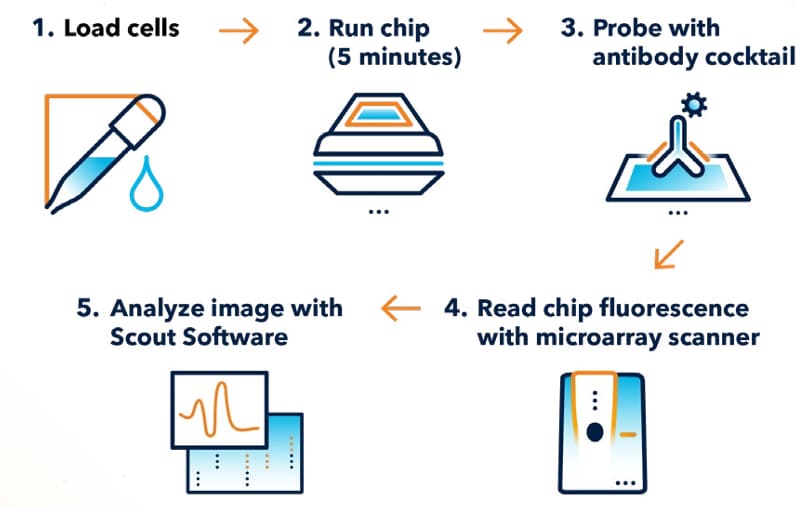
Add 1 mL of a single-cell suspension onto an scWest chip. Individual cells settle into microwells patterned into the pre-cast polyacrylamide gel. Milo lyses the cells, does a rapid (~1 min) SDS-PAGE separation on each single-cell lysate and immobilizes the proteins in the gel using UV. Probe with conventional Western primary and fluorescent secondary antibodies in the probing chamber and image chip fluorescence. Scout Software analyzes images to extract peak area for each target detected in each single-cell lysate.

(1) Singles are applied to the scWest chips which contain a 8%T polyacrylamide gel.
(2) The cells settle by gravity into micro-wells patterned into the thin polyacrylamide gel.
(3) The cells are then lysed and proteins are separated, in situ, followed by (4) immobilization of separated proteins into the gel via UV light.
(5) Proteins are then detected using target specific primary antibodies and fluorescently labeled secondary antibodies.
(6) A microarray scanner is used for fluorescence read-out and the Scout software automates the image processing and data analysis.
How Single-Cell Westerns can help you?
Western blots or Simple Western technology is useful for measuring protein expression in cells at the bulk or population level. However, Single-cell Western blot provides single-cell resolution so that users can measure heterogeneity in their sample and identify and characterize subpopulations of cells within a sample that would be missed otherwise with a bulk or average measurement technique.
| Intercellular protein analysis at the single cell level | In comparison to flow cytometry, Single-Cell Westerns facilitate the detection of intracellular proteins by lysing the cells before analysis. This makes intracellular targets such as transcription factors and even methylated histones accessible for analysis. Single-Cell Westerns are also great for the detection of phosphorylated proteins, transcription factors or proteins for which there are no high-quality flow validated antibodies available. |
| Validate single cell sequencing data | For single-cell RNA researchers, Single-Cell Western provides a flexible platform to validate RNA data at the protein level by enabling measurement of multiple protein targets. Taking advantage of the ability to archive scWEst chips, you can split your sample, run half through a single-cell RNA-seq workflow and half through the Milo workflow. Then archive the scWest chip for up to 9 months. Once you have your sequencing results back, you can probe your scWest chip(s) to get protein validation of your single-cell RNA-seq data on the same sample. Single-Cell Westerns also makes it possible to do protein validation of single-cell RNA seq or single-cell qPCR data.
|
| Validate success of gene editing | In gene editing research, Single-Cell Westerns are useful to measure the efficiency of gene editing/transfection. Milo makes it possible to determine if all cells are transfected or just a few of them and to see if transfection has any effect on the cells that were transfected.
|
Hear from your peers using Single-Cell Western Technology
M. Maya Kaelberer, Ph.D.

Postdoctoral Associate, Duke University School of Medicine
'We have been pairing Milo with single cell real time qPCR data. We have the RNA and we know the transcripts are present. We used Milo to confirm our results and quantify the amount of protein that is in each individual cell.'
Yi Zhong, M.D., Ph.D.

Research Associate, Memorial Sloan Kettering Cancer Center
'Milo permits study of proteins at the single cell level to understand the heterogeneity among metastatic cells within a population.'
Prashant Vijay Thakkar, Ph.D.

Postdoctoral associate, Weill Cornell Medicine
'I was looking at two different isoforms of a protein, and it was important to know if the cells were expressing just one versus the other or both in a given cell. That was tricky until Milo came. We’re also getting more relevant information because Milo allows us to look at expression of this protein in tissue biopsies.'