
Human ARNT/HIF-1 beta ELISA Kit (Colorimetric)
Novus Biologicals | Catalog # NBP3-27505

Loading...
Key Product Details
Sample Type & Volume Required Per Well
Tissue homogenates, cell lysates and other biological fluids (100 uL)
Sensitivity
0.067 ng/mL (example only; lot dependent)
Assay Range
0.156 - 10 ng/mL (example only; lot dependent)
Loading...
Product Specifications
Assay Type
Sandwich ELISA
Kit Type
ELISA Kit (Colorimetric)
Species
Human
Description
Assay Length: 4.5 hours
精度
Intra-Assay Precision (Precision within an assay) %CV < 10 (example only; lot dependent)
Inter-Assay Precision (Precision between assays) %CV < 12 (example only; lot dependent)
Scientific Data Images for Human ARNT/HIF-1 beta ELISA Kit (Colorimetric)
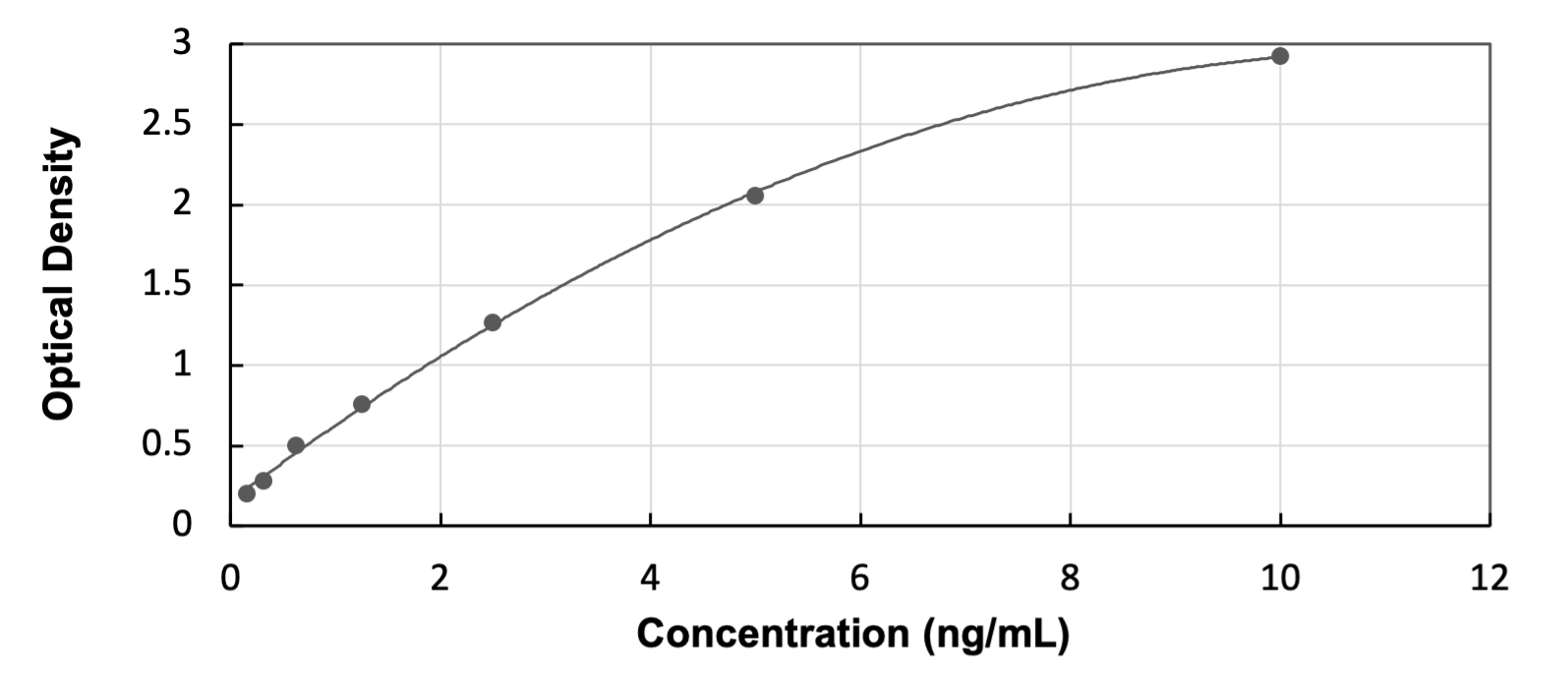
ELISA: Human ARNT/HIF-1 beta ELISA Kit (Colorimetric) [NBP3-27505] -
ELISA: Human ARNT/HIF-1 beta ELISA Kit (Colorimetric) [NBP3-27505] - Standard Curve ReferenceKit Contents for Human ARNT/HIF-1 beta ELISA Kit (Colorimetric)
- Detection Reagent A
- Detection Reagent B
- Diluent Buffer
- Instruction manual
- Plate sealer for 96 wells
- Pre-coated 96T strip plate
- Standard
- Stop Solution
- TMB Substrate
- Wash Buffer (30 x concentrate)
Preparation and Storage
Shipping
The product is shipped with polar packs. Upon receipt, store it immediately at the temperature recommended below.
Stability & Storage
Storage of components varies. See protocol for specific instructions.
Background: ARNT/HIF-1 beta
ARNT has an important role in two specific signaling pathways - the aryl hydrocarbon receptor (AhR) and the hypoxia inducible factor (HIF) pathway (1). In the AhR pathway, AhR in the cytosol is typically inactive and bound to heat shock protein 90 (hsp90) (3). Upon activation and ligand binding by environmental pollutants such as dioxins, AhR is translocated to the nucleus, dissociates from hsp90, and dimerizes with ARNT, leading to binding to response elements and expression of target genes including monooxygenases (1, 3). In the HIF pathway, under hypoxia (low oxygen) conditions prolylhydroxylase domain (PHD) enzymes and factor inhibiting HIF (FIH) are inhibited. HIF-1 alpha (or HIF-2 alpha) accumulates and is transported to the nucleus where it heterodimerizes with ARNT, allowing for binding to target gene's hypoxia response element (HRE), recruitment of coactivators, and transcription (1, 3). HIF-induced gene transcription plays a large role in tumor progression by promoting invasion, metastasis, de-differentiation and altered metabolism, and angiogenesis (1). While HIF-1 alpha's stability is dependent upon oxygen conditions, HIF-1 beta is stable in both normoxia and hypoxia (1-3).
The bHLH-PAS family and ARNT have been linked with a variety of pathologies and diseases including cancer, metabolic diseases, autoimmune diseases, and psychiatric disorders (2). ARNT/AHR is expressed in the skin and its pathway activation enhances skin barrier function and epidermal terminal differentiation, thus AHR agonists are currently being used as therapeutics for atopic dermatitis and psoriasis (4). Accordingly, studies of Arnt-deficient mice show profound abnormalities in skin barrier function and keratinization (4). Additionally, studies suggest that ARNT plays an important role in diabetes and beta-cell function (5). Islets from patients with type 2 diabetes have a significantly decreased ARNT expression compared to glucose-tolerant control donors (5). Modulation and stimulation of the HIF pathway may be a potential therapeutic strategy for treating type 2 diabetes and metabolic syndrome (5).
Alternate names for ARNT/HIF-1 beta include aryl hydrocarbon receptor nuclear translocator, BHLHE2, class E basic helix-loop-helix protein 2, Dixon receptor nuclear translocator, Hypoxia-inducible factor 1-beta, nuclear translocator, and TANGO.
References
1. Mandl, M., & Depping, R. (2014). Hypoxia-inducible aryl hydrocarbon receptor nuclear translocator (ARNT) (HIF-1beta): is it a rare exception?. Molecular medicine (Cambridge, Mass.). https://doi.org/10.2119/molmed.2014.00032
2. Wu, D., & Rastinejad, F. (2017). Structural characterization of mammalian bHLH-PAS transcription factors. Current opinion in structural biology. https://doi.org/10.1016/j.sbi.2016.09.011
3. Esser, C., & Rannug, A. (2015). The aryl hydrocarbon receptor in barrier organ physiology, immunology, and toxicology. Pharmacological reviews.https://doi.org/10.1124/pr.114.009001
4. Furue, M., Hashimoto-Hachiya, A., & Tsuji, G. (2019). Aryl Hydrocarbon Receptor in Atopic Dermatitis and Psoriasis. International journal of molecular sciences. https://doi.org/10.3390/ijms20215424
5. Girgis, C. M., Cheng, K., Scott, C. H., & Gunton, J. E. (2012). Novel links between HIFs, type 2 diabetes, and metabolic syndrome. Trends in endocrinology and metabolism: TEM, https://doi.org/10.1016/j.tem.2012.05.003
Long Name
Aryl Hydrocarbon Receptor Nuclear Translocator
Alternate Names
HIF-1 beta, HIF1 beta, TANGO
Gene Symbol
ARNT
Additional ARNT/HIF-1 beta Products
Product Documents for Human ARNT/HIF-1 beta ELISA Kit (Colorimetric)
Certificate of Analysis
To download a Certificate of Analysis, please enter a lot or batch number in the search box below.
Product Specific Notices for Human ARNT/HIF-1 beta ELISA Kit (Colorimetric)
This product is for research use only and is not approved for use in humans or in clinical diagnosis. ELISA Kits are guaranteed for 6 months from date of receipt.
Customer Reviews for Human ARNT/HIF-1 beta ELISA Kit (Colorimetric)
There are currently no reviews for this product. Be the first to review Human ARNT/HIF-1 beta ELISA Kit (Colorimetric) and earn rewards!
Have you used Human ARNT/HIF-1 beta ELISA Kit (Colorimetric)?
Submit a review and receive an Amazon gift card!
$25/€18/£15/$25CAN/¥2500 for a review with an image
$10/€7/£6/$10CAN/¥1110 for a review without an image
Submit a review
Protocols
Find general support by application which include: protocols, troubleshooting, illustrated assays, videos and webinars.
- ELISA Sample Preparation & Collection Guide
- ELISA Troubleshooting Guide
- How to Run an R&D Systems DuoSet ELISA
- How to Run an R&D Systems Quantikine ELISA
- How to Run an R&D Systems Quantikine™ QuicKit™ ELISA
- Quantikine HS ELISA Kit Assay Principle, Alkaline Phosphatase
- Quantikine HS ELISA Kit Principle, Streptavidin-HRP Polymer
- Sandwich ELISA (Colorimetric) – Biotin/Streptavidin Detection Protocol
- Sandwich ELISA (Colorimetric) – Direct Detection Protocol
- Troubleshooting Guide: ELISA
- View all Protocols, Troubleshooting, Illustrated assays and Webinars
FAQs for Human ARNT/HIF-1 beta ELISA Kit (Colorimetric)
Showing
1
-
3 的
3 FAQs
Showing All
-
Q: For use in Western Blot with HIF-1 beta antibodies, what molecular weight of the band should I expect to see?
A: The theoretical molecular weight determined by our technical team for ARNT/HIF-1 beta antibodies is 86.6 kDa.
-
Q: If this product is used in an application or species as a part of a customer review, will that validate this product in the application/species?
A: If any of our primary antibodes are used in an untested application or species and it is shown to work through images from customer reviews or through publications, this validates the application/species for this product, allowing the tested application/species to fall under our 100% guarantee. Please check out our Innovator's Reward Program if you decide to test a primary antibody with a species or application that is not currently listed. Please note that the Innovator's Reward Program only applies to our primary antibodies.
-
Q: Is this target appropriate for use in Chromatin Research?
A: Yes; here is a list of research areas that we have deemed appropriate for the target "ARNT/HIF-1 beta": Angiogenesis, Autophagy, Cancer, Cellular Markers, Chromatin Research, HIF Target Genes, Hypoxia, Transcription Factors and Regulators, Cardiovascular Biology, Lipid and Metabolism.
-
Q: For use in Western Blot with HIF-1 beta antibodies, what molecular weight of the band should I expect to see?
A: The theoretical molecular weight determined by our technical team for ARNT/HIF-1 beta antibodies is 86.6 kDa.
-
Q: If this product is used in an application or species as a part of a customer review, will that validate this product in the application/species?
A: If any of our primary antibodes are used in an untested application or species and it is shown to work through images from customer reviews or through publications, this validates the application/species for this product, allowing the tested application/species to fall under our 100% guarantee. Please check out our Innovator's Reward Program if you decide to test a primary antibody with a species or application that is not currently listed. Please note that the Innovator's Reward Program only applies to our primary antibodies.
-
Q: Is this target appropriate for use in Chromatin Research?
A: Yes; here is a list of research areas that we have deemed appropriate for the target "ARNT/HIF-1 beta": Angiogenesis, Autophagy, Cancer, Cellular Markers, Chromatin Research, HIF Target Genes, Hypoxia, Transcription Factors and Regulators, Cardiovascular Biology, Lipid and Metabolism.
-
Q: For use in Western Blot with HIF-1 beta antibodies, what molecular weight of the band should I expect to see?
A: The theoretical molecular weight determined by our technical team for ARNT/HIF-1 beta antibodies is 86.6 kDa.
-
Q: If this product is used in an application or species as a part of a customer review, will that validate this product in the application/species?
A: If any of our primary antibodes are used in an untested application or species and it is shown to work through images from customer reviews or through publications, this validates the application/species for this product, allowing the tested application/species to fall under our 100% guarantee. Please check out our Innovator's Reward Program if you decide to test a primary antibody with a species or application that is not currently listed. Please note that the Innovator's Reward Program only applies to our primary antibodies.
-
Q: Is this target appropriate for use in Chromatin Research?
A: Yes; here is a list of research areas that we have deemed appropriate for the target "ARNT/HIF-1 beta": Angiogenesis, Autophagy, Cancer, Cellular Markers, Chromatin Research, HIF Target Genes, Hypoxia, Transcription Factors and Regulators, Cardiovascular Biology, Lipid and Metabolism.
Loading...
Associated Pathways

