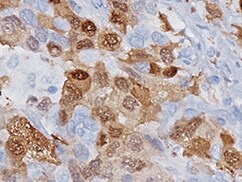
Human CCL16/HCC-4 Antibody Summary
Gln24-Gln120
Accession # O15467
Applications
Human CCL16/HCC-4 Sandwich Immunoassay
Please Note: Optimal dilutions should be determined by each laboratory for each application. General Protocols are available in the Technical Information section on our website.
Scientific Data
View Larger
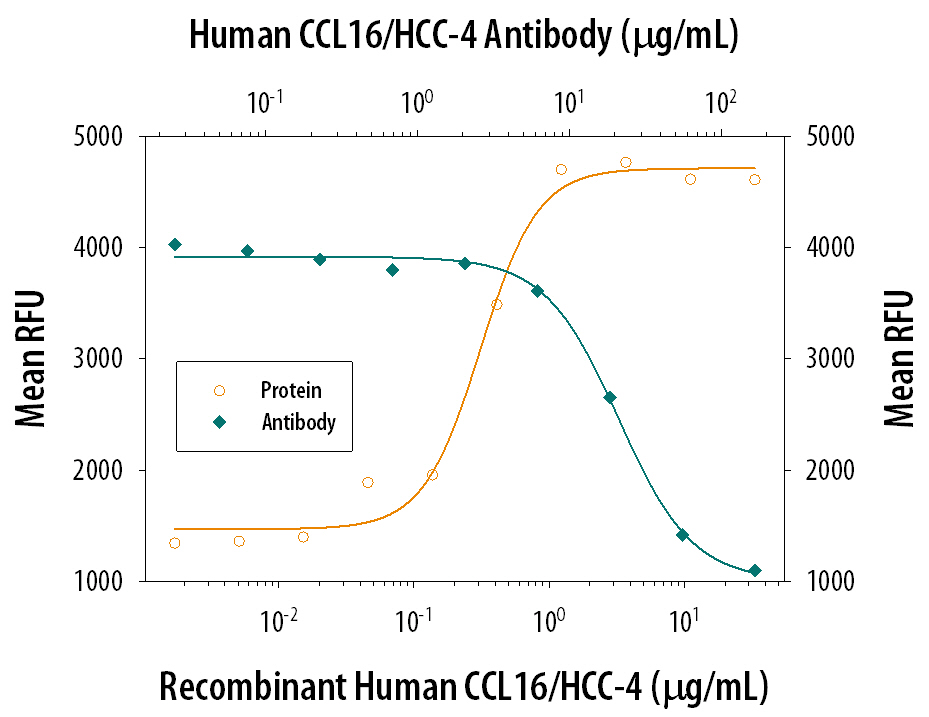
Chemotaxis Induced by CCL16/HCC‑4 and Neutral-ization by Human CCL16/ HCC‑4 Antibody. Recombinant Human CCL16/ HCC-4 (Catalog # 802-HC) chemoattracts the BaF3 mouse pro-B cell line transfected with human CCR1 in a dose-dependent manner (orange line). The amount of cells that migrated through to the lower chemotaxis chamber was measured by Resazurin (Catalog # AR002). Chemotaxis elicited by Recombinant Human CCL16/ HCC-4 (0.75 µg/mL) is neutralized (green line) by increasing concentrations of Mouse Anti-Human CCL16/ HCC-4 Monoclonal Antibody (Catalog # MAB328). The ND50 is typically 5-20 µg/mL.
Reconstitution Calculator
Preparation and Storage
- 12 months from date of receipt, -20 to -70 °C as supplied.
- 1 month, 2 to 8 °C under sterile conditions after reconstitution.
- 6 months, -20 to -70 °C under sterile conditions after reconstitution.
Background: CCL16/HCC-4
Human HCC-4, also named NCC-4, liver-expressed chemokine (LEC), and lymphocyte and monocyte chemoattractant (LMC), is a novel CC chemokine identified through bioinformatics. HCC-4 cDNA encodes a 120 amino acid (aa) residue precursor protein with a 23 aa residue predicted signal peptide that is cleaved to generate a 97 aa residue mature protein. HCC-4 is distantly related to other CC chemokines, exhibiting less than 30% aa sequence identity. Among these CC chemokines, HCC-4 has the most similarity to HCC-1. Two potential polyadenylation signals are present on the human HCC-4 gene, and as a result, two transcripts containing approximately 1,500 base pairs and 500 base pairs have been detected. HCC-4 is expressed weakly by some lymphocytes, including NK cells, gamma δ T cells, and some T cell clones. The expression of HCC-4 in monocytes is highly upregulated in the presence of IL-10. The HCC-4 gene has been mapped to chromosome 17q where multiple CC chemokines are clustered.
Recombinant HCC-4 has been shown to chemoattract human monocytes and THP-1 cells but not resting lymphocytes or neutrophils. HCC-4 has also been found to suppress proliferation of myeloid progenitor cells. The HCC-4 induced calcium flux in THP-1 cells can be desensitized by prior exposure to RANTES, suggesting that HCC-4 and RANTES share the same receptor in THP-1 cells.
- Shoudai, K. et al. (1998) Biochim. Biophys. Acta 1396:273.
- Hedrick, J. et al. (1998) Blood 91:4242.
- Youn, B-S. et al. (1998) BBRC 247:217.
Product Datasheets
Citations for Human CCL16/HCC-4 Antibody
R&D Systems personnel manually curate a database that contains references using R&D Systems products. The data collected includes not only links to publications in PubMed, but also provides information about sample types, species, and experimental conditions.
2
Citations: Showing 1 - 2
Filter your results:
Filter by:
-
Structure and Dynamics of Human Chemokine CCL16-Implications for Biological Activity
Authors: OH Weiergräbe, D Petrovi?, A Kislat, M Pattky, J Fabig, R Batra-Saff, J Schulte Am, K Hänel, C Huhn, B Strodel, B Homey, D Willbold
Biomolecules, 2022-10-28;12(11):.
Species: Human
Sample Types: Whole Tissue
Applications: IHC -
CCL16/LEC powerfully triggers effector and antigen-presenting functions of macrophages and enhances T cell cytotoxicity.
Authors: Cappello P, Caorsi C, Bosticardo M
J. Leukoc. Biol., 2003-10-02;75(1):135-42.
Species: Mouse
Sample Types: Whole Cells
Applications: Neutralization
FAQs
No product specific FAQs exist for this product, however you may
View all Antibody FAQsReviews for Human CCL16/HCC-4 Antibody
Average Rating: 5 (Based on 1 Review)
Have you used Human CCL16/HCC-4 Antibody?
Submit a review and receive an Amazon gift card.
$25/€18/£15/$25CAN/¥75 Yuan/¥2500 Yen for a review with an image
$10/€7/£6/$10 CAD/¥70 Yuan/¥1110 Yen for a review without an image
Filter by: