
Human Plexin B2 Antibody (537237)
R&D Systems | Catalog # MAB5329

Scientific images may be resized, cropped, or adjusted for brightness or contrast for presentation purposes. These updates are limited to presentation and do not affect the underlying scientific interpretation of the data. Where available, additional source data may be provided upon request.
Key Product Details
Species Reactivity
Validated:
Cited:
Applications
Validated:
Cited:
Label
Antibody Source
Product Specifications
Immunogen
Leu20-Arg1160
Accession # O15031
Specificity
Clonality
Host
Isotype
Scientific Data Images for Human Plexin B2 Antibody (537237)
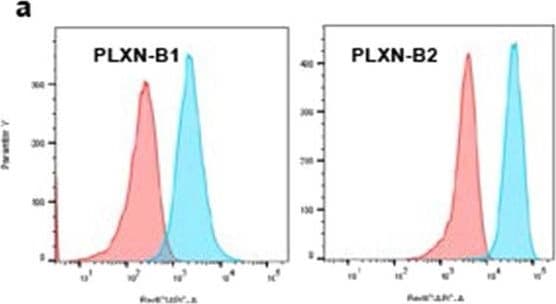
Detection of Plexin B2 by Flow Cytometry
SEMA4D triggers receptor-mediated astrocyte reactivity, including changes in astrocyte morphology, expression of key transporters for glutamate recycling and energy metabolism and impairs astrocyte function of glucose uptake. a Primary human astrocyte cultures were stained for PLXN receptors (blue), compared to isotype control antibodies (red). Antibody blocking effect was determined by incubation with rSEMA4D or control protein, in presence/absence of anti-SEMA4D antibody/VX15 (human IgG4) or isotype-matched control antibodies for 48 h. Cultures were stained for b EAAT-2, and c GLUT-1 and MCT-4 transporters. d In a separate experiment, blocking of receptors was assessed using anti-PLXNB1 (mouse IgG1) and/or anti-PLXNB2 (mouse IgG2a) or isotype-matched control antibodies and the same conditions as above. Quantification is shown as; mean + SEM of replicates for each treatment. e Glucose uptake was measured in human astrocyte cultures treated as above. rSEMA4D was added at time 0 and antibodies were added at t = 0 (solid lines and circles) for inhibition or t = 24 h (dotted lines and triangles) to evaluate reversal of activity. Quantification for each condition is shown as average + SEM from 3 wells/condition/timepoint. f Morphologic changes showing length and number of primary processes. For b to f, multivariate regression analysis was performed to determine the effect treatment conditions and dependent variables with treatment type. The significance levels are reported with Tukey post hoc tests for multivariate analysis Image collected and cropped by CiteAb from the following open publication (https://pubmed.ncbi.nlm.nih.gov/35933420), licensed under a CC-BY license. Not internally tested by R&D Systems.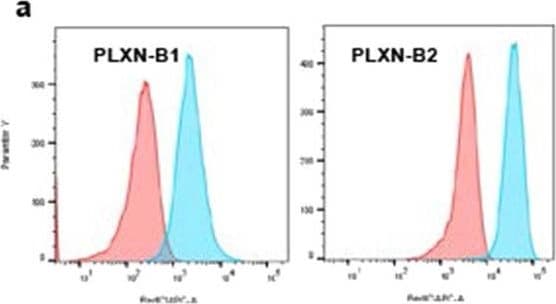
Detection of Plexin B2 by Flow Cytometry
SEMA4D triggers receptor-mediated astrocyte reactivity, including changes in astrocyte morphology, expression of key transporters for glutamate recycling and energy metabolism and impairs astrocyte function of glucose uptake. a Primary human astrocyte cultures were stained for PLXN receptors (blue), compared to isotype control antibodies (red). Antibody blocking effect was determined by incubation with rSEMA4D or control protein, in presence/absence of anti-SEMA4D antibody/VX15 (human IgG4) or isotype-matched control antibodies for 48 h. Cultures were stained for b EAAT-2, and c GLUT-1 and MCT-4 transporters. d In a separate experiment, blocking of receptors was assessed using anti-PLXNB1 (mouse IgG1) and/or anti-PLXNB2 (mouse IgG2a) or isotype-matched control antibodies and the same conditions as above. Quantification is shown as; mean + SEM of replicates for each treatment. e Glucose uptake was measured in human astrocyte cultures treated as above. rSEMA4D was added at time 0 and antibodies were added at t = 0 (solid lines and circles) for inhibition or t = 24 h (dotted lines and triangles) to evaluate reversal of activity. Quantification for each condition is shown as average + SEM from 3 wells/condition/timepoint. f Morphologic changes showing length and number of primary processes. For b to f, multivariate regression analysis was performed to determine the effect treatment conditions and dependent variables with treatment type. The significance levels are reported with Tukey post hoc tests for multivariate analysis Image collected and cropped by CiteAb from the following open publication (https://pubmed.ncbi.nlm.nih.gov/35933420), licensed under a CC-BY license. Not internally tested by R&D Systems.Applications for Human Plexin B2 Antibody (537237)
Western Blot
Sample: Recombinant Human Plexin B2 under non-reducing conditions only
Reviewed Applications
Read 1 review rated 4 using MAB5329 in the following applications:
Formulation, Preparation, and Storage
Purification
Reconstitution
Reconstitute at 0.5 mg/mL in sterile PBS. For liquid material, refer to CoA for concentration.
Formulation
Shipping
Stability & Storage
- 12 months from date of receipt, -20 to -70 °C as supplied.
- 1 month, 2 to 8 °C under sterile conditions after reconstitution.
- 6 months, -20 to -70 °C under sterile conditions after reconstitution.
Calculators
Background: Plexin B2
Alternate Names
Gene Symbol
UniProt
Additional Plexin B2 Products
Product Documents for Human Plexin B2 Antibody (537237)
Certificate of Analysis
To download a Certificate of Analysis, please enter a lot or batch number in the search box below.
Note: Certificate of Analysis not available for kit components.
Product Specific Notices for Human Plexin B2 Antibody (537237)
For research use only
Citations for Human Plexin B2 Antibody (537237)
 Powered by Bioz
Customer Reviews for Human Plexin B2 Antibody (537237) (1)
Have you used Human Plexin B2 Antibody (537237)?
Submit a review and receive an Amazon gift card!
$25/€18/£15/$25CAN/¥2500 for a review with an image
$10/€7/£6/$10CAN/¥1110 for a review without an image
Submit a review
-
Application: Western BlotSample Tested: B cellsSpecies: HumanVerified Customer | Posted 07/27/2016
There are no reviews that match your criteria.
Protocols
Find general support by application which include: protocols, troubleshooting, illustrated assays, videos and webinars.
- Cellular Response to Hypoxia Protocols
- R&D Systems Quality Control Western Blot Protocol
- Troubleshooting Guide: Western Blot Figures
- Western Blot Conditions
- Western Blot Protocol
- Western Blot Protocol for Cell Lysates
- Western Blot Troubleshooting
- Western Blot Troubleshooting Guide
- View all Protocols, Troubleshooting, Illustrated assays and Webinars