
Integrin alpha 8 is a 170‑200 kDa member of the Integrin family of adhesion molecules. It forms an exclusive noncovalent heterodimer with Integrin beta 1. alpha 8 beta 1 promotes both cell adhesion and survival and is known to bind to fibronectin, the latency-associated peptide in latent TGF-beta 1 and nephronectin. Mouse Integrin alpha 8 is a 1025 amino acid (aa) type I transmembrane glycoprotein. It contains a 969 aa extracellular region (aa 38‑1006) and a 29 aa cytoplasmic domain. One isoform may exist that shows a truncation after Ala675 of the precursor. In the ECD, mouse Integrin alpha 8 shares 96% and 90% aa sequence identity with rat and human Integrin alpha 8 protein, respectively.
Mouse Integrin alpha 8 Antibody [Biotin]
R&D Systems | Catalog # BAF4076


Scientific images may be resized, cropped, or adjusted for brightness or contrast for presentation purposes. These updates are limited to presentation and do not affect the underlying scientific interpretation of the data. Where available, additional source data may be provided upon request.
Key Product Details
Species Reactivity
Validated:
Mouse
Cited:
Human, Mouse
Applications
Validated:
Western Blot, Immunocytochemistry
Cited:
Immunohistochemistry, Flow Cytometry
Label
Biotin
Antibody Source
Polyclonal Goat IgG
Loading...
Product Specifications
Immunogen
Chinese hamster ovary cell line CHO-derived recombinant mouse Integrin alpha 8
Phe38-Phe1007
Accession # A2ARA8
Phe38-Phe1007
Accession # A2ARA8
Specificity
Detects mouse Integrin alpha 8 in Western blots. In Western blots, less than 5% cross-reactivity with recombinant human Integrin alpha 5 and recombinant mouse (rm) Integrin alpha 5 is observed, and less than 1% cross-reactivity with rmIntegrin alpha V is observed.
Clonality
Polyclonal
Host
Goat
Isotype
IgG
Scientific Data Images for Mouse Integrin alpha 8 Antibody [Biotin]
Integrin alpha 8 in 4T1 Mouse Cell Line.
Integrin a8 was detected in immersion fixed 4T1 mouse breast cancer cell line using Goat Anti-Mouse Integrin a8 Biotinylated Antigen Affinity-purified Polyclonal Antibody (Catalog # BAF4076) at 10 µg/mL for 3 hours at room temperature. Cells were stained using the NorthernLights™ 557-conjugated Streptavidin (red; NL999) and counterstained with DAPI(blue). Specific staining was localized to cytoplasm and cell surface. View our protocol for Fluorescent ICC Staining of Cells on Coverslips.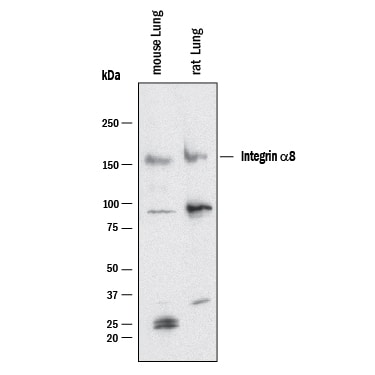
Detection of Mouse Integrin alpha 8 by Western Blot.
Western blot shows lysates of Mouse Lung and Rat Lung. PVDF membrane was probed with 0.5 µg/mL of Goat Anti-Mouse Integrin alpha 8 Biotinylated Antigen Affinity-purified Polyclonal Antibody (Catalog # BAF4076) followed by Streptavidin-HRP (Catalog # DY998) in 3% BSA. A specific band was detected for Integrin alpha 8 at approximately 155 kDa (as indicated). This experiment was conducted under reducing conditions and using Western Blot Buffer Group 1.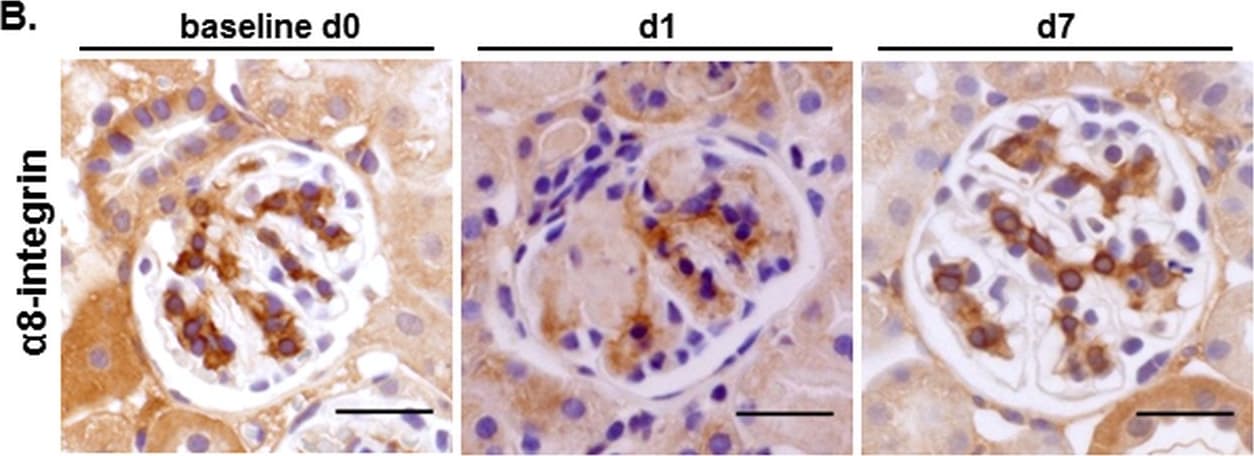
Detection of Mouse Integrin alpha 8 by Immunocytochemistry/Immunofluorescence
Mesangial cells and not podocytes display considerable transient damage in the course of the EC model.Mice were analyzed at baseline (day 0), day 1, and day 7 following disease induction. A. Quantification of glomerular mesangial injury by alpha 8-integrin (mesangial cell marker) staining of kidney slices. Data are presented as mean ± SEM, n = 5/5/10 for day 0 /day 1 /day 7, respectively. **p<0.01, ***p<0.001 by one-way ANOVA; B. Representative alpha 8-integrin staining images in the course of the EC model. Scale bars correspond to 25 μm; C. Quantification of podocyte depletion and injury on kidney slices by WT1 and nephrin staining, respectively. Data are presented as mean ± SEM, n = 5/5/10 for day 0 /day 1 /day 7, respectively. *p<0.05, **p<0.01, ns- not significant by one-way ANOVA; D. Representative WT1/nephrin co-staining images in the course of the EC model. 4′,6-diamidino-2-phenylindole (DAPI) was used as a nuclear marker. Scale bars correspond to 25 μm. Image collected and cropped by CiteAb from the following publication (https://pubmed.ncbi.nlm.nih.gov/29771991), licensed under a CC-BY license. Not internally tested by R&D Systems.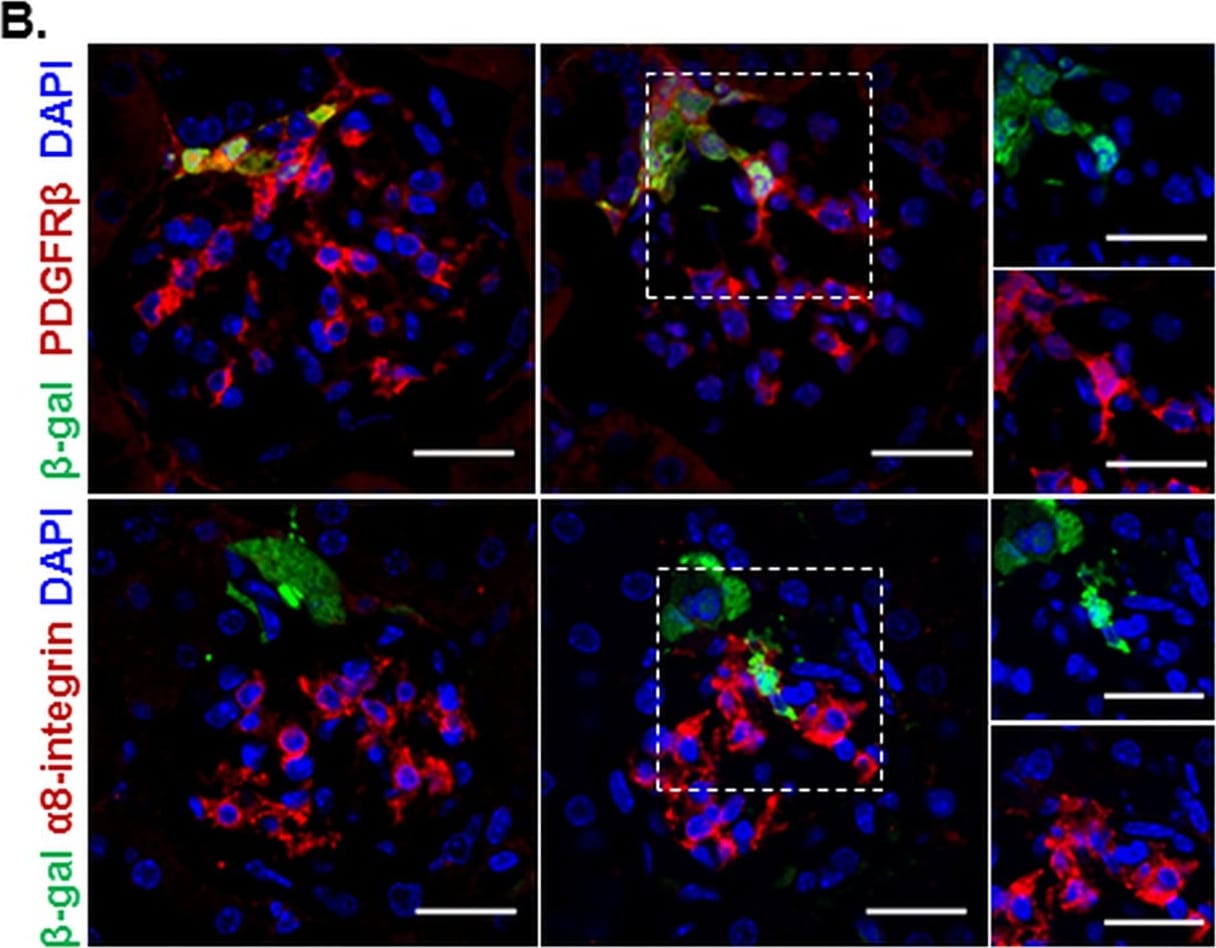
Detection of Mouse Integrin alpha 8 by Immunocytochemistry/Immunofluorescence
RLCs selectively differentiate to intraglomerular mesangial cells during EC model.A. Representative confocal microscopy images for day 0 and day 7 of beta -gal and the EC markers ERG (upper panels) or CD31 (lower panels) co-stained kidney slices; B. Representative confocal microscopy images for day 0 and day 7 of beta -gal and the mesangial cell markers PDGF beta R (upper panels) or alpha 8-integrin (lower panels) co-stained kidney slices; C. Representative confocal microscopy images for day 0 and day 7 of beta -gal/WT1 (podocyte marker) co-stained kidney slices. 4′,6-diamidino-2-phenylindole (DAPI) was used as a nuclear marker throughout. The channels for green ( beta -gal) and red (corresponding cell marker) fluorescent signals in the dashed squares on day 7 are separately shown in the small right panels. Scale bars correspond to 25 μm. Image collected and cropped by CiteAb from the following publication (https://pubmed.ncbi.nlm.nih.gov/29771991), licensed under a CC-BY license. Not internally tested by R&D Systems.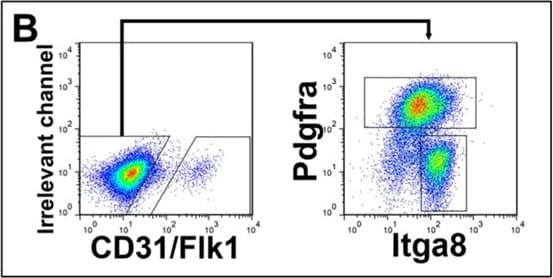
Detection of Mouse Integrin alpha 8 by Flow Cytometry
Vascular development is limited in the reconstituted kidney organoids in vitro (A) Scheme for kidney organoid reconstitution and culture in vitro. Three types of kidney progenitors at E11.5 (NPs, SPs, and Hoxb7-GFP+ UBs) were aggregated overnight with or without ECs. The organoids were subsequently cultured at the air-liquid interface for 2–6 days (days 3–7). (B) Sorting of ECs, NP, and SPs. CD31+ and/or Flk1+ cells were sorted as ECs (left), and the cells in the CD31−/Flk1− fraction (left) were further sorted into Itga8+ NP and Pdgfra+ SP fractions (right). (C–F) Whole-mount staining of kidney organoids aggregated with ECs and cultured for the indicated days. GFP+ UB branching and CD31+ vasculature formation (C,D), as well as Nephrin+ glomerulus formation (E), were observed. No Cx40+ arterioles (F) were observed. (G) Section staining of glomeruli (nephrin). No CD31+ ECs were detected in glomeruli. (H–L) Whole-mount (H–K) or section (L) staining of kidney organoids aggregated without ECs and cultured for the indicated days. No apparent differences between the organoids with (C–G) and without (H–L) ECs were observed. Scale bars: 100 µm (C–F, H–K); 10 µm (G,L). Representative images of three organoids each with and without ECs from three independent experiments are shown. Image collected and cropped by CiteAb from the following publication (https://pubmed.ncbi.nlm.nih.gov/30718617), licensed under a CC-BY license. Not internally tested by R&D Systems.Applications for Mouse Integrin alpha 8 Antibody [Biotin]
Application
Recommended Usage
Immunocytochemistry
5-15 µg/mL
Sample: Immersion fixed 4T1 mouse breast cancer cell line
Sample: Immersion fixed 4T1 mouse breast cancer cell line
Western Blot
0.5 µg/mL
Sample: Mouse lung and rat lung
Sample: Mouse lung and rat lung
Formulation, Preparation, and Storage
Purification
Antigen Affinity-purified
Reconstitution
Reconstitute at 0.2 mg/mL in sterile PBS.
Loading...
Formulation
Lyophilized from a 0.2 μm filtered solution in PBS with BSA as a carrier protein.
Shipping
The product is shipped at ambient temperature. Upon receipt, store it immediately at the temperature recommended below.
Stability & Storage
Use a manual defrost freezer and avoid repeated freeze-thaw cycles.
- 12 months from date of receipt, -20 to -70 °C as supplied.
- 1 month, 2 to 8 °C under sterile conditions after reconstitution.
- 6 months, -20 to -70 °C under sterile conditions after reconstitution.
Calculators
Background: Integrin alpha 8
Alternate Names
ITGA8
Gene Symbol
ITGA8
UniProt
Additional Integrin alpha 8 Products
Product Documents for Mouse Integrin alpha 8 Antibody [Biotin]
Certificate of Analysis
To download a Certificate of Analysis, please enter a lot or batch number in the search box below.
Note: Certificate of Analysis not available for kit components.
Product Specific Notices for Mouse Integrin alpha 8 Antibody [Biotin]
For research use only
Related Research Areas
Citations for Mouse Integrin alpha 8 Antibody [Biotin]
 Powered by Bioz
Customer Reviews for Mouse Integrin alpha 8 Antibody [Biotin]
There are currently no reviews for this product. Be the first to review Mouse Integrin alpha 8 Antibody [Biotin] and earn rewards!
Have you used Mouse Integrin alpha 8 Antibody [Biotin]?
Submit a review and receive an Amazon gift card!
$25/€18/£15/$25CAN/¥2500 for a review with an image
$10/€7/£6/$10CAN/¥1110 for a review without an image
Submit a review
Protocols
Find general support by application which include: protocols, troubleshooting, illustrated assays, videos and webinars.
- Appropriate Fixation of IHC/ICC Samples
- Cellular Response to Hypoxia Protocols
- ClariTSA™ Fluorophore Kits
- Detection & Visualization of Antibody Binding
- ICC Cell Smear Protocol for Suspension Cells
- ICC Immunocytochemistry Protocol Videos
- ICC for Adherent Cells
- Immunocytochemistry (ICC) Protocol
- Immunocytochemistry Troubleshooting
- Immunofluorescence of Organoids Embedded in Cultrex Basement Membrane Extract
- Immunohistochemistry (IHC) and Immunocytochemistry (ICC) Protocols
- Preparing Samples for IHC/ICC Experiments
- Preventing Non-Specific Staining (Non-Specific Binding)
- Primary Antibody Selection & Optimization
- Protocol for VisUCyte™ HRP Polymer Detection Reagent
- Protocol for the Fluorescent ICC Staining of Cell Smears - Graphic
- Protocol for the Fluorescent ICC Staining of Cultured Cells on Coverslips - Graphic
- Protocol for the Preparation and Fluorescent ICC Staining of Cells on Coverslips
- Protocol for the Preparation and Fluorescent ICC Staining of Non-adherent Cells
- Protocol for the Preparation and Fluorescent ICC Staining of Stem Cells on Coverslips
- Protocol for the Preparation of a Cell Smear for Non-adherent Cell ICC - Graphic
- R&D Systems Quality Control Western Blot Protocol
- TUNEL and Active Caspase-3 Detection by IHC/ICC Protocol
- The Importance of IHC/ICC Controls
- Troubleshooting Guide: Western Blot Figures
- Western Blot Conditions
- Western Blot Protocol
- Western Blot Protocol for Cell Lysates
- Western Blot Troubleshooting
- Western Blot Troubleshooting Guide
- View all Protocols, Troubleshooting, Illustrated assays and Webinars
Loading...