
Recombinant Cynomolgus Lipocalin-2/NGAL His-tag Protein, CF
R&D Systems | Catalog # 2357-LC

Loading...
Key Product Details
- R&D Systems CHO-derived Recombinant Cynomolgus Lipocalin-2/NGAL His-tag Protein (2357-LC)
- Quality control testing to verify active proteins with lot specific assays by in-house scientists
- All R&D Systems proteins are covered with a 100% guarantee
Source
CHO
Accession Number
Applications
Enzyme Activity
Loading...
Product Specifications
Source
Chinese Hamster Ovary cell line, CHO-derived cynomolgus monkey Lipocalin-2/NGAL protein
Gln21-Gly198
with C-terminal 6-His tag
Gln21-Gly198
with C-terminal 6-His tag
Purity
>95%, by SDS-PAGE visualized with Silver Staining and quantitative densitometry by Coomassie® Blue Staining.
Endotoxin Level
<0.10 EU per 1 μg of the protein by the LAL method.
N-terminal Sequence Analysis
No results obtained. Gln21 is inferred from enzymatic pyroglutamate treatment revealing Asp22.
Predicted Molecular Mass
21 kDa
SDS-PAGE
21-27 kDa, reducing conditions
Activity
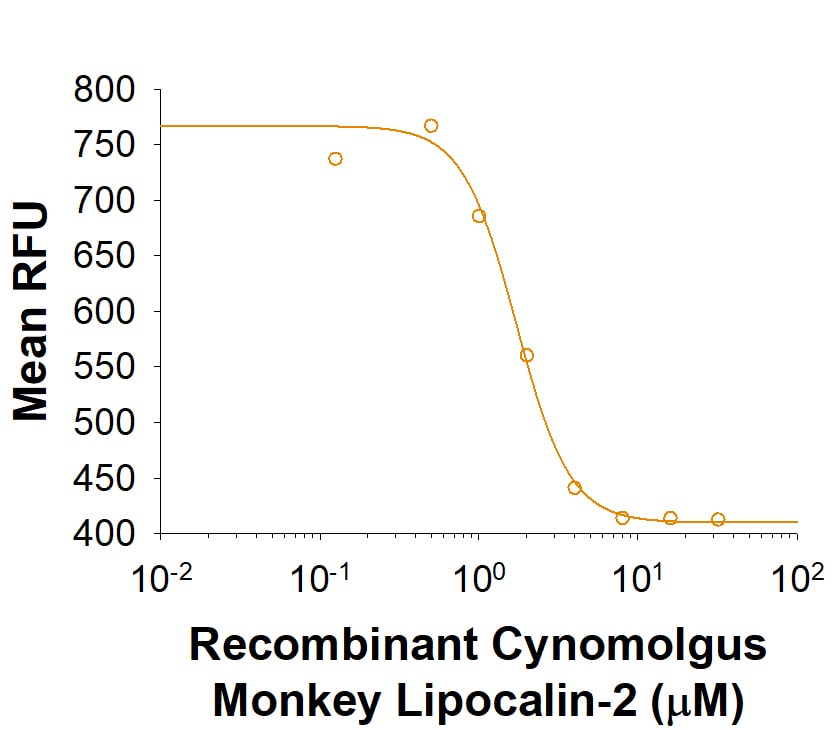
Measured by its ability to bind Iron(III) dihydroxybenzoic acid [Fe(DHBA)3]. The binding of Fe(DHBA)3 results in the quenching of Trp fluorescence in Lipocalin-2.
>1.0 μM of Fe(DHBA)3 can be bound under the described conditions.
>1.0 μM of Fe(DHBA)3 can be bound under the described conditions.
Scientific Data Images for Recombinant Cynomolgus Lipocalin-2/NGAL His-tag Protein, CF
Recombinant Cynomolgus Lipocalin-2/NGAL His-tag Protein Binding Activity
Recombinant Cynomolgus Monkey Lipocalin-2 (Catalog # 2357-LC) is measured by its ability to bind Iron(III) dihydroxybenzoic acid.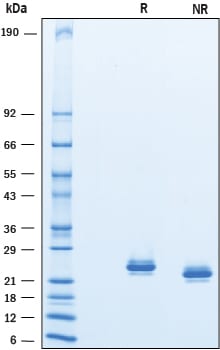
Recombinant Cynomolgus Lipocalin-2/NGAL His-tag Protein SDS-PAGE
2 μg/lane of Recombinant Cynomolgus Monkey Lipocalin‑2/NGAL was resolved with SDS-PAGE under reducing (R) and non-reducing (NR) conditions and visualized by Coomassie® Blue staining, showing a primary band at 24 kDa under reducing conditions.Formulation, Preparation, and Storage
2357-LC
| Formulation | Supplied as a 0.2 μm filtered solution in MES and NaCl. |
| Shipping | The product is shipped with polar packs. Upon receipt, store it immediately at the temperature recommended below. |
| Stability & Storage | Use a manual defrost freezer and avoid repeated freeze-thaw cycles.
|
Background: Lipocalin-2/NGAL
References
- Flower, D. R. et al. (1994) FEBS Lett. 354:7.
- Kjeldsen L. et al. (2000) Biochim. Biophys. Acta. 1482:272.
- Goetz, D. H. et al. (2002) Mol. Cell 10:1033.
- Flo, T. H. et al. (2004) Nature 432:917.
- Yang, M. B. et al. (2002) Mol. Cell. 10:1045.
- Ferreira, A. C. et al. (2018) Neurosci. BioBehav. Rev. 95:73.
- Devireddy, L. R. et al. (2001) Science 293:829.
- Jung, M. et al. (2017) Front. Immunol. 8:1171.
- Hanai, J. et al. (2005) J. Biol. Chem. 280:13641.
- Mori, K. et al. (2005) J. Clin. Invest. 115:610.
- Sun, W. Y. et al. (2018) JCI Insight. 3:120196.
- Zhou, F. et al. (2016) Eur. J. Cardiothorac. Surg. 49:746.
Long Name
Neutrophil Gelatinase-associated Lipocalin
Alternate Names
24p3, LCN2, Lipocalin2, MSFI, NGAL, Oncogene 24p3, p25, Siderocalin, Uterocalin
Gene Symbol
LCN2
UniProt
Additional Lipocalin-2/NGAL Products
Product Documents for Recombinant Cynomolgus Lipocalin-2/NGAL His-tag Protein, CF
Certificate of Analysis
To download a Certificate of Analysis, please enter a lot or batch number in the search box below.
Note: Certificate of Analysis not available for kit components.
Product Specific Notices for Recombinant Cynomolgus Lipocalin-2/NGAL His-tag Protein, CF
For research use only
Related Research Areas
Citations for Recombinant Cynomolgus Lipocalin-2/NGAL His-tag Protein, CF
 Powered by Bioz
Customer Reviews for Recombinant Cynomolgus Lipocalin-2/NGAL His-tag Protein, CF
There are currently no reviews for this product. Be the first to review Recombinant Cynomolgus Lipocalin-2/NGAL His-tag Protein, CF and earn rewards!
Have you used Recombinant Cynomolgus Lipocalin-2/NGAL His-tag Protein, CF?
Submit a review and receive an Amazon gift card!
$25/€18/£15/$25CAN/¥2500 for a review with an image
$10/€7/£6/$10CAN/¥1110 for a review without an image
Submit a review
Protocols
View specific protocols for Recombinant Cynomolgus Lipocalin-2/NGAL His-tag Protein, CF (2357-LC):
Materials
- Assay Buffer: 50 mM Tris, 10 mM CaCl2, 150 mM NaCl, pH 7.5 (TCN)
- Ligand Buffer: 0.1 M Tris, pH 8.0
- Recombinant Cynomolgus Monkey Lipocalin‑2/NGAL His-tag (cynoLipocalin-2) (Catalog # 2357-LC)
- Iron III (Fe3+) (Sigma, Catalog # 16596)
- 2,3,Dihydroxybenzoic Acid (DHBA) (Sigma, Catalog # 126209)
- F16 Black Maxisorp Plate (Nunc, Catalog # 475515)
- Fluorescent Plate Reader (Model: SpectraMax Gemini EM by Molecular Devices) or equivalent
- Prepare a curve of Fe3+ in deionized water with the following serial dilutions: 640, 320, 160, 80, 40, 20, 10, 5, and 2.5 µM.
- Prepare 1 mM DHBA in Ligand Buffer from powder stock.
- Combine equal volumes of the Fe3+ curve with 1 mM DHBA. Include a control containing 1 mM DHBA and deionized water.
- Incubate at room temperature for 10 minutes. A curve of the metal ligand complex of Fe(DHBA)3 is formed.
- After incubation, perform 5 fold dilutions to the curve using Assay Buffer.
- Dilute rcynoLipocalin-2 (MW: 21200 Da) to 4 µM in Assay Buffer.
- In the plate, load 50 µL of the diluted Fe(DHBA)3 complex curve and 50 µL of 4 µM rcynoLipocalin-2.
- Incubate at room temperature for 30 minutes.
- Read at excitation and emission wavelengths of 280 nm and 340 nm, respectively in endpoint mode.
- Plot a 4-parameter curve of Fe(DHBA)3 Concentration (x-axis) versus RFUs ( gamma -axis), and calculate a BC50 from the curve.
- Fe(DHBA)3 Complex Curve: 0.125, 0.25, 0.5, 1.0, 2.0, 4.0, 8.0, 16, and 32 µM
- rcynoLipocalin-2: 2 µM
Loading...