
NKp30, along with NKp44 and NKp46, constitute a group of receptors termed "Natural Cytotoxicity Receptors" (1). These receptors play a major role in triggering NK-mediated killing of most tumor cells lines. NKp30 is a type I transmembrane protein having a single extracellular V-like immunoglobulin domain (2). A physical association with the ITAM‑bearing accessory protein, CD3 zeta, occurs via a charged residue in the NKp30 transmembrane domain. Ligation of NKp30 with a specific antibody results in phosphorylation of CD3 zeta (3). NKp30 is expressed on both resting and activated NK cells of the CD56dim, CD16+ subset that account for more that 85% of NK cells found in peripheral blood and spleen (4). NKp30 is absent from the CD56bright, CD16- subset that constitutes the majority of NK cells in lymph node and tonsil, however, its expression is up-regulated in these cells upon IL-2 activation (4). Studies with neutralizing antibodies reveal that NKp30 is partially responsible for triggering lytic activity against several tumor cell types and that it is the main receptor responsible for NK-mediated lysis of immature dendritic cells (2, 5). The ligand(s) recognized by NKp30 has not been described. Our Avi-tag Biotinylated human NKp30 features biotinylation at a single site contained within the Avi-tag, a unique 15 amino acid peptide. Protein orientation will be uniform when bound to streptavidin-coated surface due to the precise control of biotinylation and the rest of the protein is unchanged so there is no interference in the protein's bioactivity.
Recombinant Human NKp30 Fc Chimera Avi-tag Protein, CF
R&D Systems | Catalog # AVI1849
Biotinylated

Loading...
Key Product Details
- R&D Systems HEK293-derived Recombinant Human NKp30 Fc Chimera Avi-tag Protein (AVI1849)
- Quality control testing to verify active proteins with lot specific assays by in-house scientists
- All R&D Systems proteins are covered with a 100% guarantee
Source
HEK293
Accession Number
Structure / Form
Disulfide-linked homodimer
Biotinylated via Avi-tag
Biotinylated via Avi-tag
Conjugate
Biotin
Applications
Bioactivity
Loading...
Learn more about Avi-tag Biotinylated Proteins
Product Specifications
Source
Human embryonic kidney cell, HEK293-derived human NKp30/NCR3 protein
| Human NKp30 (Leu19-Thr138) Accession # Q14931.1 |
IEGRMD | Human IgG1 (Pro100-Lys330) |
Avi-tag |
| N-terminus | C-terminus | ||
Purity
>95%, by SDS-PAGE visualized with Silver Staining and quantitative densitometry by Coomassie® Blue Staining.
Endotoxin Level
<0.10 EU per 1 μg of the protein by the LAL method.
N-terminal Sequence Analysis
Leu19
Predicted Molecular Mass
40 kDa (monomer)
SDS-PAGE
53-63 kDa, under reducing conditions.
Activity
Measured by its binding ability in a functional ELISA.
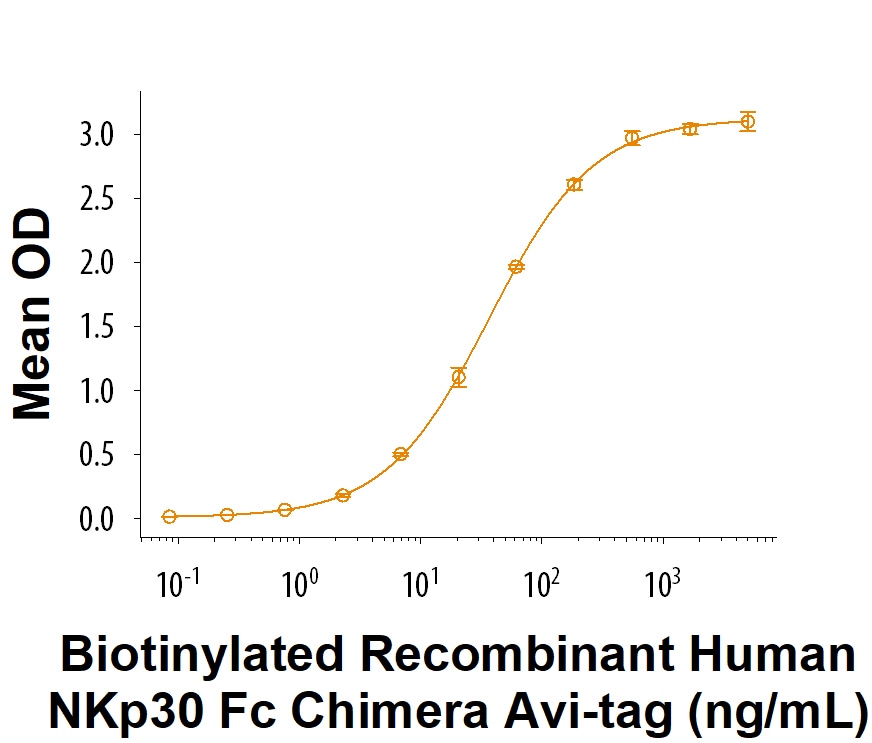
When Recombinant Human B7-H6 Fc Chimera (Catalog # 7144-B7) is immobilized at 1 µg/mL (100 µL/well), Biotinylated Recombinant Human NKp30/NCR3 Fc Chimera Avi-tag binds with an ED50 of 8.00-96.0 ng/mL.
When Recombinant Human B7-H6 Fc Chimera (Catalog # 7144-B7) is immobilized at 1 µg/mL (100 µL/well), Biotinylated Recombinant Human NKp30/NCR3 Fc Chimera Avi-tag binds with an ED50 of 8.00-96.0 ng/mL.
Scientific Data Images for Recombinant Human NKp30 Fc Chimera Avi-tag Protein, CF
Recombinant Human NKp30 Fc Chimera Avi-tag Protein Binding Activity.
When Recombinant Human B7-H6 Fc Chimera (7144-B7) is immobilized at 1 µg/mL (100 µL/well), Biotinylated Recombinant Human NKp30 Fc Chimera Avi-tag binds with an ED50 of 8.00-96.0 ng/mL.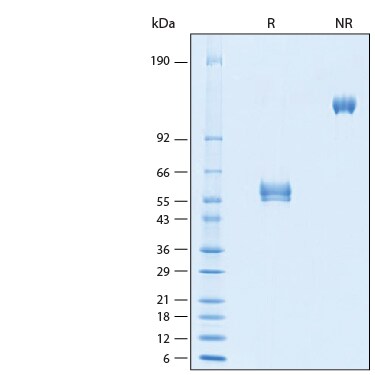
Recombinant Human NKp30 Fc Chimera Avi-tag Protein SDS-PAGE.
2 μg/lane of Recombinant Human NKp30 Fc Chimera Avi-tag Protein (Catalog # AVI1849) was resolved with SDS-PAGE under reducing (R) and non-reducing (NR) conditions and visualized by Coomassie® Blue staining, showing bands at 53-63 kDa and 110-120 kDa, respectively.Formulation, Preparation, and Storage
AVI1849
| Formulation | Lyophilized from a 0.2 μm filtered solution in PBS with Trehalose. |
| Reconstitution | Reconstitute at 500 μg/mL in PBS. |
| Shipping | The product is shipped at ambient temperature. Upon receipt, store it immediately at the temperature recommended below. |
| Stability & Storage | Use a manual defrost freezer and avoid repeated freeze-thaw cycles.
|
Calculators
Background: NKp30/NCR3
References
- Moretta, L. and A. Moretta (2004) EMBO J. 23:255.
- Pende, D. et al. (1999) J. Exp. Med. 190:1505.
- Augugliaro, R. et al. (2003) Eur. J. Immunol. 33:1235.
- Ferlazzo, G. et al. (2004) J. Immunol. 172:1455.
- Ferlazzo, G. et al. (2002) J. Exp. Med. 195:343.
Alternate Names
CD337, NCR3
Gene Symbol
NCR3
UniProt
Additional NKp30/NCR3 Products
Product Documents for Recombinant Human NKp30 Fc Chimera Avi-tag Protein, CF
Certificate of Analysis
To download a Certificate of Analysis, please enter a lot or batch number in the search box below.
Note: Certificate of Analysis not available for kit components.
Product Specific Notices for Recombinant Human NKp30 Fc Chimera Avi-tag Protein, CF
For research use only
Customer Reviews for Recombinant Human NKp30 Fc Chimera Avi-tag Protein, CF
There are currently no reviews for this product. Be the first to review Recombinant Human NKp30 Fc Chimera Avi-tag Protein, CF and earn rewards!
Have you used Recombinant Human NKp30 Fc Chimera Avi-tag Protein, CF?
Submit a review and receive an Amazon gift card!
$25/€18/£15/$25CAN/¥2500 for a review with an image
$10/€7/£6/$10CAN/¥1110 for a review without an image
Submit a review
Loading...
Associated Pathways
