
UNC13D/Munc 13-4 Antibody [Biotin]
Novus Biologicals | Catalog # NBP3-77340

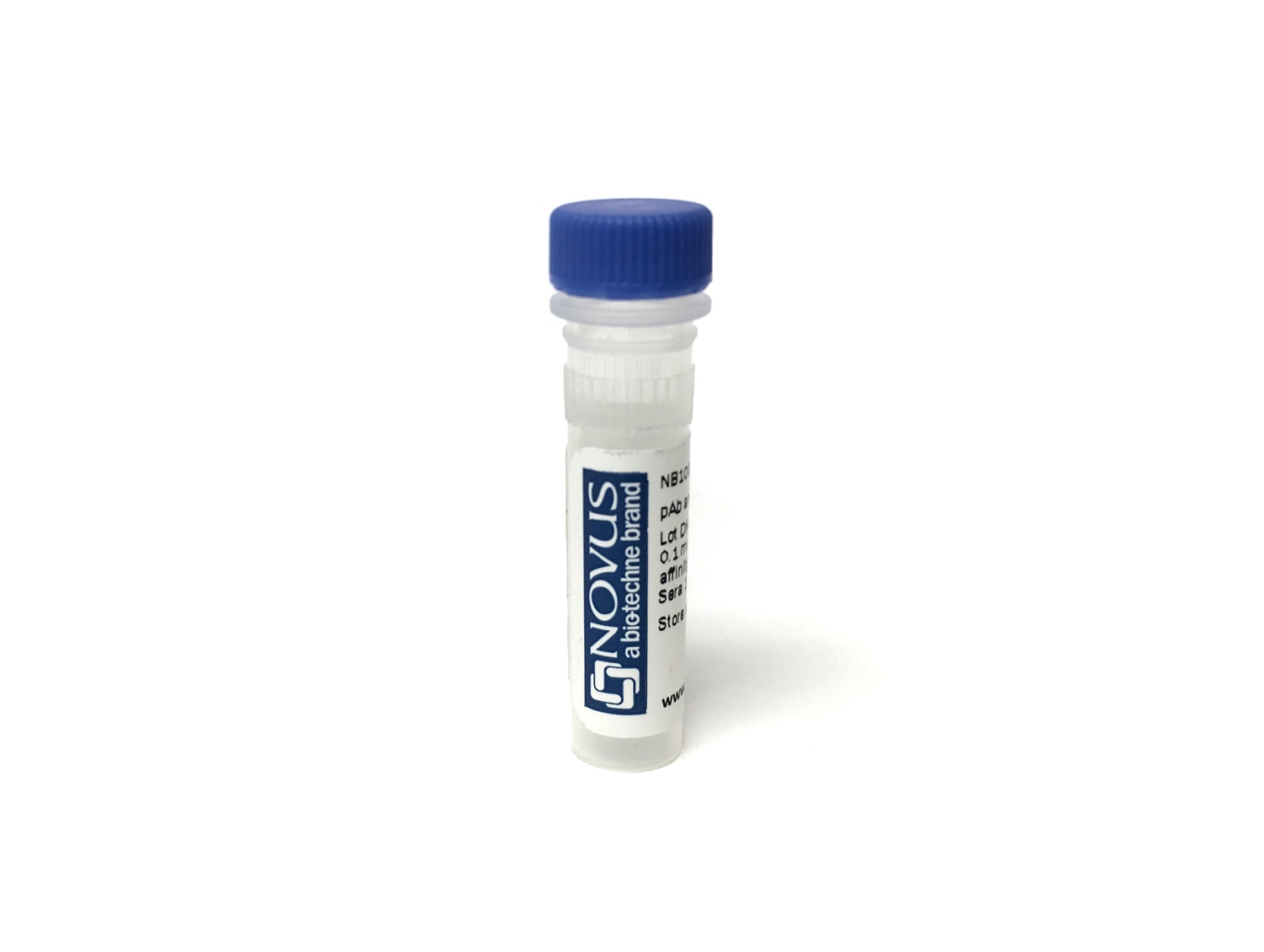
Key Product Details
Species Reactivity
Applications
Label
Antibody Source
Product Specifications
Immunogen
Reactivity Notes
Clonality
Host
Isotype
Description
This conjugate is made on demand and is not held in inventory. As a result, each order represents a unique lot.
Successful site-specific biotin conjugation is confirmed by reducing SDS-PAGE, revealing a mobility shift of the antibody heavy-chain when biotin is covalently attached. Free biotin from the conjugation process has been removed. The antibody concentration is provided on the individual product label.
For specialized conjugation needs, like large quantities, and specific concentrations, bulk and custom antibody conjugation services are available.
Applications for UNC13D/Munc 13-4 Antibody [Biotin]
Immunocytochemistry/ Immunofluorescence
NBP2-57967
Formulation, Preparation, and Storage
Purification
Formulation
Preservative
Concentration
Shipping
Stability & Storage
Background: UNC13D
Long Name
Alternate Names
Gene Symbol
Additional UNC13D Products
Product Documents for UNC13D/Munc 13-4 Antibody [Biotin]
Certificate of Analysis
To download a Certificate of Analysis, please enter a lot or batch number in the search box below.
Product Specific Notices for UNC13D/Munc 13-4 Antibody [Biotin]
This product is for research use only and is not approved for use in humans or in clinical diagnosis. Primary Antibodies are guaranteed for 1 year from date of receipt.
Related Research Areas
Customer Reviews for UNC13D/Munc 13-4 Antibody [Biotin]
There are currently no reviews for this product. Be the first to review UNC13D/Munc 13-4 Antibody [Biotin] and earn rewards!
Have you used UNC13D/Munc 13-4 Antibody [Biotin]?
Submit a review and receive an Amazon gift card!
$25/€18/£15/$25CAN/¥2500 for a review with an image
$10/€7/£6/$10CAN/¥1110 for a review without an image
Submit a review
Protocols
Find general support by application which include: protocols, troubleshooting, illustrated assays, videos and webinars.
- Appropriate Fixation of IHC/ICC Samples
- Cellular Response to Hypoxia Protocols
- ClariTSA™ Fluorophore Kits
- Detection & Visualization of Antibody Binding
- ICC Cell Smear Protocol for Suspension Cells
- ICC Immunocytochemistry Protocol Videos
- ICC for Adherent Cells
- Immunocytochemistry (ICC) Protocol
- Immunocytochemistry Troubleshooting
- Immunofluorescence of Organoids Embedded in Cultrex Basement Membrane Extract
- Immunohistochemistry (IHC) and Immunocytochemistry (ICC) Protocols
- Preparing Samples for IHC/ICC Experiments
- Preventing Non-Specific Staining (Non-Specific Binding)
- Primary Antibody Selection & Optimization
- Protocol for VisUCyte™ HRP Polymer Detection Reagent
- Protocol for the Fluorescent ICC Staining of Cell Smears - Graphic
- Protocol for the Fluorescent ICC Staining of Cultured Cells on Coverslips - Graphic
- Protocol for the Preparation and Fluorescent ICC Staining of Cells on Coverslips
- Protocol for the Preparation and Fluorescent ICC Staining of Non-adherent Cells
- Protocol for the Preparation and Fluorescent ICC Staining of Stem Cells on Coverslips
- Protocol for the Preparation of a Cell Smear for Non-adherent Cell ICC - Graphic
- TUNEL and Active Caspase-3 Detection by IHC/ICC Protocol
- The Importance of IHC/ICC Controls
- View all Protocols, Troubleshooting, Illustrated assays and Webinars
FAQs for UNC13D/Munc 13-4 Antibody [Biotin]
-
Q: I'm looking Munc13-4 N terminal antibody with related epitope sequence.
A:
Unfortunately we do not epitope map our antibodies, but we do have a whole list of antibodies against your target depending on species reactivity and application you want to use them for. Please see this link to our MUNC 13-4 antibodies. All of the immunogen information that is not proprietary, or known should be presented on the datasheet. Often times a range will be provided where the peptide falls within, or if it was raised against a larger recombinant protein as is the case for the one you inquired about we do not know exactly where the binding occurs.