
Automated Total Protein Normalization with Simple Western
When measuring protein expression, total protein normalization (TPN) may be more reliable than housekeeping proteins, as the expression of housekeeping proteins can vary with experimental conditions. However, TPN often requires additional time-consuming and messy gel staining steps. With Simple Western™ technology, reproducible TPN is integrated seamlessly with your immunoassay. The result? You can quickly see if your samples contain a consistent protein load, identify experimental setup and user errors, and effectively normalize expression of your target protein to get accurate and consistent data, giving you in your results.
Methods for Total Protein Normalization with Simple Western
TPN using RePlex and Chemiluminescent-based Detection
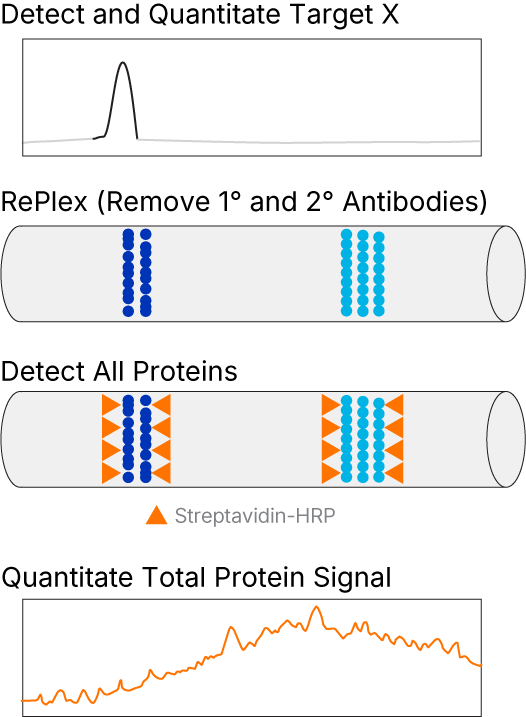
TPN using RePlex and Chemi detection allows total protein detection following RePlex to remove antibodies from a chemiluminescent or fluorescent immunoassay.
TPN using RePlex and NIR-based Detection
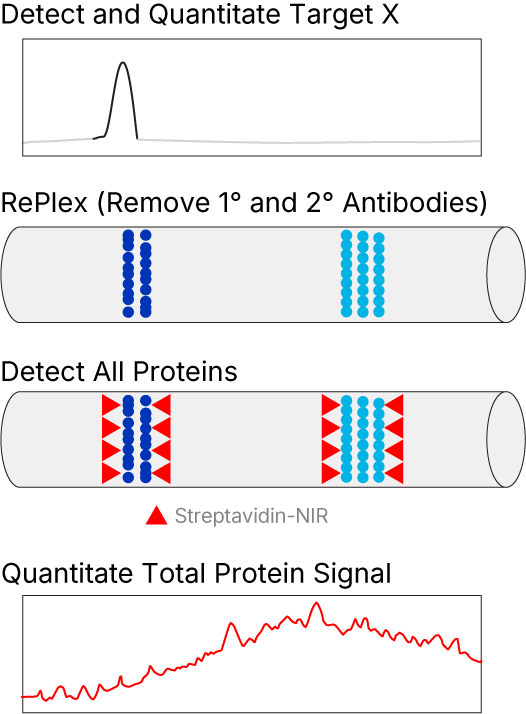
TPN using RePlex and NIR detection allows total protein detection following RePlex to remove antibodies from a chemiluminescent or fluorescent immunoassay.
Which TPN Assay is Right for You?*
| TPN using RePlex and Chemi detection1 | TPN using RePlex and NIR detection | |
| Instrument | Jess, Abby, Leo | Jess |
| Sample conc. | 0.005 – 0.4 mg/mL | 0.5–2.5 mg/mL |
| MW range | 2–440 kDa | 12–440 kDa2 |
| RePlex? | Yes | Yes |
| Immunoassay | Chemi, NIR, IR (RePlex Probe 1) | Chemi, NIR, IR (RePlex Probe 1) |
| Total protein | Chemi (RePlex Probe 2) | NIR (RePlex Probe 2) |
TPN using RePlex and Chemi Detection
This method is recommended to start your TPN assay development because it's proven to work with various MW ranges and sample concentrations.
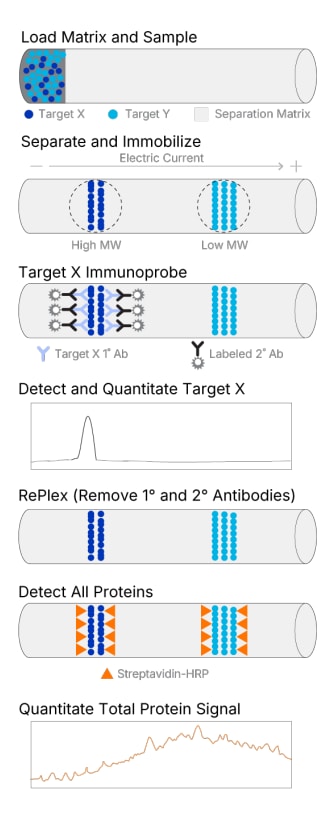
TPN using RePlex and Chemi detection allows total protein detection following RePlex to remove antibodies from an immunoassay with chemiluminescent or fluorescent probes. The Chemiluminescent Total Protein Assay can be used to detect all the proteins in your lysate, similar to a Coomassie or SYRPO Ruby stained gel. Chemiluminescent Total Protein Assay attaches biotin to all the proteins in your sample instead of an antibody for a specific target. Then, incubation with Streptavidin-HRP followed by Luminol/Peroxide generates a chemiluminescent signal for the total captured protein.
| Compatible instruments | Jess, Abby, Leo |
| Sample concentration | 0.005 – 0.4 mg/mL |
| MW range | 2–440 kDa |
| Compatible with RePlex? | Yes |
| Multiplex immunoassay channels | Chemi, NIR, IR (RePlex Probe 1) |
| Total protein detection channel | Chemi (RePlex Probe 2) |
| Additional materials required |
|
More sensitive than SYPRO Ruby. The 5X Biotin Labeling boosts the sensitivity of total protein detection to as little as 150 pg. Learn more.
More coverage than anti-HCP antibodies. Detect more of your host cell protein (HCP) than an anti-HCP antibody. Learn more.
TPN using RePlex and NIR Detection
Recommended for low abundance targets in high-concentration samples.
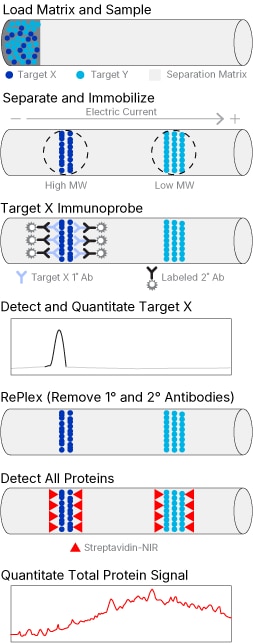
Like TPN using RePlex and Chemi detection, TPN using RePlex and NIR detection attaches biotin to all the proteins in your sample. Incubation with Streptavidin-NIR generates an NIR signal for the total captured protein. TPN using RePlex and NIR detection is linear for high sample concentrations (0.5–2.5 mg/mL), facilitating the analysis of low abundance targets. The protocol described here has been tested on whole-cell lysates, brain tissue, and muscle-skeletal tissue homogenates. This protocol guides your TPN assays with high-concentration samples to measure low abundance targets, including tips for setting up your assay and analyzing the data.
| Compatible instruments | Jess |
| Sample concentration | 0.5–2.5 mg/mL |
| MW range | 12–440 kDa |
| Compatible with RePlex? | Yes |
| Multiplex immunoassay channels | Chemi, NIR, IR (RePlex Probe 1) |
| Total protein detection channel | NIR (RePlex Probe 2) |
| Additional materials required |
As part of Bio-Techneʼs commitment to quality and customer support, the Protein Normalization Module (DM-PN02) will be discontinued.To give sufficient time to evaluate next generation replacement solutions, we will continue to accept orders for Protein Normalization Modules until December 1st, 2026. This product will no longer be available for purchase after this date.
For replacement solutions, we recommend Total Protein Normalization (TPN) using RePlex and Chemiluminescence Detection (DM-TP01 and RP-001), which offers improved sensitivity compared to the Protein Normalization Module. We also recently introduced a protocol for TPN using RePlex and NIR Detection, which is linear for high sample concentrations (0.5–2.5 mg/mL), facilitating the analysis of low abundance targets. Please visit our page on total protein normalization to learn more about our newer products for protein quantification.