
NanoPro 1000





Simple Western Charge Assays
NanoPro™ 1000 is a capillary-based nano-immunoassay platform, using capillary-based charge separation to characterize proteins. As in Western blot analysis, proteins from complex biological samples are separated, immobilized, and probed with antibodies. The NanoPro 1000 automates the entire process and uses isoelectric focusing (IEF) to resolve proteins. It’s capillary-based charge separation can detect subtle isoelectric point differences in proteins from complex samples across the widest pI gradient range, from 3 to 10. The NanoPro 1000 enables reproducible and comprehensive protein characterization, providing insights into post-translational modifications as well as subtle changes in protein isoforms. By separating proteins by charge or pI, this system can detect extremely small differences in isoelectric points, allowing for the visualization of discreet variations in protein isoforms. Up to 12 samples can be analyzed simultaneously in a single cycle and up to 8 cycles (96 samples) can be processed in a single run. This system is also a conservationist, requiring as few as 25 cells per assay—even when characterizing low-abundance proteins in limited cell populations. Save both cells and time with NanoPro 1000.

How Can NanoPro 1000 Help You?
My Sample is Precious, and I Don't Have Enough for Other Methods
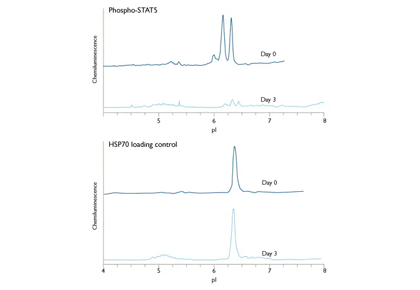
Sometimes you wish you could do more with your small and precious sample. NanoPro 1000 is a conservationist. Uses as few as 25 cells per assay, even when you're characterizing low abundance proteins in precious and extremely small samples such as primary cells, fine-needle tumor aspirates and laser capture microdissection (LCM). Imagine all the data you can get from your sample! In this image: Monitoring of drug effects in fine needle aspirates from individual mice over time with NanoPro 1000.
I Need More Than Size Data
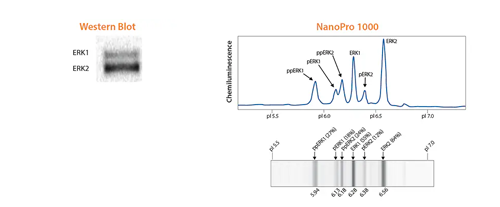
Sometimes a band from a Western is not telling you the entire story about your target of interest. Size-based separation will not be able to resolve phosphorylation isoforms and other post-translational modification. A charge assay (cIEF plus immunodetection) has the power to let you see beyond what's detected by a traditional Western.

I Have Too Many Samples and Need Higher Throughput Protein Characterization
Our Simple Western systems offer the right throughput for your needs. NanoPro 1000 will process up to 96 data points per run in eight cycles of 12 data points each. Ideal for screening or applying the same assay to large number of samples. All the throughput you need with minimum hands-on time.
Instrument Specifications
| Description | Immunoassay Charge Specification |
| Sample Required | 0.6-1.2 µg |
| Volume Required | 5-12 µL/well |
| Size or pI Range | Widest gradient ranges from pI 3 to pI 10 |
| Sizing CV | <10% |
| Intra-assay CV | <20% |
| Inter-assay CV | <20% |
| Resolution (± percent difference in MW) | ± 0.1 pI units |
| Quantitation CV | <20% |
| Dynamic Range | 3 logs |
| Sensitivity | Low pg |
| Capillary | 5 cm, 100 µm, 400 nL |


“The Simple Western Charge assay, a capillary isoelectric focusing immunoassay, exceeded the reliability of 2D Western blots for resolving recombinant PKG-Iα and PKG-Iβ and uses 100,000X less sample quantity, making it well-suited for clinical disease proteomics because protein isoforms and post-translational modifications can be detected in precious tissue biopsies.”
— Mary G. Johlfs, M.S., Director of Research Operations/Scientist, Roseman University of Health Sciences
 Powered by Bioz