
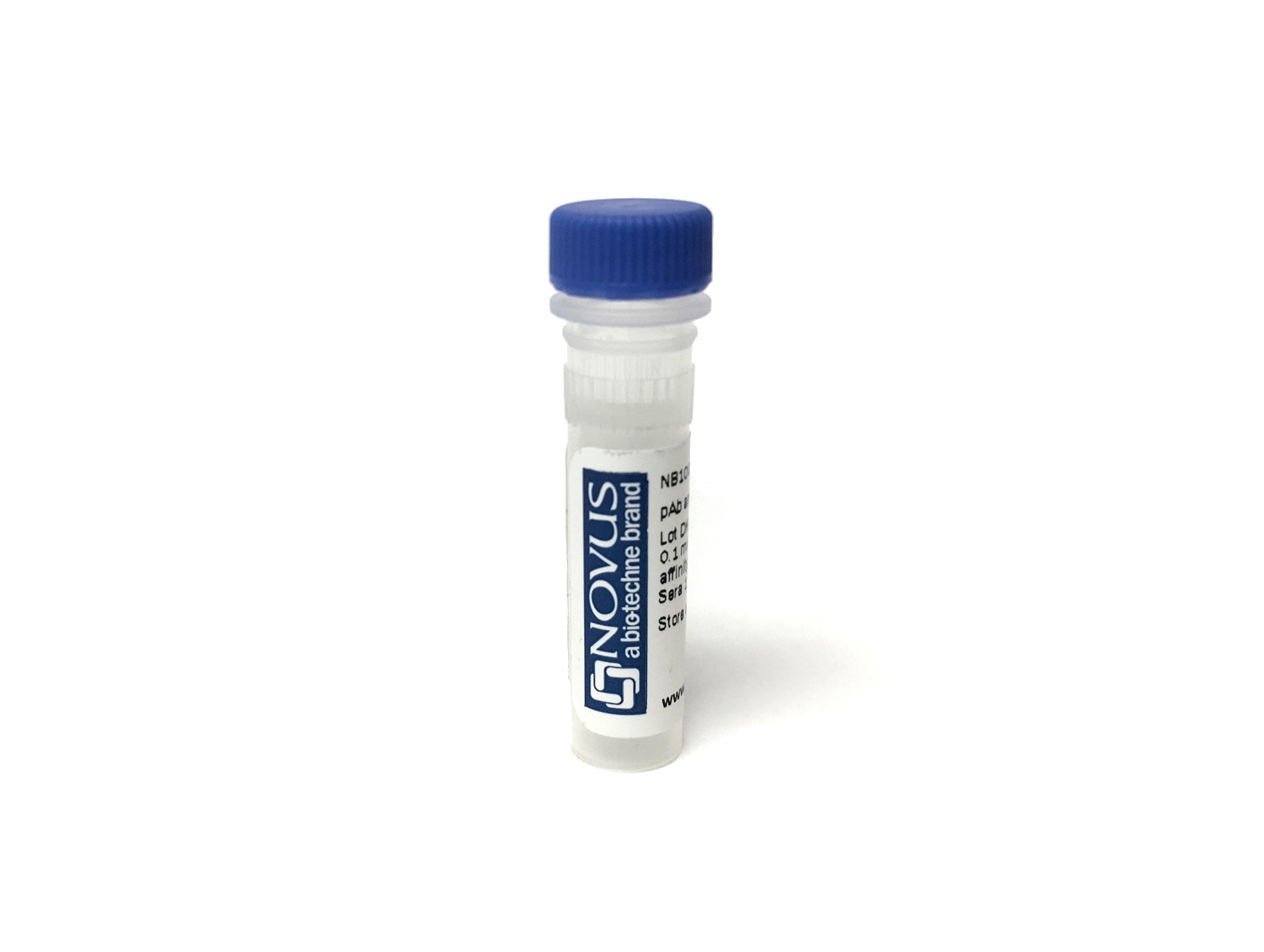
Collagen III alpha 1/COL3A1 Antibody (C3) - BSA Free
Novus Biologicals | Catalog # NBP3-43315

Loading...
Key Product Details
Species Reactivity
Mouse
Applications
Immunohistochemistry, Immunohistochemistry-Paraffin
Label
Unconjugated
Antibody Source
Monoclonal Mouse IgG1 kappa Clone # C3
Format
BSA Free
Loading...
Product Specifications
Immunogen
Immunized with recombinant Mouse Collagen III alpha 1/COL3A1 (Uniprot#: P08121; Gln24~Pro154)
Clonality
Monoclonal
Host
Mouse
Isotype
IgG1 kappa
Applications for Collagen III alpha 1/COL3A1 Antibody (C3) - BSA Free
Application
Recommended Usage
Immunohistochemistry
5-20ug/mL
Immunohistochemistry-Paraffin
5-20ug/mL
Formulation, Preparation, and Storage
Purification
Protein A or G purified
Formulation
0.01M PBS, pH7.4, 50% glycerol.
Format
BSA Free
Preservative
0.05% Proclin 300
Concentration
1 mg/ml
Shipping
The product is shipped with polar packs. Upon receipt, store it immediately at the temperature recommended below.
Stability & Storage
Store at 4C short term. Aliquot and store at -20C long term. Avoid freeze-thaw cycles.
Background: Collagen III alpha 1/COL3A1
Collagen III is a fibrillar collagen that constitutes 5-20% of all collagen in the body (1). It provides structural integrity and is found in many hallow organs and soft connective tissue including the vascular system, skin, lung, uterus, and intestine (1,2). Additionally, collagen III has be found to be associated with type I collagen in the same fibrils (1). Collagen III interacts with signaling integrins to carry out other key functions including cell adhesion, proliferation, and differentiation (1).
Mutations in the COL3A1 gene has been associated with a variety of human diseases, the most well-known being a group of connective tissue disorders termed Ehlers-Danlos Syndromes (1,2,4). Vascular Ehlers-Danlos Syndrome is a specific subtype that is considered the most severe and although the clinical manifestations vary, symptoms include thin skin and fragile blood vessels and can often result in both lung and heart complications (1,4). COL3A1 is also associated with glomerulopathies, or diseases of the glomeruli, which are characterized by an abundance of extracellular matrix (3). Collagenofibrotic glomerulopathy is one specific rare renal disease that is characterized by excessive levels of collagen III (3).
References
1. Kuivaniemi, H., & Tromp, G. (2019). Type III collagen (COL3A1): Gene and protein structure, tissue distribution, and associated diseases. Gene. https://doi.org/10.1016/j.gene.2019.05.003
2. Ricard-Blum S. (2011). The collagen family. Cold Spring Harbor perspectives in biology. https://doi.org/10.1101/cshperspect.a004978
3. Cohen A. H. (2012). Collagen Type III Glomerulopathies. Advances in chronic kidney disease. https://doi.org/10.1053/j.ackd.2012.02.017
4. Olson, S. L., Murray, M. L., & Skeik, N. (2019). A Novel Frameshift COL3A1 Variant in Vascular Ehlers-Danlos Syndrome. Annals of vascular surgery. https://doi.org/10.1016/j.avsg.2019.05.057
Alternate Names
COL3A1, EDS4A
Gene Symbol
COL3A1
Additional Collagen III alpha 1/COL3A1 Products
Product Documents for Collagen III alpha 1/COL3A1 Antibody (C3) - BSA Free
Certificate of Analysis
To download a Certificate of Analysis, please enter a lot or batch number in the search box below.
Product Specific Notices for Collagen III alpha 1/COL3A1 Antibody (C3) - BSA Free
This product is for research use only and is not approved for use in humans or in clinical diagnosis. Primary Antibodies are guaranteed for 1 year from date of receipt.
Related Research Areas
Customer Reviews for Collagen III alpha 1/COL3A1 Antibody (C3) - BSA Free
There are currently no reviews for this product. Be the first to review Collagen III alpha 1/COL3A1 Antibody (C3) - BSA Free and earn rewards!
Have you used Collagen III alpha 1/COL3A1 Antibody (C3) - BSA Free?
Submit a review and receive an Amazon gift card!
$25/€18/£15/$25CAN/¥2500 for a review with an image
$10/€7/£6/$10CAN/¥1110 for a review without an image
Submit a review
Protocols
Find general support by application which include: protocols, troubleshooting, illustrated assays, videos and webinars.
- Antigen Retrieval Protocol (PIER)
- Antigen Retrieval for Frozen Sections Protocol
- Appropriate Fixation of IHC/ICC Samples
- Cellular Response to Hypoxia Protocols
- Chromogenic IHC Staining of Formalin-Fixed Paraffin-Embedded (FFPE) Tissue Protocol
- Chromogenic Immunohistochemistry Staining of Frozen Tissue
- ClariTSA™ Fluorophore Kits
- Detection & Visualization of Antibody Binding
- Fluorescent IHC Staining of Frozen Tissue Protocol
- Graphic Protocol for Heat-induced Epitope Retrieval
- Graphic Protocol for the Preparation and Fluorescent IHC Staining of Frozen Tissue Sections
- Graphic Protocol for the Preparation and Fluorescent IHC Staining of Paraffin-embedded Tissue Sections
- Graphic Protocol for the Preparation of Gelatin-coated Slides for Histological Tissue Sections
- IHC Sample Preparation (Frozen sections vs Paraffin)
- Immunofluorescent IHC Staining of Formalin-Fixed Paraffin-Embedded (FFPE) Tissue Protocol
- Immunohistochemistry (IHC) and Immunocytochemistry (ICC) Protocols
- Immunohistochemistry Frozen Troubleshooting
- Immunohistochemistry Paraffin Troubleshooting
- Preparing Samples for IHC/ICC Experiments
- Preventing Non-Specific Staining (Non-Specific Binding)
- Primary Antibody Selection & Optimization
- Protocol for Heat-Induced Epitope Retrieval (HIER)
- Protocol for Making a 4% Formaldehyde Solution in PBS
- Protocol for VisUCyte™ HRP Polymer Detection Reagent
- Protocol for the Preparation & Fixation of Cells on Coverslips
- Protocol for the Preparation and Chromogenic IHC Staining of Frozen Tissue Sections
- Protocol for the Preparation and Chromogenic IHC Staining of Frozen Tissue Sections - Graphic
- Protocol for the Preparation and Chromogenic IHC Staining of Paraffin-embedded Tissue Sections
- Protocol for the Preparation and Chromogenic IHC Staining of Paraffin-embedded Tissue Sections - Graphic
- Protocol for the Preparation and Fluorescent IHC Staining of Frozen Tissue Sections
- Protocol for the Preparation and Fluorescent IHC Staining of Paraffin-embedded Tissue Sections
- Protocol for the Preparation of Gelatin-coated Slides for Histological Tissue Sections
- TUNEL and Active Caspase-3 Detection by IHC/ICC Protocol
- The Importance of IHC/ICC Controls
- Troubleshooting Guide: Immunohistochemistry
- View all Protocols, Troubleshooting, Illustrated assays and Webinars
Loading...