
CpG oligodeoxynucleotides with negative control, TLR9 ligand
Novus Biologicals | Catalog # NBP2-26232

Key Product Details
Species
Applications
Product Summary for CpG oligodeoxynucleotides with negative control, TLR9 ligand
Human Sequence CpG ODN (2006) Type B: 5' T*C*G*T*C*G*T*T*T*T*G*T*C*G*T*T*T*T*G*T*C*G*T*T 3'
(* Indicates a phosphorothioate modification)
Negative Control oligo: 5' TGCTGCTTTTGTGCTTTTGTGCTT 3'
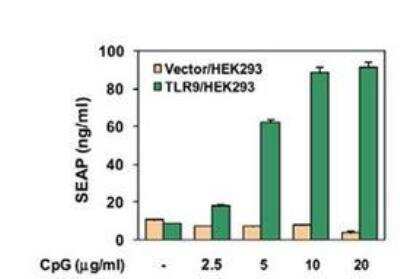
Functionality: This product is useful for the activation of TLR9 and the stimulation of TLR9 has been reported with 5-20 ug/ml.
Product Specifications
Specificity
Applications
Application Notes
Scientific Data Images for CpG oligodeoxynucleotides with negative control, TLR9 ligand
Kit Contents for CpG oligodeoxynucleotides with negative control, TLR9 ligand
Formulation, Preparation, and Storage
Formulation
Concentration
Shipping
Storage
Background: CpG oligodeoxynucleotides with negative control, TLR9 ligand
Alternate Names
Additional CpG oligodeoxynucleotides with negative control, TLR9 ligand Products
Product Documents for CpG oligodeoxynucleotides with negative control, TLR9 ligand
Certificate of Analysis
To download a Certificate of Analysis, please enter a lot or batch number in the search box below.
Product Specific Notices for CpG oligodeoxynucleotides with negative control, TLR9 ligand
This product is for research use only and is not approved for use in humans or in clinical diagnosis. Support products are guaranteed for 6 months from date of receipt.
Citations for CpG oligodeoxynucleotides with negative control, TLR9 ligand
 Powered by Bioz
Customer Reviews for CpG oligodeoxynucleotides with negative control, TLR9 ligand (1)
Have you used CpG oligodeoxynucleotides with negative control, TLR9 ligand?
Submit a review and receive an Amazon gift card!
$25/€18/£15/$25CAN/¥2500 for a review with an image
$10/€7/£6/$10CAN/¥1110 for a review without an image
Submit a review
-
Application: Western BlotSample Tested: SH-SY5Y cellsSpecies: HumanVerified Customer | Posted 07/01/2016
There are no reviews that match your criteria.
Protocols
View specific protocols for CpG oligodeoxynucleotides with negative control, TLR9 ligand (NBP2-26232):
Hazard Information
Chemical Name CPG ODN 2006 & Negative Control
Chemical Formula CpG ODN- 5' T*C*G*T*C*G*T*T*T*T*G*T*C*G*T*T*T*T*G*T*C*G*T*T 3' (* Phosphorothioate bonds)
CAS Number N/A
EEC-No N/A
First Aid Measures
Eye Contact May cause eye irritation.
Skin Contact May cause skin irritation. May be harmful if absorbed through the skin.
Inhalation May causes respiratory tract irritation. May be harmful if inhaled.
Ingestion May be harmful if swallowed.
Fire Fighting Measures
Special risks: N/A
Suitable Extinguish Media: Water spray, carbon dioxide, dry chemical powder or appropriate foam.
Accidental Release Measures
Eyes: Immediately flush eyes with plenty of water for at least 15 minutes, occasionally lifting the upper and lower eyelids. Consult a physician.
Skin: Get medical aid immediately. Immediately flush skin with plenty of water for at least 15 minutes while removing contaminated clothing and shoes. SPEEDY ACTION IS CRITICAL!
Ingestion: If swallowed, get medical aid immediately. Only induce vomiting if directed to do so by medical personnel. Never give anything by mouth to an unconscious person.
Inhalation: Remove from exposure and move to fresh air immediately. If breathing is difficult, give oxygen. SPEED IS ESSENTIAL, OBTAIN MEDICAL AID IMMEDIATELY. Do not use mouth-to-mouth resuscitation if victim ingested or inhaled the substance; induce artificial respiration with the aid of a pocket mask equipped with a one-way valve or other proper respiratory medical device.
Notes: Consult a physician. Show this safety data sheet to the physician. Move away from the dangerous area.
Handling and Storage
Handling Avoid contact with eyes, skin and clothing. Avoid prolonged or repeated exposure. Avoid inhalation. Use personal protective equipment (i.e. impermeable gloves, lab coat or apron).
Store at -20 degrees C. Store in a tightly closed container. Stable under recommended storage conditions
Exposure Controls / Personal Protection
Physical and Chemical Properties
Form Powder
Color Colorless
Odor Odorless
Melting Point No data available
Boiling Temperature No data available
Density No data available
Vapor Pressure No data available
Solubility in Water Very soluble
Flash Point No data available
Explosion limits No data available
Ignition Temperature No data available
Stability and Reactivity
Stability: Stable
Hazardous Polymerization: Will not occur.
Materials to avoid: Strong oxidizing agents.
Hazardous Decomposition Products: Decomposition products are not hazardous.
HMIS Classification: Health Hazard 0, Flammability Hazard 0, Reactivity Hazard 0
NFPA Rating: Health Hazard 0, Fire 0, Reactivity Hazard 0.
Disposal Considerations
Observe all federal, state, and local environmental regulations. Contact a licensed professional waste disposal service to dispose of this material. Must not be disposed together with household garbage.
Other Information
The information contained in this material safety datasheet is believed to be accurate but it is the responsibility of the user or supplier to determine the applicability of these data to the formulation of necessary safety precautions.
NOVUS shall not be held responsible for any damage resulting from the use of the above product or the information contained in this material safety data sheet.
FAQs for CpG oligodeoxynucleotides with negative control, TLR9 ligand
-
Q: I worked with your product NBP2-26232 (CpG ODN (2006)) on pDCs. In the data sheet, there is no record whether this CpG is type A or type B so I was wondering if you can clearly this for me. In addition, I wanted to know how this specific CpG is expected to influence the maturation status of pDCs?
A:
Thank you for your inquiry about the CpG ODN (NBP2-26232). This sequence is Type B as shown in the chart on CpG ODN (NBP2-26238). As denoted on the data sheets, ODNs are synthetic forms of oligonucleotides, which contain unmethylated CpG motifs, and can induce cellular immune responses through the activation of Toll-like receptor 9 (TLR9). According to the published literature, Type B promotes survival, activation and maturation of pDC. We quality control the ODNs using our TLR9 stable cell lines as shown on the data sheets (Validation of CpG using the TLR9/HEK 293 cell line). There is considerable published literature regarding ODNs and the maturation of dendritic cells, for examples see these links (type b odn dendritic maturation & 2006 cpg odn dendritic). I would also encourage you consult the literature for additional information about this topic for example using the key words in the scholar.google.com that are most relevant to your model system.