
CXCR7/RDC-1 is a G protein-coupled receptor (GPCR) member of the CXC subfamily of chemokine receptors. Human CXCR7/RDC-1 is 362 amino acids (aa) in length with a predicted molecular weight of 41 kDa. Mouse and rat CXCR7/RDC-1 share 93% aa sequence identity with the human protein. CXCR7/RDC-1 binds to and acts as a scavenger for CXCL11/I-TAC and CXCL12/SDF-1. CXCR7/RDC-1 can also function as a co-receptor for HIV and SIV. Unlike other chemokine receptors, CXCR7/RDC-1 does not activate G protein signaling, but instead initiates beta-Arrestin-mediated receptor-ligand internalization. Although CXCR7/RDC-1 itself does not activate G protein signaling, the receptor can heterodimerize with CXCR4 to activate G proteins in response to CXCL12/SDF-1 binding. Studies on CXCR7/RDC-1 knockout mice suggest that it is critical for cardiovascular development. While CXCR7/RDC-1 does not appear to signal in normal hematopoietic cells, it is highly expressed in leukemic cells where it activates Akt signaling that promotes cell trafficking and adhesion. CXCR7/RDC-1 also mediates neuronal migration, displays aberrant signaling in astrocytes, and is highly expressed in glioma cells.
CXCR7/RDC-1 Antibody (896032) [mFluor Violet 450 SE]
Novus Biologicals | Catalog # FAB8399MFV450

Key Product Details
Species Reactivity
Applications
Label
Antibody Source
Product Specifications
Immunogen
Met1-Lys362
Accession # NP_445804
Specificity
Clonality
Host
Isotype
Description
For specialized conjugation needs, like large quantities, specific concentrations, and defined F/P ratios, bulk and custom antibody conjugation services are available.
Applications for CXCR7/RDC-1 Antibody (896032) [mFluor Violet 450 SE]
CyTOF-ready
Flow Cytometry
Spectra Viewer
Plan Your Experiments
Use our spectra viewer to interactively plan your experiments, assessing multiplexing options. View the excitation and emission spectra for our fluorescent dye range and other commonly used dyes.
Spectra Viewer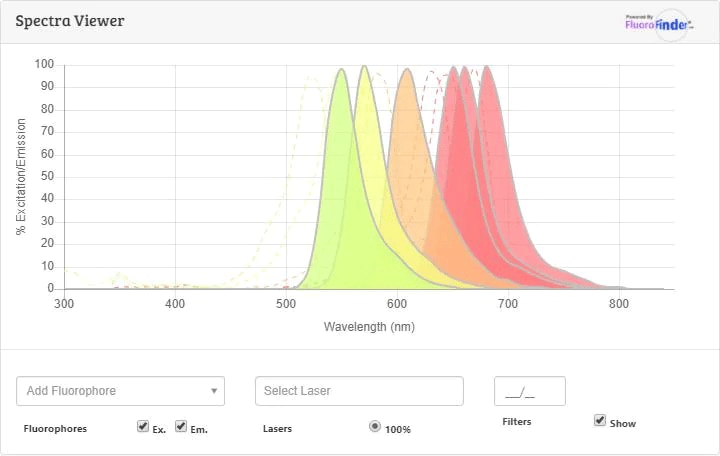
Flow Cytometry Panel Builder
Bio-Techne Knows Flow Cytometry
Save time and reduce costly mistakes by quickly finding compatible reagents using the Panel Builder Tool.
Advanced Features
- Spectra Viewer - Custom analysis of spectra from multiple fluorochromes
- Spillover Popups - Visualize the spectra of individual fluorochromes
- Antigen Density Selector - Match fluorochrome brightness with antigen density

Formulation, Preparation, and Storage
Purification
Formulation
Preservative
Concentration
Shipping
Stability & Storage
Background: CXCR7/RDC-1
Alternate Names
Gene Symbol
Additional CXCR7/RDC-1 Products
Product Documents for CXCR7/RDC-1 Antibody (896032) [mFluor Violet 450 SE]
Certificate of Analysis
To download a Certificate of Analysis, please enter a lot or batch number in the search box below.
Product Specific Notices for CXCR7/RDC-1 Antibody (896032) [mFluor Violet 450 SE]
mFluor(TM) is a trademark of AAT Bioquest, Inc. This conjugate is made on demand. Actual recovery may vary from the stated volume of this product. The volume will be greater than or equal to the unit size stated on the datasheet.
This product is for research use only and is not approved for use in humans or in clinical diagnosis. Primary Antibodies are guaranteed for 1 year from date of receipt.
Customer Reviews for CXCR7/RDC-1 Antibody (896032) [mFluor Violet 450 SE]
There are currently no reviews for this product. Be the first to review CXCR7/RDC-1 Antibody (896032) [mFluor Violet 450 SE] and earn rewards!
Have you used CXCR7/RDC-1 Antibody (896032) [mFluor Violet 450 SE]?
Submit a review and receive an Amazon gift card!
$25/€18/£15/$25CAN/¥2500 for a review with an image
$10/€7/£6/$10CAN/¥1110 for a review without an image
Submit a review
Protocols
Find general support by application which include: protocols, troubleshooting, illustrated assays, videos and webinars.
- 7-Amino Actinomycin D (7-AAD) Cell Viability Flow Cytometry Protocol
- Extracellular Membrane Flow Cytometry Protocol
- Flow Cytometry Protocol for Cell Surface Markers
- Flow Cytometry Protocol for Staining Membrane Associated Proteins
- Flow Cytometry Staining Protocols
- Flow Cytometry Troubleshooting Guide
- Intracellular Flow Cytometry Protocol Using Alcohol (Methanol)
- Intracellular Flow Cytometry Protocol Using Detergents
- Intracellular Nuclear Staining Flow Cytometry Protocol Using Detergents
- Intracellular Staining Flow Cytometry Protocol Using Alcohol Permeabilization
- Intracellular Staining Flow Cytometry Protocol Using Detergents to Permeabilize Cells
- Propidium Iodide Cell Viability Flow Cytometry Protocol
- Protocol for Liperfluo
- Protocol for the Characterization of Human Th22 Cells
- Protocol for the Characterization of Human Th9 Cells
- Protocol: Annexin V and PI Staining by Flow Cytometry
- Protocol: Annexin V and PI Staining for Apoptosis by Flow Cytometry
- Troubleshooting Guide: Fluorokine Flow Cytometry Kits
- View all Protocols, Troubleshooting, Illustrated assays and Webinars
Associated Pathways
