Why Analyze Human Stem Cell Pluripotency by Live Cell Staining Using Stem Cell Markers?
Maintaining pluripotent human embryonic stem (ES) cells and deriving induced pluripotent stem (iPS) cells requires colony selection and cell expansion. Manually picking colonies that contain pluripotent stem cells can be achieved by analyzing colony morphology. However, colony morphology is not truly indicative of pluripotency, since cells can naturally differentiate within the colony. Moreover, colony picking is a time-consuming and labor-intensive process.
Designed to verify pluripotency in live cells, the GloLIVE™ Human Pluripotent Stem Cell Live Cell Imaging Kit increases research efficiency and success by allowing single-step staining of unfixed cells.
Live pluripotent stem cell imaging:
Promotes the selection of high quality, undifferentiated stem cell colonies to reduce experimental variation.
Verifies stem cell pluripotency in 30 minutes, ensuring efficient use of time and reagents.
Provides increased confidence in pluripotent status through the use of positive and negative markers.
Allows for the continued culture of pluripotent cells with no adverse effects on cell proliferation or stemness following staining.
Kit Contents
This kit contains the following azide-free, fluorochrome-conjugated antibodies to verify human stem cell pluripotency:
Positive Markers
NL493-conjugated Mouse Anti-Human SSEA-4
NL557-conjugated Mouse Anti-Human TRA-1-60(R)
NL493-conjugated Mouse Anti-Human TRA-1-81
Negative Marker
NL557-conjugated Mouse Anti-Human SSEA-1
Each antibody is supplied as a 50X stock; enough for 25 assays when used in 500 µL staining volume per assay. Each 1X antibody solution has an endotoxin level of < 5 EU/mL.
Stability and Storage
Reagents are stable for 12 months from date of receipt when stored in the dark at 2° C to 8°.
Human Induced Pluripotent Stem Cells Express TRA-1-81.
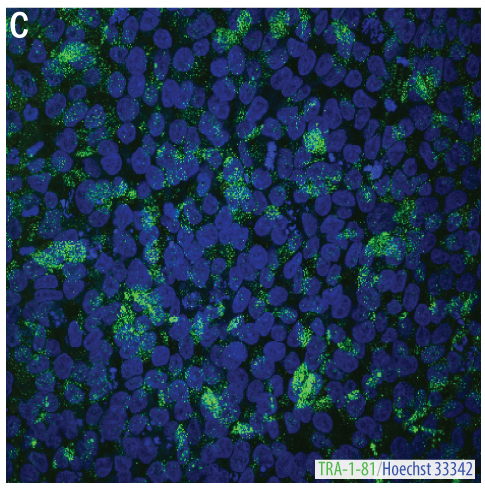
JOY1 human induced pluripotent stem cells were stained with the NL493-conjugated TRA-1-81 (green) antibody included in the GloLIVE™ Human Induced Pluripotent Stem Cell Live Cell Imaging Kit. Cells were counterstained with Hoechst 33342 (blue).
Verification of Pluripotency in Human Induced Pluripotent Stem Cells.
iPS2 human induced pluripotent stem cells were grown on irradiated mouse embryonic fibroblasts (Catalog # PSC001), and stained using antibodies included in the Human Pluripotent Stem Cell Live Cell Imaging Kit. A. iPS2 cells stained with the NL493-conjugated SSEA-4 (green) and NL557-conjugated SSEA-1 (red) antibodies. B. iPS2 cells stained with the NL493-conjugated SSEA-4 (green) and NL557-conjugated TRA-1-60(R) (red) antibodies. The cells were counterstained with Hoechst 33342 (blue). The colonies are positive for the stem cell markers SSEA-4 and TRA-1-60(R) and are negative for SSEA-1, suggesting that these colonies primarily contain undifferentiated human stem cells.
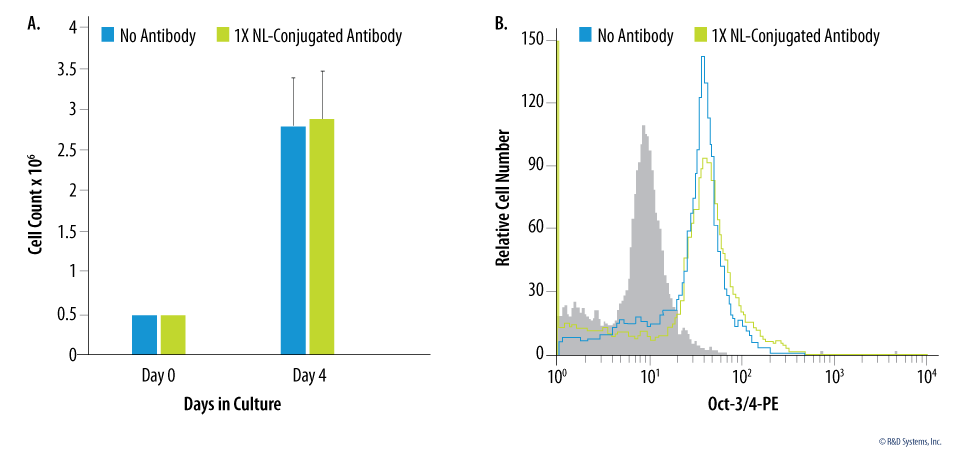
Analysis of Human Embryonic Stem Cell Growth and Stemness Post-staining. A.BG01V human embryonic stem cells were plated in triplicate in 6 well plates at 0.5 x 10⁶ cells per well on Day 0. On Day 1, cells were stained with (green bars) or without (blue bars) 1X NL-conjugated antibody. On Day 4, cells were harvested and counted using a hemocytometer. There was no effect of SSEA-4, TRA-1-60(R), or SSEA-1 staining on cell proliferation. Error bars indicate standard deviation. B. BG01V human embryonic stem cells were stained with (green histogram) or without (blue histogram) 1X NL-conjugated antibody and cultured for 3 days. Cells were then harvested and stained using the pluripotent marker PE-conjugated Rat Anti-Human/Mouse Oct-3/4 Monoclonal Antibody (Catalog # IC1759P; open histogram) or a Rat IgG2B PE-conjugated Isotype Control (Catalog # IC013P; filled histogram). Staining with SSEA-4, TRA-1-60(R), or SSEA-1 had no effect on stemness as analyzed by Oct-3/4 expression. Stemness post-staining was also verified by SSEA-4 and SSEA-1 expression (data not shown).
Loading...
Scientific Data Images for GloLIVE Human Pluripotent Stem Cell Live Cell Imaging Kit
Human Induced Pluripotent Stem Cells Express TRA-1-81.
JOY1 human induced pluripotent stem cells were stained with the NL493-conjugated TRA-1-81 (green) antibody included in the GloLIVE™Human Induced Pluripotent Stem Cell Live Cell Imaging Kit. Cells were counterstained with Hoechst 33342 (blue).
Verification of Pluripotency in Human Induced Pluripotent Stem Cells.
iPS2 human induced pluripotent stem cells were grown on irradiated mouse embryonic fibroblasts (Catalog # PSC001), and stained using antibodies included in the Human Pluripotent Stem Cell Live Cell Imaging Kit.A.iPS2 cells stained with the NL493-conjugated SSEA-4 (green) and NL557-conjugated SSEA-1 (red) antibodies.B.iPS2 cells stained with the NL493-conjugated SSEA-4 (green) and NL557-conjugated TRA-1-60(R) (red) antibodies. The cells were counterstained with Hoechst 33342 (blue). The colonies are positive for the stem cell markers SSEA-4 and TRA-1-60(R) and are negative for SSEA-1, suggesting that these colonies primarily contain undifferentiated human stem cells.
Analysis of Human Embryonic Stem Cell Growth and Stemness Post-staining.
BG01V human embryonic stem cells were plated in triplicate in 6 well plates at 0.5 x 10⁶ cells per well on Day 0. On Day 1, cells were stained with (green bars) or without (blue bars) 1X NL-conjugated antibody. On Day 4, cells were harvested and counted using a hemocytometer. There was no effect of SSEA-4, TRA-1-60(R), or SSEA-1 staining on cell proliferation. Error bars indicate standard deviation.B.BG01V human embryonic stem cells were stained with (green histogram) or without (blue histogram) 1X NL-conjugated antibody and cultured for 3 days. Cells were then harvested and stained using the pluripotent marker PE-conjugated Rat Anti-Human/Mouse Oct-3/4 Monoclonal Antibody (Catalog # IC1759P; open histogram) or a Rat IgG2B PE-conjugated Isotype Control (Catalog # IC013P; filled histogram). Staining with SSEA-4, TRA-1-60(R), or SSEA-1 had no effect on stemness as analyzed by Oct-3/4 expression. Stemness post-staining was also verified by SSEA-4 and SSEA-1 expression (data not shown).
Formulation, Preparation, and Storage
Shipping
The product is shipped with polar packs. Upon receipt, store it immediately at the temperature recommended below.
Background: Pluripotent Stem Cells
Embryonic stem (ES) cells are pluripotent stem cells derived from the inner cell mass of pre-implantation embryos. Induced pluripotent stem (iPS) cells can be generated by somatic cell reprogramming following the exogenous expression of specific transcription factors (Oct-3/4, KLF4, SOX2, and c-Myc). These cell types are capable of unlimited, undifferentiated proliferation in vitro and still maintain the capacity to differentiate into a wide variety of somatic cells. In this capacity, pluripotent stem cells have widespread clinical potential for the treatments of heart disease, diabetes, spinal cord injury, and a variety of neurodegenerative disorders.
R&D Systems offers a wide range of products to support pluripotent stem cell culture and differentiation. Mouse embryonic fibroblasts may be used to maintain and expand pluripotent stem cells in an undifferentiated state. We also offer defined culture media, which are specifically optimized for use with human or rodent pluripotent stem cells. In addition, R&D Systems offers a variety of products to assess differentiation status and identify specific stem cell types of interest, including panels of marker antibodies, primer pairs, multi-color flow cytometry kits, and specialized verification kits.
Note: These antibodies have been tested for immunocytochemistry using human induced pluripotent stem cells grown either on irradiated mouse embryonic fibroblast feeder cells (Catalog # PSC001) or in feeder-free conditions. Each antibody is supplied as a 50X stock; enough for 25 assays when used in 500 µL staining volume per assay.
Other Supplies Required
Reagents
Stem cell culture media
Materials
Human pluripotent stem cells
Pipettes and pipette tips
Serological pipettes
Equipment
37 °C and 5% CO2 incubator
Fluorescence microscope
Procedure Overview
To ensure sterility of cultures, all steps should be performed under sterile conditions.
Note: Culture with antibodies does not affect cell proliferation or stemness as assayed by proliferation curves and expression levels of SSEA-4, SSEA-1, and Oct-3/4 three days post-antibody incubation.
Add primary antibodies in appropriate culture media to cells.
Incubate for 30 minutes.
Replace with fresh culture media.
Visualize using a fluorescence microscope.
FAQs for GloLIVE Human Pluripotent Stem Cell Live Cell Imaging Kit
Showing
1-1 of
1 FAQ
Showing All
Q: What is the recommended starting confluence to observe staining?
A: The optimal confluence would depend on the purpose of the staining. If the plan is to use all the cells in the flask after they have proliferated, then one can wait for the cells to become confluent or almost confluent (80-90% confluent) and then check the staining. If the goal is to to check on the cells mid-way through their growth and there are sufficient cells in the flask, one could check the staining then as well. The staining is not dependent on how many cells are in the flask, as long as there are sufficient cells.





 Powered by Bioz



