
VSIG3 (V-set and Ig domain-containing protein 3; also BT-IgSF and IGSF11) is a 52 kDa brain and testis-specific protein that belongs to the IGSF11 family of proteins. It is expressed by neurons, astrocytes and oligodendroglia. VSIG3 is an adhesion molecule that forms Ca-independent homophilic interactions in trans. Human VSIG3 is 413 amino acids (aa) in length. It is a type I transmembrane glycoprotein that contains a 219 aa extracellular domain (ECD). The ECD contains one V-type (aa 23‑136) and one C2-type Ig-like domain (aa 144‑234). Over aa 23‑245, human VSIG3 is 94% aa identical to mouse VSIG3. Two potential splice variants exist in human. Both exhibit a 16 aa substitution for the first 17 aa of the signal sequence, and one contains an additional single Ala substitution for aa 211‑235.
Human VSIG3 Antibody (2637B)
R&D Systems | Catalog # MAB11226

Scientific images may be resized, cropped, or adjusted for brightness or contrast for presentation purposes. These updates are limited to presentation and do not affect the underlying scientific interpretation of the data. Where available, additional source data may be provided upon request.
Key Product Details
Species Reactivity
Applications
Label
Antibody Source
Product Specifications
Immunogen
Gly129-Cys138
Accession # Q5DX21
Specificity
Clonality
Host
Isotype
Scientific Data Images for Human VSIG3 Antibody (2637B)
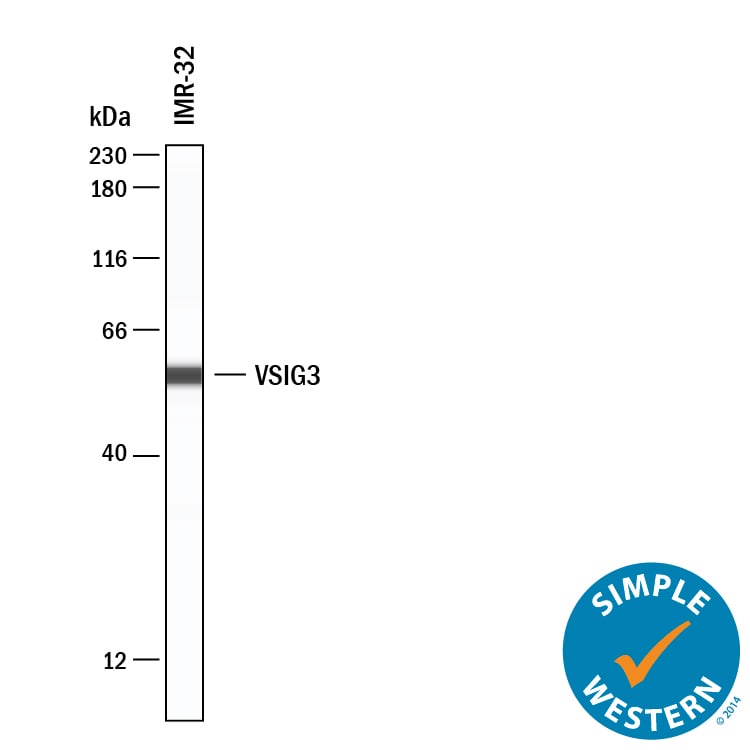
Detection of Human VSIG3 by Simple WesternTM.
Simple Western lane view shows lysates of IMR‑32 human neuroblastoma cell line, loaded at 0.2 mg/mL. A specific band was detected for VSIG3 at approximately 57 kDa (as indicated) using 20 µg/mL of Rabbit Anti-Human VSIG3 Monoclonal Antibody (Catalog # MAB11226). This experiment was conducted under reducing conditions and using the 12-230 kDa separation system.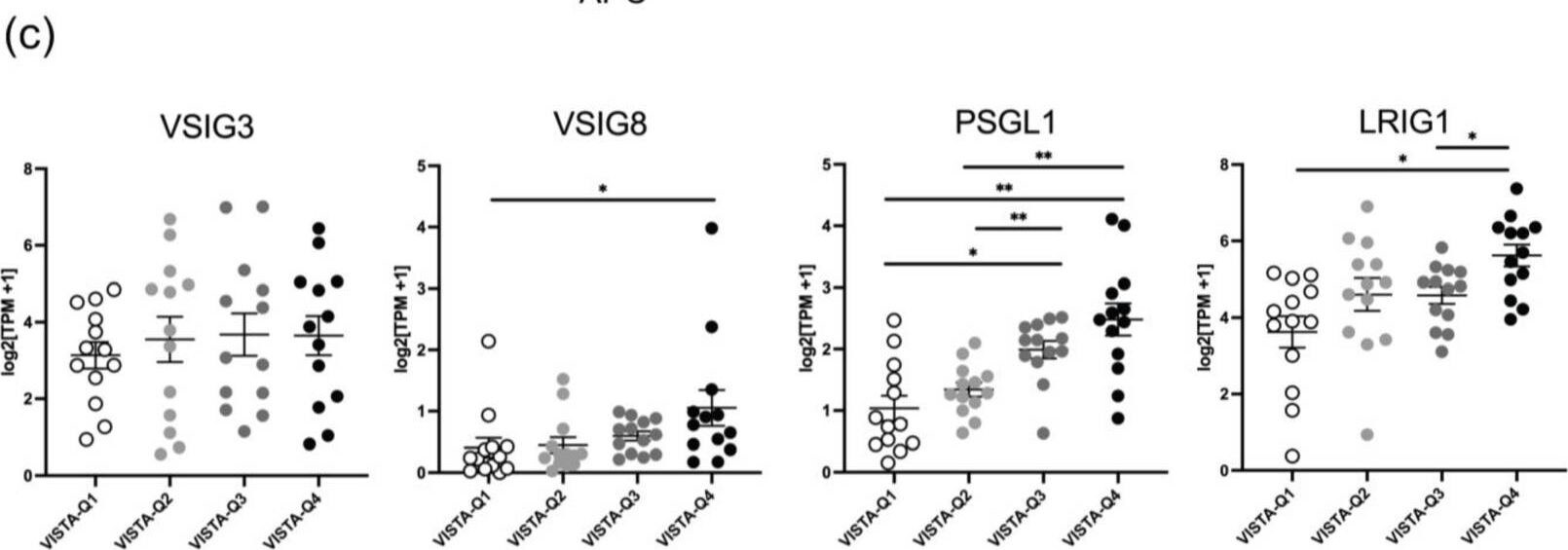
Detection of VSIG3 by Flow Cytometry
Human and mouse MB tumor cells exhibit in vitro expression of VISTA binding partners and are translationally relevant. (a) Cells gated on live singlets, then further gated based on GFP expression. Histograms (blue) representing in vitro expression of VSIG8 and VSIG3 in human MB cell lines (D283-MED and D425-MED) and our GFP+ mouse medulloblastoma cell line (mCB DNp53 MYC). Fluorescence minus one control represented in gray, and isotype control represented in green. (b) Western blot analysis confirming expression of VSIG3 and VSIG8 and relative absence of VISTA from human and mouse medulloblastoma tumor cell lines (n = 3). Uncropped blots are shown in File S2. (c) Transcriptome analysis of 52 human MB patient samples. X-axis represents quartile distribution of VISTA expression levels: Q1 (lowest 25%), Q2 (next 25%), Q3 (third 25%), and Q4 (highest 25%). Y-axis represents log2 [TPM+1]. Bar graphs representing VISTA transcript (C10orf54) expression correlation with VSIG3, VSIG8, and PSGL1 and LRIG1. Error bars represent standard error of the mean (SEM), and p-values were calculated using a Mann–Whitney test and corrected for multiple comparisons. The asterisks indicate adjusted p-values as follows: * padj < 0.05, ** padj < 0.01. Image collected and cropped by CiteAb from the following open publication (https://pubmed.ncbi.nlm.nih.gov/39123357), licensed under a CC-BY license. Not internally tested by R&D Systems.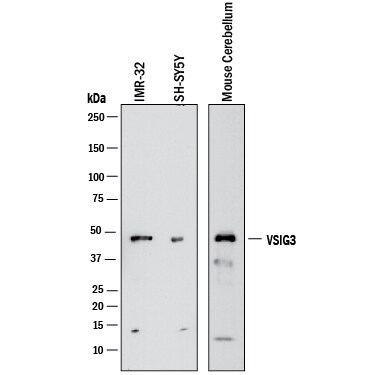
Detection of Human VSIG3 by Western Blot.
Western blot shows lysates of IMR‑32 human neuroblastoma cell line, SH‑SY5Y human neuroblastoma cell line and Mouse cerebellum. PVDF membrane was probed with 2 µg/mL of Rabbit Anti-Human VSIG3 Monoclonal Antibody (Catalog # MAB11226) followed by HRP-conjugated Anti-Rabbit IgG Secondary Antibody (Catalog # HAF008). A specific band was detected for VSIG3 at approximately 46 kDa (as indicated). This experiment was conducted under reducing conditions and using Western Blot Buffer Group 1.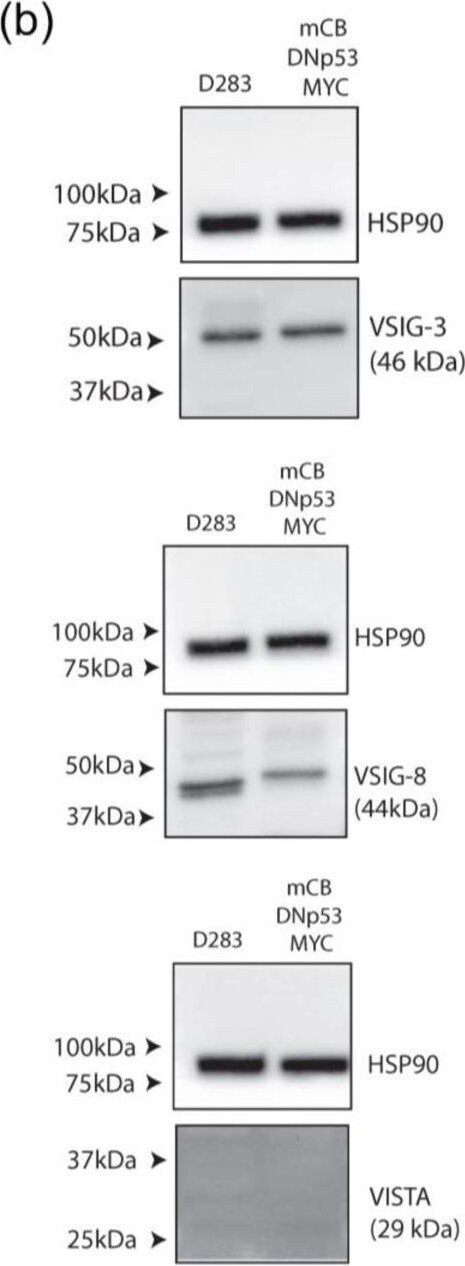
Detection of VSIG3 by Western Blot
Human and mouse MB tumor cells exhibit in vitro expression of VISTA binding partners and are translationally relevant. (a) Cells gated on live singlets, then further gated based on GFP expression. Histograms (blue) representing in vitro expression of VSIG8 and VSIG3 in human MB cell lines (D283-MED and D425-MED) and our GFP+ mouse medulloblastoma cell line (mCB DNp53 MYC). Fluorescence minus one control represented in gray, and isotype control represented in green. (b) Western blot analysis confirming expression of VSIG3 and VSIG8 and relative absence of VISTA from human and mouse medulloblastoma tumor cell lines (n = 3). Uncropped blots are shown in File S2. (c) Transcriptome analysis of 52 human MB patient samples. X-axis represents quartile distribution of VISTA expression levels: Q1 (lowest 25%), Q2 (next 25%), Q3 (third 25%), and Q4 (highest 25%). Y-axis represents log2 [TPM+1]. Bar graphs representing VISTA transcript (C10orf54) expression correlation with VSIG3, VSIG8, and PSGL1 and LRIG1. Error bars represent standard error of the mean (SEM), and p-values were calculated using a Mann–Whitney test and corrected for multiple comparisons. The asterisks indicate adjusted p-values as follows: * padj < 0.05, ** padj < 0.01. Image collected and cropped by CiteAb from the following open publication (https://pubmed.ncbi.nlm.nih.gov/39123357), licensed under a CC-BY license. Not internally tested by R&D Systems.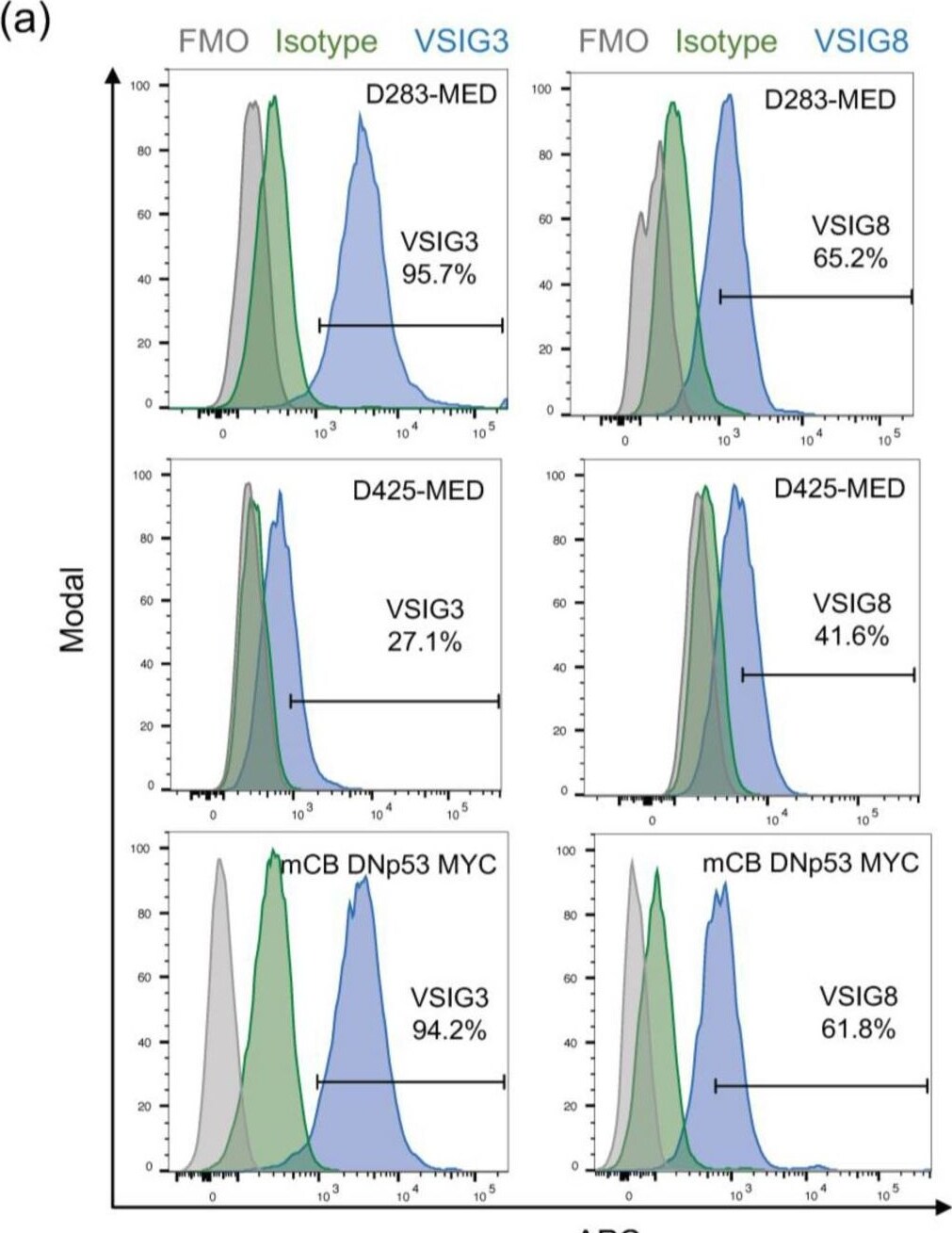
Detection of VSIG3 by Flow Cytometry
Human and mouse MB tumor cells exhibit in vitro expression of VISTA binding partners and are translationally relevant. (a) Cells gated on live singlets, then further gated based on GFP expression. Histograms (blue) representing in vitro expression of VSIG8 and VSIG3 in human MB cell lines (D283-MED and D425-MED) and our GFP+ mouse medulloblastoma cell line (mCB DNp53 MYC). Fluorescence minus one control represented in gray, and isotype control represented in green. (b) Western blot analysis confirming expression of VSIG3 and VSIG8 and relative absence of VISTA from human and mouse medulloblastoma tumor cell lines (n = 3). Uncropped blots are shown in File S2. (c) Transcriptome analysis of 52 human MB patient samples. X-axis represents quartile distribution of VISTA expression levels: Q1 (lowest 25%), Q2 (next 25%), Q3 (third 25%), and Q4 (highest 25%). Y-axis represents log2 [TPM+1]. Bar graphs representing VISTA transcript (C10orf54) expression correlation with VSIG3, VSIG8, and PSGL1 and LRIG1. Error bars represent standard error of the mean (SEM), and p-values were calculated using a Mann–Whitney test and corrected for multiple comparisons. The asterisks indicate adjusted p-values as follows: * padj < 0.05, ** padj < 0.01. Image collected and cropped by CiteAb from the following open publication (https://pubmed.ncbi.nlm.nih.gov/39123357), licensed under a CC-BY license. Not internally tested by R&D Systems.Applications for Human VSIG3 Antibody (2637B)
Simple Western
Sample: IMR‑32 human neuroblastoma cell line
Western Blot
Sample: IMR‑32 human neuroblastoma cell line, SH‑SY5Y human neuroblastoma cell line and Mouse cerebellum
Formulation, Preparation, and Storage
Purification
Reconstitution
Formulation
Shipping
Stability & Storage
- 12 months from date of receipt, -20 to -70 °C as supplied.
- 1 month, 2 to 8 °C under sterile conditions after reconstitution.
- 6 months, -20 to -70 °C under sterile conditions after reconstitution.
Calculators
Background: VSIG3
Long Name
Alternate Names
Gene Symbol
UniProt
Additional VSIG3 Products
Product Documents for Human VSIG3 Antibody (2637B)
Certificate of Analysis
To download a Certificate of Analysis, please enter a lot or batch number in the search box below.
Note: Certificate of Analysis not available for kit components.
Product Specific Notices for Human VSIG3 Antibody (2637B)
For research use only
Related Research Areas
Citations for Human VSIG3 Antibody (2637B)
 Powered by Bioz
Customer Reviews for Human VSIG3 Antibody (2637B)
There are currently no reviews for this product. Be the first to review Human VSIG3 Antibody (2637B) and earn rewards!
Have you used Human VSIG3 Antibody (2637B)?
Submit a review and receive an Amazon gift card!
$25/€18/£15/$25CAN/¥2500 for a review with an image
$10/€7/£6/$10CAN/¥1110 for a review without an image
Submit a review
Protocols
Find general support by application which include: protocols, troubleshooting, illustrated assays, videos and webinars.
- Cellular Response to Hypoxia Protocols
- R&D Systems Quality Control Western Blot Protocol
- Troubleshooting Guide: Western Blot Figures
- Western Blot Conditions
- Western Blot Protocol
- Western Blot Protocol for Cell Lysates
- Western Blot Troubleshooting
- Western Blot Troubleshooting Guide
- View all Protocols, Troubleshooting, Illustrated assays and Webinars