
Lightning-Link (R) R-PE Antibody Labeling Kit
Novus Biologicals | Catalog # 703-0003

![Flow Cytometry: Lightning-Link (R) R-PE Antibody Labeling Kit [703-0003]](https://resources.rndsystems.com/images/products/Lightning-Link-R-PE-Antibody-Labeling-Kit-Flow-Cytometry-703-0003-img0003.jpg "Flow Cytometry: Lightning-Link (R) R-PE Antibody Labeling Kit [703-0003]")
New PE Conjugation Kit Available: Faster, more simplified workflow—try LinkAble™ PE Conjugation Kits. Multiple pack sizes available for a range of antibody inputs. View LNKPE.
Key Product Details
Applications
Kit Type
Conjugate
Product Summary for Lightning-Link (R) R-PE Antibody Labeling Kit
Our R-PE antibody labeling kit enables the direct conjugation of R-PE to any biomolecule with an available amine group. The researcher simply pipettes the antibody or other biomolecule into the vial of Lightning-Link R-PE and incubates for 3 hours.
| Features | Benefits |
| Quick and easy to use | Save time, no special knowledge required |
| No separation steps | 100% recovery - no antibody/protein loss |
| Can be used in a wide range of applications | Flexible |
| Freeze dried | Ships at ambient temperature, long shelf-life |
| Fully scalable (10 ug to 1 g or more) | Easy transfer from R&D to manufacturing |
| Stringently QC tested | Consistent high quality, excellent batch-to-batch reproducibility |
| Large number of labels available | Experimental flexibility |
| Reliable: nearly 300 references | Successfully used in many fields of research |
R-Phycoerythrin (R-PE) is a fluorescent protein from the phycobiliprotein family, present in red algae and cryptophytes. It has three maximal absorbance values of 498, 544 and 566nm (the optimal will depend on the application), and it has a strong emission peak at 580nm. RPE is closely related to B-Phycoerythrin (B-PE) and these are the most intense fluorescent phycobiliproteins providing an orange fluorescence.
Learn more about Lightning-Link™ Conjugation Kits by reading FAQs
For more information please check out these useful links!
Antibody Labeling Guide
Antibody Conjugation Illustrated Assay
Product Specifications
Application Notes
Scientific Data Images for Lightning-Link (R) R-PE Antibody Labeling Kit
Flow Cytometry: Lightning-Link (R) R-PE Antibody Labeling Kit [703-0003]
Flow Cytometry: Lightning-Link R-PE Antibody Labeling Kit [703-0003] - Mouse anti-human CD8 was conjugated with R Phycoerythrin using Lightning-Link kit. The conjugated antibody was then used to stain human peripheral blood lymphocytes, followed by analysis with flow cytometry. (Blue line - negative control; red line - positive staining).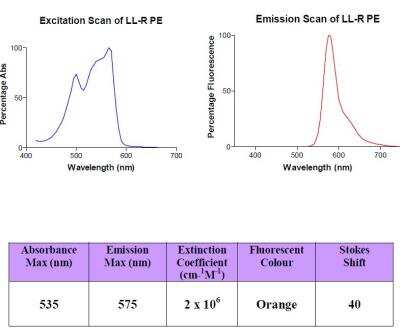
Kit Contents for Lightning-Link (R) R-PE Antibody Labeling Kit
- 1 or 3 or 5 glass vial(s) of Lightning-Link mix
- 1 vial of LL-Modifier reagent
- 1 vial of LL-Quencher reagent
Formulation, Preparation, and Storage
Concentration
Shipping
Storage
Background: Lightning-Link (R) R-PE
Additional Lightning-Link (R) R-PE Products
Product Documents for Lightning-Link (R) R-PE Antibody Labeling Kit
Certificate of Analysis
To download a Certificate of Analysis, please enter a lot or batch number in the search box below.
Product Specific Notices for Lightning-Link (R) R-PE Antibody Labeling Kit
This product is manufactured by Abcam and distributed by Novus Biologicals.
This product is for research use only and is not approved for use in humans or in clinical diagnosis. This product is guaranteed for 1 year from date of receipt and this statement overrides any mentioned guarantee period on the limitations section of this products datasheet. Please contact technical@novusbio.com with questions.
This product is for research use only and is not approved for use in humans or in clinical diagnosis. Kits are guaranteed for 6 months from date of receipt.
Citations for Lightning-Link (R) R-PE Antibody Labeling Kit
 Powered by Bioz
Customer Reviews for Lightning-Link (R) R-PE Antibody Labeling Kit
There are currently no reviews for this product. Be the first to review Lightning-Link (R) R-PE Antibody Labeling Kit and earn rewards!
Have you used Lightning-Link (R) R-PE Antibody Labeling Kit?
Submit a review and receive an Amazon gift card!
$25/€18/£15/$25CAN/¥2500 for a review with an image
$10/€7/£6/$10CAN/¥1110 for a review without an image
Submit a review
Protocols
Find general support by application which include: protocols, troubleshooting, illustrated assays, videos and webinars.
- 7-Amino Actinomycin D (7-AAD) Cell Viability Flow Cytometry Protocol
- Extracellular Membrane Flow Cytometry Protocol
- Flow Cytometry Protocol for Cell Surface Markers
- Flow Cytometry Protocol for Staining Membrane Associated Proteins
- Flow Cytometry Staining Protocols
- Flow Cytometry Troubleshooting Guide
- Intracellular Flow Cytometry Protocol Using Alcohol (Methanol)
- Intracellular Flow Cytometry Protocol Using Detergents
- Intracellular Nuclear Staining Flow Cytometry Protocol Using Detergents
- Intracellular Staining Flow Cytometry Protocol Using Alcohol Permeabilization
- Intracellular Staining Flow Cytometry Protocol Using Detergents to Permeabilize Cells
- Propidium Iodide Cell Viability Flow Cytometry Protocol
- Protocol for Liperfluo
- Protocol for the Characterization of Human Th22 Cells
- Protocol for the Characterization of Human Th9 Cells
- Protocol: Annexin V and PI Staining by Flow Cytometry
- Protocol: Annexin V and PI Staining for Apoptosis by Flow Cytometry
- Troubleshooting Guide: Fluorokine Flow Cytometry Kits
- View all Protocols, Troubleshooting, Illustrated assays and Webinars
FAQs for Lightning-Link (R) R-PE Antibody Labeling Kit
-
Q: Can I label a peptide/protein/antibody other than IgG?
A: Yes. The Lightning-Link® technology works by targeting free amine groups on your target, meaning it can be used to label most biomolecules.As the protocols provided were optimized for labeling IgGs, we would recommend you adjust the amount of material you add to the Lighting-Link® vial to allow for molecular weight difference. This should be done without changing the volume added to the vial, as this could affect the conjugation efficiency. As a rough guideline, we would recommend changing the amount of material proportionally to the size difference with IgGs. An average IgG is about 160kD, therefore for a target that is half the size of an antibody (about 80kD), add half as much to the vial. Please note this is only a guideline and the best amount for your assay should be determined experimentally; our 3x10ug kits enable you to do this using small amounts of material and therefore at a low cost.
-
Q: Can I use your lightning-link kits to label other proteins rather than antibodies?
A: Yes, the kits work by using free amines, so as long as you have that the kit should work.
-
Q: Do I need a wash or desalt step?
A: One of the advantages of the Lightning-Link® technology compared to traditional labeling methods is that conjugate purification is not required. The Lightning-Link® reactions are highly efficient, and the kits have been optimized so that, provided the protocols are followed, there should be only a very low amount of free label left at the end of the conjugation. Any remaining free label would have its reactive 'Lightning-Link®' groups blocked by the Quencher provided in the kit, and would then be washed away during the relevant wash step of your application.
-
Q: Do my antibody and buffer fit the requirements?
A: Your antibody should be purified (affinity purification is preferred), as other molecules with free amine groups will interfere with the reaction, resulting in a poor quality conjugate. A suitable method of purification should be used (such as affinity or Protein A/G). Please note that 0.2/0.22 um filtration is a method of sterilization, not purification.
Your biomolecule should also be in a suitable, 10-50mM amine free buffer (e.g. MES, MOPS, HEPES, PBS), pH range 6.5 to 8.5 and not in any of the following: ascites fluid, serum or tissue culture supernatant. It should not contain any additives such as Azide, BSA, Tris or Glycine at a concentration of >0.1%.The amount of antibody (IgG) you should add to the Lightning-Link® vial usually corresponds to the kit size your purchased (for example: a 3x100ug kit enable you to label 3 lots of 100ug antibody) and the volume added should also match (eg: 100ul), meaning the ideal concentration is of 1mg/ml. For other biomolecule, the amount added should be adjusted by changing your concentration (see above).NOTE: The amount and volume of antibody recommended above are for all Lightning-Link• kits offered by Innova Biosciences, with the exception of RPE and PE tandem dyes. For more details on the recommendations specific to these dyes, please consult the protocols available on each product page. -
Q: How many labels will bind to my biomolecule?
A: It is difficult to give a precise answer to this as the result will vary from antibody to antibody (or other protein). Traditional labelling techniques often have F/P ratios in the range of 4-7:1, and our comparative data for staining with antibodies labelled with Lightning Link shows similar staining intensity. The ratio of dye to antibody is only ever an average for the population of labelled molecules, as individual molecules may have different amount of dye incorporated into them.
-
Q: How stable will my new conjugate be?
A: The Lightning-Link® chemistry joins the label to the antibody via a uni directional stable, covalent bond. The stability of your conjugate will therefore be dependent on your antibody and label of choice. In our in-house studies, conjugates made with our Lightning-Link® kits were fully active after more than 18 months' storage, undiluted, at 4 degrees C. Conjugates stored in 50% glycerol at -20 degrees C were found to be even more stable (several years). Please see below for advice on storage conditions. Please note that tandem dye stability is lower than the other dyes'. Tandem conjugates are fully stable for about 3 months at 4 degrees C.
-
Q: Is trehalose accepatable in PBS for label with Lightning Link R-PE
A: The trehalose should not affect any protein modification. Trehalose is a common component as lyophilised excipient and we do not expect that it will interfere with the conjugation.
-
Q: What are the best storage conditions for my new conjugate?
A: TA new conjugate can be stored for 12-18 months at 4 degrees C as long as the antibody will tolerate storage at 4 degrees C. As the bond between the antibody and dye is covalent and very stable, it should not degrade, therefore at 4 degrees C no additional preservatives are needed. The antibody is usually the least stable component of the conjugate so please check the antibody datasheet for storage recommendations. However, all conjugates can be stored in 50% glycerol at -20 degrees C which allows them to remain stable for 2 years. Please bear in mind that APC and RPE conjugates should never be stored at -20 degrees C on their own without glycerol. The dilution factor also has an effect. Storing the conjugate undiluted is recommended if possible; however, for HRP conjugates, if you wish to store at working concentrations (e.g. 1/10,000), this can be done using our LifeXtend HRP Conjugate Stabilizer/Diluent. Please note that the preservative sodium azide will inhibit HRP. We suggest that the optimal storage conditions for any conjugate are determined experimentally, using small aliquots of the conjugate.
-
Q: What can I do if my antibody formulation does not fit the requirements?
A: If your antibody buffer is not compatible with our kits, we have developed an AbSelect™ purification kit range that allows you to quickly and simply purify your antibody and is fully compatible with the Lightning-Link® kits.The appropriate kit to use depends on your particular sample (species, buffer, contaminants, volume,...). We have designed a handy flow chart on the AbSelect™ webpage to help you select a kit, but feel free to contact us if you require further guidance. Please consult the kit protocols to see the antibody amount/volume suitable for each kit.If your antibody is already purified but its concentration is too low, you can concentrate it by using our Antibody Concentration and Clean Up Kit. This kit can also be used to remove low molecular weight contaminants such as azide, tris or glycine by carrying out a buffer exchange into the buffer supplied in the kit, which is fully compatible with Lightning-Link®.If your antibody contains BSA, you can now use our BSA removal kit to purify your antibody in a few simple steps. Please note this kit will also enable you to concentrate your antibody.NB: All the AbSelect kits will ONLY work with antibodies. They will not purify other molecules. The only exception is the concentration and clean up kit (861-0010), which will work with other molecules greater than 10kD.
-
Q: What is the difference between Lightning-Link® and Lightning-Link® Rapid?
A: The benefit of the Rapid kits is that the conjugates can be generated faster because the conjugation and quenching incubation times are shorter. The antibody/protein/peptide considerations are exactly the same, as is the high quality of the final conjugate. DyLight® dyes are only available in the Rapid format.
-
Q: Can I label a peptide/protein/antibody other than IgG?
A: Yes. The Lightning-Link® technology works by targeting free amine groups on your target, meaning it can be used to label most biomolecules.As the protocols provided were optimized for labeling IgGs, we would recommend you adjust the amount of material you add to the Lighting-Link® vial to allow for molecular weight difference. This should be done without changing the volume added to the vial, as this could affect the conjugation efficiency. As a rough guideline, we would recommend changing the amount of material proportionally to the size difference with IgGs. An average IgG is about 160kD, therefore for a target that is half the size of an antibody (about 80kD), add half as much to the vial. Please note this is only a guideline and the best amount for your assay should be determined experimentally; our 3x10ug kits enable you to do this using small amounts of material and therefore at a low cost.
-
Q: Can I use your lightning-link kits to label other proteins rather than antibodies?
A: Yes, the kits work by using free amines, so as long as you have that the kit should work.
-
Q: Do I need a wash or desalt step?
A: One of the advantages of the Lightning-Link® technology compared to traditional labeling methods is that conjugate purification is not required. The Lightning-Link® reactions are highly efficient, and the kits have been optimized so that, provided the protocols are followed, there should be only a very low amount of free label left at the end of the conjugation. Any remaining free label would have its reactive 'Lightning-Link®' groups blocked by the Quencher provided in the kit, and would then be washed away during the relevant wash step of your application.
-
Q: Do my antibody and buffer fit the requirements?
A: Your antibody should be purified (affinity purification is preferred), as other molecules with free amine groups will interfere with the reaction, resulting in a poor quality conjugate. A suitable method of purification should be used (such as affinity or Protein A/G). Please note that 0.2/0.22 um filtration is a method of sterilization, not purification.
Your biomolecule should also be in a suitable, 10-50mM amine free buffer (e.g. MES, MOPS, HEPES, PBS), pH range 6.5 to 8.5 and not in any of the following: ascites fluid, serum or tissue culture supernatant. It should not contain any additives such as Azide, BSA, Tris or Glycine at a concentration of >0.1%.The amount of antibody (IgG) you should add to the Lightning-Link® vial usually corresponds to the kit size your purchased (for example: a 3x100ug kit enable you to label 3 lots of 100ug antibody) and the volume added should also match (eg: 100ul), meaning the ideal concentration is of 1mg/ml. For other biomolecule, the amount added should be adjusted by changing your concentration (see above).NOTE: The amount and volume of antibody recommended above are for all Lightning-Link• kits offered by Innova Biosciences, with the exception of RPE and PE tandem dyes. For more details on the recommendations specific to these dyes, please consult the protocols available on each product page. -
Q: How many labels will bind to my biomolecule?
A: It is difficult to give a precise answer to this as the result will vary from antibody to antibody (or other protein). Traditional labelling techniques often have F/P ratios in the range of 4-7:1, and our comparative data for staining with antibodies labelled with Lightning Link shows similar staining intensity. The ratio of dye to antibody is only ever an average for the population of labelled molecules, as individual molecules may have different amount of dye incorporated into them.
-
Q: How stable will my new conjugate be?
A: The Lightning-Link® chemistry joins the label to the antibody via a uni directional stable, covalent bond. The stability of your conjugate will therefore be dependent on your antibody and label of choice. In our in-house studies, conjugates made with our Lightning-Link® kits were fully active after more than 18 months' storage, undiluted, at 4 degrees C. Conjugates stored in 50% glycerol at -20 degrees C were found to be even more stable (several years). Please see below for advice on storage conditions. Please note that tandem dye stability is lower than the other dyes'. Tandem conjugates are fully stable for about 3 months at 4 degrees C.
-
Q: Is trehalose accepatable in PBS for label with Lightning Link R-PE
A: The trehalose should not affect any protein modification. Trehalose is a common component as lyophilised excipient and we do not expect that it will interfere with the conjugation.
-
Q: What are the best storage conditions for my new conjugate?
A: TA new conjugate can be stored for 12-18 months at 4 degrees C as long as the antibody will tolerate storage at 4 degrees C. As the bond between the antibody and dye is covalent and very stable, it should not degrade, therefore at 4 degrees C no additional preservatives are needed. The antibody is usually the least stable component of the conjugate so please check the antibody datasheet for storage recommendations. However, all conjugates can be stored in 50% glycerol at -20 degrees C which allows them to remain stable for 2 years. Please bear in mind that APC and RPE conjugates should never be stored at -20 degrees C on their own without glycerol. The dilution factor also has an effect. Storing the conjugate undiluted is recommended if possible; however, for HRP conjugates, if you wish to store at working concentrations (e.g. 1/10,000), this can be done using our LifeXtend HRP Conjugate Stabilizer/Diluent. Please note that the preservative sodium azide will inhibit HRP. We suggest that the optimal storage conditions for any conjugate are determined experimentally, using small aliquots of the conjugate.
-
Q: What can I do if my antibody formulation does not fit the requirements?
A: If your antibody buffer is not compatible with our kits, we have developed an AbSelect™ purification kit range that allows you to quickly and simply purify your antibody and is fully compatible with the Lightning-Link® kits.The appropriate kit to use depends on your particular sample (species, buffer, contaminants, volume,...). We have designed a handy flow chart on the AbSelect™ webpage to help you select a kit, but feel free to contact us if you require further guidance. Please consult the kit protocols to see the antibody amount/volume suitable for each kit.If your antibody is already purified but its concentration is too low, you can concentrate it by using our Antibody Concentration and Clean Up Kit. This kit can also be used to remove low molecular weight contaminants such as azide, tris or glycine by carrying out a buffer exchange into the buffer supplied in the kit, which is fully compatible with Lightning-Link®.If your antibody contains BSA, you can now use our BSA removal kit to purify your antibody in a few simple steps. Please note this kit will also enable you to concentrate your antibody.NB: All the AbSelect kits will ONLY work with antibodies. They will not purify other molecules. The only exception is the concentration and clean up kit (861-0010), which will work with other molecules greater than 10kD.
-
Q: What is the difference between Lightning-Link® and Lightning-Link® Rapid?
A: The benefit of the Rapid kits is that the conjugates can be generated faster because the conjugation and quenching incubation times are shorter. The antibody/protein/peptide considerations are exactly the same, as is the high quality of the final conjugate. DyLight® dyes are only available in the Rapid format.
-
Q: Can I label a peptide/protein/antibody other than IgG?
A: Yes. The Lightning-Link® technology works by targeting free amine groups on your target, meaning it can be used to label most biomolecules.As the protocols provided were optimized for labeling IgGs, we would recommend you adjust the amount of material you add to the Lighting-Link® vial to allow for molecular weight difference. This should be done without changing the volume added to the vial, as this could affect the conjugation efficiency. As a rough guideline, we would recommend changing the amount of material proportionally to the size difference with IgGs. An average IgG is about 160kD, therefore for a target that is half the size of an antibody (about 80kD), add half as much to the vial. Please note this is only a guideline and the best amount for your assay should be determined experimentally; our 3x10ug kits enable you to do this using small amounts of material and therefore at a low cost.
-
Q: Can I use your lightning-link kits to label other proteins rather than antibodies?
A: Yes, the kits work by using free amines, so as long as you have that the kit should work.
-
Q: Do I need a wash or desalt step?
A: One of the advantages of the Lightning-Link® technology compared to traditional labeling methods is that conjugate purification is not required. The Lightning-Link® reactions are highly efficient, and the kits have been optimized so that, provided the protocols are followed, there should be only a very low amount of free label left at the end of the conjugation. Any remaining free label would have its reactive 'Lightning-Link®' groups blocked by the Quencher provided in the kit, and would then be washed away during the relevant wash step of your application.
-
Q: Do my antibody and buffer fit the requirements?
A: Your antibody should be purified (affinity purification is preferred), as other molecules with free amine groups will interfere with the reaction, resulting in a poor quality conjugate. A suitable method of purification should be used (such as affinity or Protein A/G). Please note that 0.2/0.22 um filtration is a method of sterilization, not purification.
Your biomolecule should also be in a suitable, 10-50mM amine free buffer (e.g. MES, MOPS, HEPES, PBS), pH range 6.5 to 8.5 and not in any of the following: ascites fluid, serum or tissue culture supernatant. It should not contain any additives such as Azide, BSA, Tris or Glycine at a concentration of >0.1%.The amount of antibody (IgG) you should add to the Lightning-Link® vial usually corresponds to the kit size your purchased (for example: a 3x100ug kit enable you to label 3 lots of 100ug antibody) and the volume added should also match (eg: 100ul), meaning the ideal concentration is of 1mg/ml. For other biomolecule, the amount added should be adjusted by changing your concentration (see above).NOTE: The amount and volume of antibody recommended above are for all Lightning-Link• kits offered by Innova Biosciences, with the exception of RPE and PE tandem dyes. For more details on the recommendations specific to these dyes, please consult the protocols available on each product page. -
Q: How many labels will bind to my biomolecule?
A: It is difficult to give a precise answer to this as the result will vary from antibody to antibody (or other protein). Traditional labelling techniques often have F/P ratios in the range of 4-7:1, and our comparative data for staining with antibodies labelled with Lightning Link shows similar staining intensity. The ratio of dye to antibody is only ever an average for the population of labelled molecules, as individual molecules may have different amount of dye incorporated into them.
-
Q: How stable will my new conjugate be?
A: The Lightning-Link® chemistry joins the label to the antibody via a uni directional stable, covalent bond. The stability of your conjugate will therefore be dependent on your antibody and label of choice. In our in-house studies, conjugates made with our Lightning-Link® kits were fully active after more than 18 months' storage, undiluted, at 4 degrees C. Conjugates stored in 50% glycerol at -20 degrees C were found to be even more stable (several years). Please see below for advice on storage conditions. Please note that tandem dye stability is lower than the other dyes'. Tandem conjugates are fully stable for about 3 months at 4 degrees C.
-
Q: Is trehalose accepatable in PBS for label with Lightning Link R-PE
A: The trehalose should not affect any protein modification. Trehalose is a common component as lyophilised excipient and we do not expect that it will interfere with the conjugation.
-
Q: What are the best storage conditions for my new conjugate?
A: TA new conjugate can be stored for 12-18 months at 4 degrees C as long as the antibody will tolerate storage at 4 degrees C. As the bond between the antibody and dye is covalent and very stable, it should not degrade, therefore at 4 degrees C no additional preservatives are needed. The antibody is usually the least stable component of the conjugate so please check the antibody datasheet for storage recommendations. However, all conjugates can be stored in 50% glycerol at -20 degrees C which allows them to remain stable for 2 years. Please bear in mind that APC and RPE conjugates should never be stored at -20 degrees C on their own without glycerol. The dilution factor also has an effect. Storing the conjugate undiluted is recommended if possible; however, for HRP conjugates, if you wish to store at working concentrations (e.g. 1/10,000), this can be done using our LifeXtend HRP Conjugate Stabilizer/Diluent. Please note that the preservative sodium azide will inhibit HRP. We suggest that the optimal storage conditions for any conjugate are determined experimentally, using small aliquots of the conjugate.
-
Q: What can I do if my antibody formulation does not fit the requirements?
A: If your antibody buffer is not compatible with our kits, we have developed an AbSelect™ purification kit range that allows you to quickly and simply purify your antibody and is fully compatible with the Lightning-Link® kits.The appropriate kit to use depends on your particular sample (species, buffer, contaminants, volume,...). We have designed a handy flow chart on the AbSelect™ webpage to help you select a kit, but feel free to contact us if you require further guidance. Please consult the kit protocols to see the antibody amount/volume suitable for each kit.If your antibody is already purified but its concentration is too low, you can concentrate it by using our Antibody Concentration and Clean Up Kit. This kit can also be used to remove low molecular weight contaminants such as azide, tris or glycine by carrying out a buffer exchange into the buffer supplied in the kit, which is fully compatible with Lightning-Link®.If your antibody contains BSA, you can now use our BSA removal kit to purify your antibody in a few simple steps. Please note this kit will also enable you to concentrate your antibody.NB: All the AbSelect kits will ONLY work with antibodies. They will not purify other molecules. The only exception is the concentration and clean up kit (861-0010), which will work with other molecules greater than 10kD.
-
Q: What is the difference between Lightning-Link® and Lightning-Link® Rapid?
A: The benefit of the Rapid kits is that the conjugates can be generated faster because the conjugation and quenching incubation times are shorter. The antibody/protein/peptide considerations are exactly the same, as is the high quality of the final conjugate. DyLight® dyes are only available in the Rapid format.
-
Q: Can I label a peptide/protein/antibody other than IgG?
A: Yes. The Lightning-Link® technology works by targeting free amine groups on your target, meaning it can be used to label most biomolecules.As the protocols provided were optimized for labeling IgGs, we would recommend you adjust the amount of material you add to the Lighting-Link® vial to allow for molecular weight difference. This should be done without changing the volume added to the vial, as this could affect the conjugation efficiency. As a rough guideline, we would recommend changing the amount of material proportionally to the size difference with IgGs. An average IgG is about 160kD, therefore for a target that is half the size of an antibody (about 80kD), add half as much to the vial. Please note this is only a guideline and the best amount for your assay should be determined experimentally; our 3x10ug kits enable you to do this using small amounts of material and therefore at a low cost.
-
Q: Can I use your lightning-link kits to label other proteins rather than antibodies?
A: Yes, the kits work by using free amines, so as long as you have that the kit should work.
-
Q: Do I need a wash or desalt step?
A: One of the advantages of the Lightning-Link® technology compared to traditional labeling methods is that conjugate purification is not required. The Lightning-Link® reactions are highly efficient, and the kits have been optimized so that, provided the protocols are followed, there should be only a very low amount of free label left at the end of the conjugation. Any remaining free label would have its reactive 'Lightning-Link®' groups blocked by the Quencher provided in the kit, and would then be washed away during the relevant wash step of your application.
-
Q: Do my antibody and buffer fit the requirements?
A: Your antibody should be purified (affinity purification is preferred), as other molecules with free amine groups will interfere with the reaction, resulting in a poor quality conjugate. A suitable method of purification should be used (such as affinity or Protein A/G). Please note that 0.2/0.22 um filtration is a method of sterilization, not purification.
Your biomolecule should also be in a suitable, 10-50mM amine free buffer (e.g. MES, MOPS, HEPES, PBS), pH range 6.5 to 8.5 and not in any of the following: ascites fluid, serum or tissue culture supernatant. It should not contain any additives such as Azide, BSA, Tris or Glycine at a concentration of >0.1%.The amount of antibody (IgG) you should add to the Lightning-Link® vial usually corresponds to the kit size your purchased (for example: a 3x100ug kit enable you to label 3 lots of 100ug antibody) and the volume added should also match (eg: 100ul), meaning the ideal concentration is of 1mg/ml. For other biomolecule, the amount added should be adjusted by changing your concentration (see above).NOTE: The amount and volume of antibody recommended above are for all Lightning-Link• kits offered by Innova Biosciences, with the exception of RPE and PE tandem dyes. For more details on the recommendations specific to these dyes, please consult the protocols available on each product page. -
Q: How many labels will bind to my biomolecule?
A: It is difficult to give a precise answer to this as the result will vary from antibody to antibody (or other protein). Traditional labelling techniques often have F/P ratios in the range of 4-7:1, and our comparative data for staining with antibodies labelled with Lightning Link shows similar staining intensity. The ratio of dye to antibody is only ever an average for the population of labelled molecules, as individual molecules may have different amount of dye incorporated into them.
-
Q: How stable will my new conjugate be?
A: The Lightning-Link® chemistry joins the label to the antibody via a uni directional stable, covalent bond. The stability of your conjugate will therefore be dependent on your antibody and label of choice. In our in-house studies, conjugates made with our Lightning-Link® kits were fully active after more than 18 months' storage, undiluted, at 4 degrees C. Conjugates stored in 50% glycerol at -20 degrees C were found to be even more stable (several years). Please see below for advice on storage conditions. Please note that tandem dye stability is lower than the other dyes'. Tandem conjugates are fully stable for about 3 months at 4 degrees C.
-
Q: Is trehalose accepatable in PBS for label with Lightning Link R-PE
A: The trehalose should not affect any protein modification. Trehalose is a common component as lyophilised excipient and we do not expect that it will interfere with the conjugation.
-
Q: What are the best storage conditions for my new conjugate?
A: TA new conjugate can be stored for 12-18 months at 4 degrees C as long as the antibody will tolerate storage at 4 degrees C. As the bond between the antibody and dye is covalent and very stable, it should not degrade, therefore at 4 degrees C no additional preservatives are needed. The antibody is usually the least stable component of the conjugate so please check the antibody datasheet for storage recommendations. However, all conjugates can be stored in 50% glycerol at -20 degrees C which allows them to remain stable for 2 years. Please bear in mind that APC and RPE conjugates should never be stored at -20 degrees C on their own without glycerol. The dilution factor also has an effect. Storing the conjugate undiluted is recommended if possible; however, for HRP conjugates, if you wish to store at working concentrations (e.g. 1/10,000), this can be done using our LifeXtend HRP Conjugate Stabilizer/Diluent. Please note that the preservative sodium azide will inhibit HRP. We suggest that the optimal storage conditions for any conjugate are determined experimentally, using small aliquots of the conjugate.
-
Q: What can I do if my antibody formulation does not fit the requirements?
A: If your antibody buffer is not compatible with our kits, we have developed an AbSelect™ purification kit range that allows you to quickly and simply purify your antibody and is fully compatible with the Lightning-Link® kits.The appropriate kit to use depends on your particular sample (species, buffer, contaminants, volume,...). We have designed a handy flow chart on the AbSelect™ webpage to help you select a kit, but feel free to contact us if you require further guidance. Please consult the kit protocols to see the antibody amount/volume suitable for each kit.If your antibody is already purified but its concentration is too low, you can concentrate it by using our Antibody Concentration and Clean Up Kit. This kit can also be used to remove low molecular weight contaminants such as azide, tris or glycine by carrying out a buffer exchange into the buffer supplied in the kit, which is fully compatible with Lightning-Link®.If your antibody contains BSA, you can now use our BSA removal kit to purify your antibody in a few simple steps. Please note this kit will also enable you to concentrate your antibody.NB: All the AbSelect kits will ONLY work with antibodies. They will not purify other molecules. The only exception is the concentration and clean up kit (861-0010), which will work with other molecules greater than 10kD.
-
Q: What is the difference between Lightning-Link® and Lightning-Link® Rapid?
A: The benefit of the Rapid kits is that the conjugates can be generated faster because the conjugation and quenching incubation times are shorter. The antibody/protein/peptide considerations are exactly the same, as is the high quality of the final conjugate. DyLight® dyes are only available in the Rapid format.
-
Q: Can I label a peptide/protein/antibody other than IgG?
A: Yes. The Lightning-Link® technology works by targeting free amine groups on your target, meaning it can be used to label most biomolecules.As the protocols provided were optimized for labeling IgGs, we would recommend you adjust the amount of material you add to the Lighting-Link® vial to allow for molecular weight difference. This should be done without changing the volume added to the vial, as this could affect the conjugation efficiency. As a rough guideline, we would recommend changing the amount of material proportionally to the size difference with IgGs. An average IgG is about 160kD, therefore for a target that is half the size of an antibody (about 80kD), add half as much to the vial. Please note this is only a guideline and the best amount for your assay should be determined experimentally; our 3x10ug kits enable you to do this using small amounts of material and therefore at a low cost.
-
Q: Can I use your lightning-link kits to label other proteins rather than antibodies?
A: Yes, the kits work by using free amines, so as long as you have that the kit should work.
-
Q: Do I need a wash or desalt step?
A: One of the advantages of the Lightning-Link® technology compared to traditional labeling methods is that conjugate purification is not required. The Lightning-Link® reactions are highly efficient, and the kits have been optimized so that, provided the protocols are followed, there should be only a very low amount of free label left at the end of the conjugation. Any remaining free label would have its reactive 'Lightning-Link®' groups blocked by the Quencher provided in the kit, and would then be washed away during the relevant wash step of your application.
-
Q: Do my antibody and buffer fit the requirements?
A: Your antibody should be purified (affinity purification is preferred), as other molecules with free amine groups will interfere with the reaction, resulting in a poor quality conjugate. A suitable method of purification should be used (such as affinity or Protein A/G). Please note that 0.2/0.22 um filtration is a method of sterilization, not purification.
Your biomolecule should also be in a suitable, 10-50mM amine free buffer (e.g. MES, MOPS, HEPES, PBS), pH range 6.5 to 8.5 and not in any of the following: ascites fluid, serum or tissue culture supernatant. It should not contain any additives such as Azide, BSA, Tris or Glycine at a concentration of >0.1%.The amount of antibody (IgG) you should add to the Lightning-Link® vial usually corresponds to the kit size your purchased (for example: a 3x100ug kit enable you to label 3 lots of 100ug antibody) and the volume added should also match (eg: 100ul), meaning the ideal concentration is of 1mg/ml. For other biomolecule, the amount added should be adjusted by changing your concentration (see above).NOTE: The amount and volume of antibody recommended above are for all Lightning-Link• kits offered by Innova Biosciences, with the exception of RPE and PE tandem dyes. For more details on the recommendations specific to these dyes, please consult the protocols available on each product page. -
Q: How many labels will bind to my biomolecule?
A: It is difficult to give a precise answer to this as the result will vary from antibody to antibody (or other protein). Traditional labelling techniques often have F/P ratios in the range of 4-7:1, and our comparative data for staining with antibodies labelled with Lightning Link shows similar staining intensity. The ratio of dye to antibody is only ever an average for the population of labelled molecules, as individual molecules may have different amount of dye incorporated into them.
-
Q: How stable will my new conjugate be?
A: The Lightning-Link® chemistry joins the label to the antibody via a uni directional stable, covalent bond. The stability of your conjugate will therefore be dependent on your antibody and label of choice. In our in-house studies, conjugates made with our Lightning-Link® kits were fully active after more than 18 months' storage, undiluted, at 4 degrees C. Conjugates stored in 50% glycerol at -20 degrees C were found to be even more stable (several years). Please see below for advice on storage conditions. Please note that tandem dye stability is lower than the other dyes'. Tandem conjugates are fully stable for about 3 months at 4 degrees C.
-
Q: Is trehalose accepatable in PBS for label with Lightning Link R-PE
A: The trehalose should not affect any protein modification. Trehalose is a common component as lyophilised excipient and we do not expect that it will interfere with the conjugation.
-
Q: What are the best storage conditions for my new conjugate?
A: TA new conjugate can be stored for 12-18 months at 4 degrees C as long as the antibody will tolerate storage at 4 degrees C. As the bond between the antibody and dye is covalent and very stable, it should not degrade, therefore at 4 degrees C no additional preservatives are needed. The antibody is usually the least stable component of the conjugate so please check the antibody datasheet for storage recommendations. However, all conjugates can be stored in 50% glycerol at -20 degrees C which allows them to remain stable for 2 years. Please bear in mind that APC and RPE conjugates should never be stored at -20 degrees C on their own without glycerol. The dilution factor also has an effect. Storing the conjugate undiluted is recommended if possible; however, for HRP conjugates, if you wish to store at working concentrations (e.g. 1/10,000), this can be done using our LifeXtend HRP Conjugate Stabilizer/Diluent. Please note that the preservative sodium azide will inhibit HRP. We suggest that the optimal storage conditions for any conjugate are determined experimentally, using small aliquots of the conjugate.
-
Q: What can I do if my antibody formulation does not fit the requirements?
A: If your antibody buffer is not compatible with our kits, we have developed an AbSelect™ purification kit range that allows you to quickly and simply purify your antibody and is fully compatible with the Lightning-Link® kits.The appropriate kit to use depends on your particular sample (species, buffer, contaminants, volume,...). We have designed a handy flow chart on the AbSelect™ webpage to help you select a kit, but feel free to contact us if you require further guidance. Please consult the kit protocols to see the antibody amount/volume suitable for each kit.If your antibody is already purified but its concentration is too low, you can concentrate it by using our Antibody Concentration and Clean Up Kit. This kit can also be used to remove low molecular weight contaminants such as azide, tris or glycine by carrying out a buffer exchange into the buffer supplied in the kit, which is fully compatible with Lightning-Link®.If your antibody contains BSA, you can now use our BSA removal kit to purify your antibody in a few simple steps. Please note this kit will also enable you to concentrate your antibody.NB: All the AbSelect kits will ONLY work with antibodies. They will not purify other molecules. The only exception is the concentration and clean up kit (861-0010), which will work with other molecules greater than 10kD.
-
Q: What is the difference between Lightning-Link® and Lightning-Link® Rapid?
A: The benefit of the Rapid kits is that the conjugates can be generated faster because the conjugation and quenching incubation times are shorter. The antibody/protein/peptide considerations are exactly the same, as is the high quality of the final conjugate. DyLight® dyes are only available in the Rapid format.
-
Q: Can I label a peptide/protein/antibody other than IgG?
A: Yes. The Lightning-Link® technology works by targeting free amine groups on your target, meaning it can be used to label most biomolecules.As the protocols provided were optimized for labeling IgGs, we would recommend you adjust the amount of material you add to the Lighting-Link® vial to allow for molecular weight difference. This should be done without changing the volume added to the vial, as this could affect the conjugation efficiency. As a rough guideline, we would recommend changing the amount of material proportionally to the size difference with IgGs. An average IgG is about 160kD, therefore for a target that is half the size of an antibody (about 80kD), add half as much to the vial. Please note this is only a guideline and the best amount for your assay should be determined experimentally; our 3x10ug kits enable you to do this using small amounts of material and therefore at a low cost.
-
Q: Can I use your lightning-link kits to label other proteins rather than antibodies?
A: Yes, the kits work by using free amines, so as long as you have that the kit should work.
-
Q: Do I need a wash or desalt step?
A: One of the advantages of the Lightning-Link® technology compared to traditional labeling methods is that conjugate purification is not required. The Lightning-Link® reactions are highly efficient, and the kits have been optimized so that, provided the protocols are followed, there should be only a very low amount of free label left at the end of the conjugation. Any remaining free label would have its reactive 'Lightning-Link®' groups blocked by the Quencher provided in the kit, and would then be washed away during the relevant wash step of your application.
-
Q: Do my antibody and buffer fit the requirements?
A: Your antibody should be purified (affinity purification is preferred), as other molecules with free amine groups will interfere with the reaction, resulting in a poor quality conjugate. A suitable method of purification should be used (such as affinity or Protein A/G). Please note that 0.2/0.22 um filtration is a method of sterilization, not purification.
Your biomolecule should also be in a suitable, 10-50mM amine free buffer (e.g. MES, MOPS, HEPES, PBS), pH range 6.5 to 8.5 and not in any of the following: ascites fluid, serum or tissue culture supernatant. It should not contain any additives such as Azide, BSA, Tris or Glycine at a concentration of >0.1%.The amount of antibody (IgG) you should add to the Lightning-Link® vial usually corresponds to the kit size your purchased (for example: a 3x100ug kit enable you to label 3 lots of 100ug antibody) and the volume added should also match (eg: 100ul), meaning the ideal concentration is of 1mg/ml. For other biomolecule, the amount added should be adjusted by changing your concentration (see above).NOTE: The amount and volume of antibody recommended above are for all Lightning-Link• kits offered by Innova Biosciences, with the exception of RPE and PE tandem dyes. For more details on the recommendations specific to these dyes, please consult the protocols available on each product page. -
Q: How many labels will bind to my biomolecule?
A: It is difficult to give a precise answer to this as the result will vary from antibody to antibody (or other protein). Traditional labelling techniques often have F/P ratios in the range of 4-7:1, and our comparative data for staining with antibodies labelled with Lightning Link shows similar staining intensity. The ratio of dye to antibody is only ever an average for the population of labelled molecules, as individual molecules may have different amount of dye incorporated into them.
-
Q: How stable will my new conjugate be?
A: The Lightning-Link® chemistry joins the label to the antibody via a uni directional stable, covalent bond. The stability of your conjugate will therefore be dependent on your antibody and label of choice. In our in-house studies, conjugates made with our Lightning-Link® kits were fully active after more than 18 months' storage, undiluted, at 4 degrees C. Conjugates stored in 50% glycerol at -20 degrees C were found to be even more stable (several years). Please see below for advice on storage conditions. Please note that tandem dye stability is lower than the other dyes'. Tandem conjugates are fully stable for about 3 months at 4 degrees C.
-
Q: Is trehalose accepatable in PBS for label with Lightning Link R-PE
A: The trehalose should not affect any protein modification. Trehalose is a common component as lyophilised excipient and we do not expect that it will interfere with the conjugation.
-
Q: What are the best storage conditions for my new conjugate?
A: TA new conjugate can be stored for 12-18 months at 4 degrees C as long as the antibody will tolerate storage at 4 degrees C. As the bond between the antibody and dye is covalent and very stable, it should not degrade, therefore at 4 degrees C no additional preservatives are needed. The antibody is usually the least stable component of the conjugate so please check the antibody datasheet for storage recommendations. However, all conjugates can be stored in 50% glycerol at -20 degrees C which allows them to remain stable for 2 years. Please bear in mind that APC and RPE conjugates should never be stored at -20 degrees C on their own without glycerol. The dilution factor also has an effect. Storing the conjugate undiluted is recommended if possible; however, for HRP conjugates, if you wish to store at working concentrations (e.g. 1/10,000), this can be done using our LifeXtend HRP Conjugate Stabilizer/Diluent. Please note that the preservative sodium azide will inhibit HRP. We suggest that the optimal storage conditions for any conjugate are determined experimentally, using small aliquots of the conjugate.
-
Q: What can I do if my antibody formulation does not fit the requirements?
A: If your antibody buffer is not compatible with our kits, we have developed an AbSelect™ purification kit range that allows you to quickly and simply purify your antibody and is fully compatible with the Lightning-Link® kits.The appropriate kit to use depends on your particular sample (species, buffer, contaminants, volume,...). We have designed a handy flow chart on the AbSelect™ webpage to help you select a kit, but feel free to contact us if you require further guidance. Please consult the kit protocols to see the antibody amount/volume suitable for each kit.If your antibody is already purified but its concentration is too low, you can concentrate it by using our Antibody Concentration and Clean Up Kit. This kit can also be used to remove low molecular weight contaminants such as azide, tris or glycine by carrying out a buffer exchange into the buffer supplied in the kit, which is fully compatible with Lightning-Link®.If your antibody contains BSA, you can now use our BSA removal kit to purify your antibody in a few simple steps. Please note this kit will also enable you to concentrate your antibody.NB: All the AbSelect kits will ONLY work with antibodies. They will not purify other molecules. The only exception is the concentration and clean up kit (861-0010), which will work with other molecules greater than 10kD.
-
Q: What is the difference between Lightning-Link® and Lightning-Link® Rapid?
A: The benefit of the Rapid kits is that the conjugates can be generated faster because the conjugation and quenching incubation times are shorter. The antibody/protein/peptide considerations are exactly the same, as is the high quality of the final conjugate. DyLight® dyes are only available in the Rapid format.
-
Q: Can I label a peptide/protein/antibody other than IgG?
A: Yes. The Lightning-Link® technology works by targeting free amine groups on your target, meaning it can be used to label most biomolecules.As the protocols provided were optimized for labeling IgGs, we would recommend you adjust the amount of material you add to the Lighting-Link® vial to allow for molecular weight difference. This should be done without changing the volume added to the vial, as this could affect the conjugation efficiency. As a rough guideline, we would recommend changing the amount of material proportionally to the size difference with IgGs. An average IgG is about 160kD, therefore for a target that is half the size of an antibody (about 80kD), add half as much to the vial. Please note this is only a guideline and the best amount for your assay should be determined experimentally; our 3x10ug kits enable you to do this using small amounts of material and therefore at a low cost.
-
Q: Can I use your lightning-link kits to label other proteins rather than antibodies?
A: Yes, the kits work by using free amines, so as long as you have that the kit should work.
-
Q: Do I need a wash or desalt step?
A: One of the advantages of the Lightning-Link® technology compared to traditional labeling methods is that conjugate purification is not required. The Lightning-Link® reactions are highly efficient, and the kits have been optimized so that, provided the protocols are followed, there should be only a very low amount of free label left at the end of the conjugation. Any remaining free label would have its reactive 'Lightning-Link®' groups blocked by the Quencher provided in the kit, and would then be washed away during the relevant wash step of your application.
-
Q: Do my antibody and buffer fit the requirements?
A: Your antibody should be purified (affinity purification is preferred), as other molecules with free amine groups will interfere with the reaction, resulting in a poor quality conjugate. A suitable method of purification should be used (such as affinity or Protein A/G). Please note that 0.2/0.22 um filtration is a method of sterilization, not purification.
Your biomolecule should also be in a suitable, 10-50mM amine free buffer (e.g. MES, MOPS, HEPES, PBS), pH range 6.5 to 8.5 and not in any of the following: ascites fluid, serum or tissue culture supernatant. It should not contain any additives such as Azide, BSA, Tris or Glycine at a concentration of >0.1%.The amount of antibody (IgG) you should add to the Lightning-Link® vial usually corresponds to the kit size your purchased (for example: a 3x100ug kit enable you to label 3 lots of 100ug antibody) and the volume added should also match (eg: 100ul), meaning the ideal concentration is of 1mg/ml. For other biomolecule, the amount added should be adjusted by changing your concentration (see above).NOTE: The amount and volume of antibody recommended above are for all Lightning-Link• kits offered by Innova Biosciences, with the exception of RPE and PE tandem dyes. For more details on the recommendations specific to these dyes, please consult the protocols available on each product page. -
Q: How many labels will bind to my biomolecule?
A: It is difficult to give a precise answer to this as the result will vary from antibody to antibody (or other protein). Traditional labelling techniques often have F/P ratios in the range of 4-7:1, and our comparative data for staining with antibodies labelled with Lightning Link shows similar staining intensity. The ratio of dye to antibody is only ever an average for the population of labelled molecules, as individual molecules may have different amount of dye incorporated into them.
-
Q: How stable will my new conjugate be?
A: The Lightning-Link® chemistry joins the label to the antibody via a uni directional stable, covalent bond. The stability of your conjugate will therefore be dependent on your antibody and label of choice. In our in-house studies, conjugates made with our Lightning-Link® kits were fully active after more than 18 months' storage, undiluted, at 4 degrees C. Conjugates stored in 50% glycerol at -20 degrees C were found to be even more stable (several years). Please see below for advice on storage conditions. Please note that tandem dye stability is lower than the other dyes'. Tandem conjugates are fully stable for about 3 months at 4 degrees C.
-
Q: Is trehalose accepatable in PBS for label with Lightning Link R-PE
A: The trehalose should not affect any protein modification. Trehalose is a common component as lyophilised excipient and we do not expect that it will interfere with the conjugation.
-
Q: What are the best storage conditions for my new conjugate?
A: TA new conjugate can be stored for 12-18 months at 4 degrees C as long as the antibody will tolerate storage at 4 degrees C. As the bond between the antibody and dye is covalent and very stable, it should not degrade, therefore at 4 degrees C no additional preservatives are needed. The antibody is usually the least stable component of the conjugate so please check the antibody datasheet for storage recommendations. However, all conjugates can be stored in 50% glycerol at -20 degrees C which allows them to remain stable for 2 years. Please bear in mind that APC and RPE conjugates should never be stored at -20 degrees C on their own without glycerol. The dilution factor also has an effect. Storing the conjugate undiluted is recommended if possible; however, for HRP conjugates, if you wish to store at working concentrations (e.g. 1/10,000), this can be done using our LifeXtend HRP Conjugate Stabilizer/Diluent. Please note that the preservative sodium azide will inhibit HRP. We suggest that the optimal storage conditions for any conjugate are determined experimentally, using small aliquots of the conjugate.
-
Q: What can I do if my antibody formulation does not fit the requirements?
A: If your antibody buffer is not compatible with our kits, we have developed an AbSelect™ purification kit range that allows you to quickly and simply purify your antibody and is fully compatible with the Lightning-Link® kits.The appropriate kit to use depends on your particular sample (species, buffer, contaminants, volume,...). We have designed a handy flow chart on the AbSelect™ webpage to help you select a kit, but feel free to contact us if you require further guidance. Please consult the kit protocols to see the antibody amount/volume suitable for each kit.If your antibody is already purified but its concentration is too low, you can concentrate it by using our Antibody Concentration and Clean Up Kit. This kit can also be used to remove low molecular weight contaminants such as azide, tris or glycine by carrying out a buffer exchange into the buffer supplied in the kit, which is fully compatible with Lightning-Link®.If your antibody contains BSA, you can now use our BSA removal kit to purify your antibody in a few simple steps. Please note this kit will also enable you to concentrate your antibody.NB: All the AbSelect kits will ONLY work with antibodies. They will not purify other molecules. The only exception is the concentration and clean up kit (861-0010), which will work with other molecules greater than 10kD.
-
Q: What is the difference between Lightning-Link® and Lightning-Link® Rapid?
A: The benefit of the Rapid kits is that the conjugates can be generated faster because the conjugation and quenching incubation times are shorter. The antibody/protein/peptide considerations are exactly the same, as is the high quality of the final conjugate. DyLight® dyes are only available in the Rapid format.
-
Q: Can I label a peptide/protein/antibody other than IgG?
A: Yes. The Lightning-Link® technology works by targeting free amine groups on your target, meaning it can be used to label most biomolecules.As the protocols provided were optimized for labeling IgGs, we would recommend you adjust the amount of material you add to the Lighting-Link® vial to allow for molecular weight difference. This should be done without changing the volume added to the vial, as this could affect the conjugation efficiency. As a rough guideline, we would recommend changing the amount of material proportionally to the size difference with IgGs. An average IgG is about 160kD, therefore for a target that is half the size of an antibody (about 80kD), add half as much to the vial. Please note this is only a guideline and the best amount for your assay should be determined experimentally; our 3x10ug kits enable you to do this using small amounts of material and therefore at a low cost.
-
Q: Can I use your lightning-link kits to label other proteins rather than antibodies?
A: Yes, the kits work by using free amines, so as long as you have that the kit should work.
-
Q: Do I need a wash or desalt step?
A: One of the advantages of the Lightning-Link® technology compared to traditional labeling methods is that conjugate purification is not required. The Lightning-Link® reactions are highly efficient, and the kits have been optimized so that, provided the protocols are followed, there should be only a very low amount of free label left at the end of the conjugation. Any remaining free label would have its reactive 'Lightning-Link®' groups blocked by the Quencher provided in the kit, and would then be washed away during the relevant wash step of your application.
-
Q: Do my antibody and buffer fit the requirements?
A: Your antibody should be purified (affinity purification is preferred), as other molecules with free amine groups will interfere with the reaction, resulting in a poor quality conjugate. A suitable method of purification should be used (such as affinity or Protein A/G). Please note that 0.2/0.22 um filtration is a method of sterilization, not purification.
Your biomolecule should also be in a suitable, 10-50mM amine free buffer (e.g. MES, MOPS, HEPES, PBS), pH range 6.5 to 8.5 and not in any of the following: ascites fluid, serum or tissue culture supernatant. It should not contain any additives such as Azide, BSA, Tris or Glycine at a concentration of >0.1%.The amount of antibody (IgG) you should add to the Lightning-Link® vial usually corresponds to the kit size your purchased (for example: a 3x100ug kit enable you to label 3 lots of 100ug antibody) and the volume added should also match (eg: 100ul), meaning the ideal concentration is of 1mg/ml. For other biomolecule, the amount added should be adjusted by changing your concentration (see above).NOTE: The amount and volume of antibody recommended above are for all Lightning-Link• kits offered by Innova Biosciences, with the exception of RPE and PE tandem dyes. For more details on the recommendations specific to these dyes, please consult the protocols available on each product page. -
Q: How many labels will bind to my biomolecule?
A: It is difficult to give a precise answer to this as the result will vary from antibody to antibody (or other protein). Traditional labelling techniques often have F/P ratios in the range of 4-7:1, and our comparative data for staining with antibodies labelled with Lightning Link shows similar staining intensity. The ratio of dye to antibody is only ever an average for the population of labelled molecules, as individual molecules may have different amount of dye incorporated into them.
-
Q: How stable will my new conjugate be?
A: The Lightning-Link® chemistry joins the label to the antibody via a uni directional stable, covalent bond. The stability of your conjugate will therefore be dependent on your antibody and label of choice. In our in-house studies, conjugates made with our Lightning-Link® kits were fully active after more than 18 months' storage, undiluted, at 4 degrees C. Conjugates stored in 50% glycerol at -20 degrees C were found to be even more stable (several years). Please see below for advice on storage conditions. Please note that tandem dye stability is lower than the other dyes'. Tandem conjugates are fully stable for about 3 months at 4 degrees C.
-
Q: Is trehalose accepatable in PBS for label with Lightning Link R-PE
A: The trehalose should not affect any protein modification. Trehalose is a common component as lyophilised excipient and we do not expect that it will interfere with the conjugation.
-
Q: What are the best storage conditions for my new conjugate?
A: TA new conjugate can be stored for 12-18 months at 4 degrees C as long as the antibody will tolerate storage at 4 degrees C. As the bond between the antibody and dye is covalent and very stable, it should not degrade, therefore at 4 degrees C no additional preservatives are needed. The antibody is usually the least stable component of the conjugate so please check the antibody datasheet for storage recommendations. However, all conjugates can be stored in 50% glycerol at -20 degrees C which allows them to remain stable for 2 years. Please bear in mind that APC and RPE conjugates should never be stored at -20 degrees C on their own without glycerol. The dilution factor also has an effect. Storing the conjugate undiluted is recommended if possible; however, for HRP conjugates, if you wish to store at working concentrations (e.g. 1/10,000), this can be done using our LifeXtend HRP Conjugate Stabilizer/Diluent. Please note that the preservative sodium azide will inhibit HRP. We suggest that the optimal storage conditions for any conjugate are determined experimentally, using small aliquots of the conjugate.
-
Q: What can I do if my antibody formulation does not fit the requirements?
A: If your antibody buffer is not compatible with our kits, we have developed an AbSelect™ purification kit range that allows you to quickly and simply purify your antibody and is fully compatible with the Lightning-Link® kits.The appropriate kit to use depends on your particular sample (species, buffer, contaminants, volume,...). We have designed a handy flow chart on the AbSelect™ webpage to help you select a kit, but feel free to contact us if you require further guidance. Please consult the kit protocols to see the antibody amount/volume suitable for each kit.If your antibody is already purified but its concentration is too low, you can concentrate it by using our Antibody Concentration and Clean Up Kit. This kit can also be used to remove low molecular weight contaminants such as azide, tris or glycine by carrying out a buffer exchange into the buffer supplied in the kit, which is fully compatible with Lightning-Link®.If your antibody contains BSA, you can now use our BSA removal kit to purify your antibody in a few simple steps. Please note this kit will also enable you to concentrate your antibody.NB: All the AbSelect kits will ONLY work with antibodies. They will not purify other molecules. The only exception is the concentration and clean up kit (861-0010), which will work with other molecules greater than 10kD.
-
Q: What is the difference between Lightning-Link® and Lightning-Link® Rapid?
A: The benefit of the Rapid kits is that the conjugates can be generated faster because the conjugation and quenching incubation times are shorter. The antibody/protein/peptide considerations are exactly the same, as is the high quality of the final conjugate. DyLight® dyes are only available in the Rapid format.
-
Q: Can I label a peptide/protein/antibody other than IgG?
A: Yes. The Lightning-Link® technology works by targeting free amine groups on your target, meaning it can be used to label most biomolecules.As the protocols provided were optimized for labeling IgGs, we would recommend you adjust the amount of material you add to the Lighting-Link® vial to allow for molecular weight difference. This should be done without changing the volume added to the vial, as this could affect the conjugation efficiency. As a rough guideline, we would recommend changing the amount of material proportionally to the size difference with IgGs. An average IgG is about 160kD, therefore for a target that is half the size of an antibody (about 80kD), add half as much to the vial. Please note this is only a guideline and the best amount for your assay should be determined experimentally; our 3x10ug kits enable you to do this using small amounts of material and therefore at a low cost.
-
Q: Can I use your lightning-link kits to label other proteins rather than antibodies?
A: Yes, the kits work by using free amines, so as long as you have that the kit should work.
-
Q: Do I need a wash or desalt step?
A: One of the advantages of the Lightning-Link® technology compared to traditional labeling methods is that conjugate purification is not required. The Lightning-Link® reactions are highly efficient, and the kits have been optimized so that, provided the protocols are followed, there should be only a very low amount of free label left at the end of the conjugation. Any remaining free label would have its reactive 'Lightning-Link®' groups blocked by the Quencher provided in the kit, and would then be washed away during the relevant wash step of your application.
-
Q: Do my antibody and buffer fit the requirements?
A: Your antibody should be purified (affinity purification is preferred), as other molecules with free amine groups will interfere with the reaction, resulting in a poor quality conjugate. A suitable method of purification should be used (such as affinity or Protein A/G). Please note that 0.2/0.22 um filtration is a method of sterilization, not purification.
Your biomolecule should also be in a suitable, 10-50mM amine free buffer (e.g. MES, MOPS, HEPES, PBS), pH range 6.5 to 8.5 and not in any of the following: ascites fluid, serum or tissue culture supernatant. It should not contain any additives such as Azide, BSA, Tris or Glycine at a concentration of >0.1%.The amount of antibody (IgG) you should add to the Lightning-Link® vial usually corresponds to the kit size your purchased (for example: a 3x100ug kit enable you to label 3 lots of 100ug antibody) and the volume added should also match (eg: 100ul), meaning the ideal concentration is of 1mg/ml. For other biomolecule, the amount added should be adjusted by changing your concentration (see above).NOTE: The amount and volume of antibody recommended above are for all Lightning-Link• kits offered by Innova Biosciences, with the exception of RPE and PE tandem dyes. For more details on the recommendations specific to these dyes, please consult the protocols available on each product page. -
Q: How many labels will bind to my biomolecule?
A: It is difficult to give a precise answer to this as the result will vary from antibody to antibody (or other protein). Traditional labelling techniques often have F/P ratios in the range of 4-7:1, and our comparative data for staining with antibodies labelled with Lightning Link shows similar staining intensity. The ratio of dye to antibody is only ever an average for the population of labelled molecules, as individual molecules may have different amount of dye incorporated into them.
-
Q: How stable will my new conjugate be?
A: The Lightning-Link® chemistry joins the label to the antibody via a uni directional stable, covalent bond. The stability of your conjugate will therefore be dependent on your antibody and label of choice. In our in-house studies, conjugates made with our Lightning-Link® kits were fully active after more than 18 months' storage, undiluted, at 4 degrees C. Conjugates stored in 50% glycerol at -20 degrees C were found to be even more stable (several years). Please see below for advice on storage conditions. Please note that tandem dye stability is lower than the other dyes'. Tandem conjugates are fully stable for about 3 months at 4 degrees C.
-
Q: Is trehalose accepatable in PBS for label with Lightning Link R-PE
A: The trehalose should not affect any protein modification. Trehalose is a common component as lyophilised excipient and we do not expect that it will interfere with the conjugation.
-
Q: What are the best storage conditions for my new conjugate?
A: TA new conjugate can be stored for 12-18 months at 4 degrees C as long as the antibody will tolerate storage at 4 degrees C. As the bond between the antibody and dye is covalent and very stable, it should not degrade, therefore at 4 degrees C no additional preservatives are needed. The antibody is usually the least stable component of the conjugate so please check the antibody datasheet for storage recommendations. However, all conjugates can be stored in 50% glycerol at -20 degrees C which allows them to remain stable for 2 years. Please bear in mind that APC and RPE conjugates should never be stored at -20 degrees C on their own without glycerol. The dilution factor also has an effect. Storing the conjugate undiluted is recommended if possible; however, for HRP conjugates, if you wish to store at working concentrations (e.g. 1/10,000), this can be done using our LifeXtend HRP Conjugate Stabilizer/Diluent. Please note that the preservative sodium azide will inhibit HRP. We suggest that the optimal storage conditions for any conjugate are determined experimentally, using small aliquots of the conjugate.
-
Q: What can I do if my antibody formulation does not fit the requirements?
A: If your antibody buffer is not compatible with our kits, we have developed an AbSelect™ purification kit range that allows you to quickly and simply purify your antibody and is fully compatible with the Lightning-Link® kits.The appropriate kit to use depends on your particular sample (species, buffer, contaminants, volume,...). We have designed a handy flow chart on the AbSelect™ webpage to help you select a kit, but feel free to contact us if you require further guidance. Please consult the kit protocols to see the antibody amount/volume suitable for each kit.If your antibody is already purified but its concentration is too low, you can concentrate it by using our Antibody Concentration and Clean Up Kit. This kit can also be used to remove low molecular weight contaminants such as azide, tris or glycine by carrying out a buffer exchange into the buffer supplied in the kit, which is fully compatible with Lightning-Link®.If your antibody contains BSA, you can now use our BSA removal kit to purify your antibody in a few simple steps. Please note this kit will also enable you to concentrate your antibody.NB: All the AbSelect kits will ONLY work with antibodies. They will not purify other molecules. The only exception is the concentration and clean up kit (861-0010), which will work with other molecules greater than 10kD.
-
Q: What is the difference between Lightning-Link® and Lightning-Link® Rapid?
A: The benefit of the Rapid kits is that the conjugates can be generated faster because the conjugation and quenching incubation times are shorter. The antibody/protein/peptide considerations are exactly the same, as is the high quality of the final conjugate. DyLight® dyes are only available in the Rapid format.
-
Q: Can I label a peptide/protein/antibody other than IgG?
A: Yes. The Lightning-Link® technology works by targeting free amine groups on your target, meaning it can be used to label most biomolecules.As the protocols provided were optimized for labeling IgGs, we would recommend you adjust the amount of material you add to the Lighting-Link® vial to allow for molecular weight difference. This should be done without changing the volume added to the vial, as this could affect the conjugation efficiency. As a rough guideline, we would recommend changing the amount of material proportionally to the size difference with IgGs. An average IgG is about 160kD, therefore for a target that is half the size of an antibody (about 80kD), add half as much to the vial. Please note this is only a guideline and the best amount for your assay should be determined experimentally; our 3x10ug kits enable you to do this using small amounts of material and therefore at a low cost.
-
Q: Can I use your lightning-link kits to label other proteins rather than antibodies?
A: Yes, the kits work by using free amines, so as long as you have that the kit should work.
-
Q: Do I need a wash or desalt step?
A: One of the advantages of the Lightning-Link® technology compared to traditional labeling methods is that conjugate purification is not required. The Lightning-Link® reactions are highly efficient, and the kits have been optimized so that, provided the protocols are followed, there should be only a very low amount of free label left at the end of the conjugation. Any remaining free label would have its reactive 'Lightning-Link®' groups blocked by the Quencher provided in the kit, and would then be washed away during the relevant wash step of your application.
-
Q: Do my antibody and buffer fit the requirements?
A: Your antibody should be purified (affinity purification is preferred), as other molecules with free amine groups will interfere with the reaction, resulting in a poor quality conjugate. A suitable method of purification should be used (such as affinity or Protein A/G). Please note that 0.2/0.22 um filtration is a method of sterilization, not purification.
Your biomolecule should also be in a suitable, 10-50mM amine free buffer (e.g. MES, MOPS, HEPES, PBS), pH range 6.5 to 8.5 and not in any of the following: ascites fluid, serum or tissue culture supernatant. It should not contain any additives such as Azide, BSA, Tris or Glycine at a concentration of >0.1%.The amount of antibody (IgG) you should add to the Lightning-Link® vial usually corresponds to the kit size your purchased (for example: a 3x100ug kit enable you to label 3 lots of 100ug antibody) and the volume added should also match (eg: 100ul), meaning the ideal concentration is of 1mg/ml. For other biomolecule, the amount added should be adjusted by changing your concentration (see above).NOTE: The amount and volume of antibody recommended above are for all Lightning-Link• kits offered by Innova Biosciences, with the exception of RPE and PE tandem dyes. For more details on the recommendations specific to these dyes, please consult the protocols available on each product page. -
Q: How many labels will bind to my biomolecule?
A: It is difficult to give a precise answer to this as the result will vary from antibody to antibody (or other protein). Traditional labelling techniques often have F/P ratios in the range of 4-7:1, and our comparative data for staining with antibodies labelled with Lightning Link shows similar staining intensity. The ratio of dye to antibody is only ever an average for the population of labelled molecules, as individual molecules may have different amount of dye incorporated into them.
-
Q: How stable will my new conjugate be?
A: The Lightning-Link® chemistry joins the label to the antibody via a uni directional stable, covalent bond. The stability of your conjugate will therefore be dependent on your antibody and label of choice. In our in-house studies, conjugates made with our Lightning-Link® kits were fully active after more than 18 months' storage, undiluted, at 4 degrees C. Conjugates stored in 50% glycerol at -20 degrees C were found to be even more stable (several years). Please see below for advice on storage conditions. Please note that tandem dye stability is lower than the other dyes'. Tandem conjugates are fully stable for about 3 months at 4 degrees C.
-
Q: Is trehalose accepatable in PBS for label with Lightning Link R-PE
A: The trehalose should not affect any protein modification. Trehalose is a common component as lyophilised excipient and we do not expect that it will interfere with the conjugation.
-
Q: What are the best storage conditions for my new conjugate?
A: TA new conjugate can be stored for 12-18 months at 4 degrees C as long as the antibody will tolerate storage at 4 degrees C. As the bond between the antibody and dye is covalent and very stable, it should not degrade, therefore at 4 degrees C no additional preservatives are needed. The antibody is usually the least stable component of the conjugate so please check the antibody datasheet for storage recommendations. However, all conjugates can be stored in 50% glycerol at -20 degrees C which allows them to remain stable for 2 years. Please bear in mind that APC and RPE conjugates should never be stored at -20 degrees C on their own without glycerol. The dilution factor also has an effect. Storing the conjugate undiluted is recommended if possible; however, for HRP conjugates, if you wish to store at working concentrations (e.g. 1/10,000), this can be done using our LifeXtend HRP Conjugate Stabilizer/Diluent. Please note that the preservative sodium azide will inhibit HRP. We suggest that the optimal storage conditions for any conjugate are determined experimentally, using small aliquots of the conjugate.
-
Q: What can I do if my antibody formulation does not fit the requirements?
A: If your antibody buffer is not compatible with our kits, we have developed an AbSelect™ purification kit range that allows you to quickly and simply purify your antibody and is fully compatible with the Lightning-Link® kits.The appropriate kit to use depends on your particular sample (species, buffer, contaminants, volume,...). We have designed a handy flow chart on the AbSelect™ webpage to help you select a kit, but feel free to contact us if you require further guidance. Please consult the kit protocols to see the antibody amount/volume suitable for each kit.If your antibody is already purified but its concentration is too low, you can concentrate it by using our Antibody Concentration and Clean Up Kit. This kit can also be used to remove low molecular weight contaminants such as azide, tris or glycine by carrying out a buffer exchange into the buffer supplied in the kit, which is fully compatible with Lightning-Link®.If your antibody contains BSA, you can now use our BSA removal kit to purify your antibody in a few simple steps. Please note this kit will also enable you to concentrate your antibody.NB: All the AbSelect kits will ONLY work with antibodies. They will not purify other molecules. The only exception is the concentration and clean up kit (861-0010), which will work with other molecules greater than 10kD.
-
Q: What is the difference between Lightning-Link® and Lightning-Link® Rapid?
A: The benefit of the Rapid kits is that the conjugates can be generated faster because the conjugation and quenching incubation times are shorter. The antibody/protein/peptide considerations are exactly the same, as is the high quality of the final conjugate. DyLight® dyes are only available in the Rapid format.