
MICB Antibody - BSA Free
Novus Biologicals | Catalog # NBP2-56506

![Immunocytochemistry/ Immunofluorescence: MICB Antibody [NBP2-56506]](https://resources.rndsystems.com/images/products/MICB-Antibody-Immunocytochemistry-Immunofluorescence-NBP2-56506-img0001.jpg "Immunocytochemistry/ Immunofluorescence: MICB Antibody [NBP2-56506]")
Scientific images may be resized, cropped, or adjusted for brightness or contrast for presentation purposes. These updates are limited to presentation and do not affect the underlying scientific interpretation of the data. Where available, additional source data may be provided upon request.
Key Product Details
Species Reactivity
Validated:
Cited:
Applications
Validated:
Cited:
Label
Antibody Source
Format
Product Specifications
Immunogen
Clonality
Host
Isotype
Scientific Data Images for MICB Antibody - BSA Free
Immunocytochemistry/ Immunofluorescence: MICB Antibody [NBP2-56506]
Immunocytochemistry/Immunofluorescence: MICB Antibody [NBP2-56506] - Staining of human cell line SiHa shows localization to the Golgi apparatus & vesicles.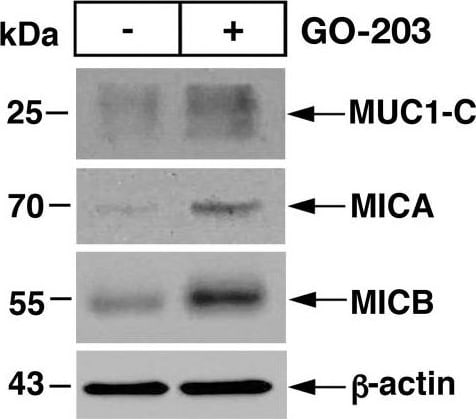
Western Blot: MICB Antibody - BSA Free [NBP2-56506] -
Pharmacologic inhibition of MUC1-C with GO-203 induces MICA/B expression. (A and B) RKO (A) and COLO 201 (B) cells treated with 5 μM GO-203 for 3 days were analyzed for MICA and MICB mRNA levels by qRT-PCR (left). The results (mean+/-SD of four determinations) are expressed as relative mRNA levels compared with that obtained for vehicle-treated cells (assigned a value of 1) (left). Lysates were immunoblotted with antibodies against the indicated proteins (right). (C) RKO cells expressing a tet-MUC1-C(AQA) vector and treated with vehicle or DOX for 7 days were analyzed for MUC1-C(AQA), MICA and MICB mRNA levels by qRT-PCR (left). The results (mean+/-SD of four determinations) are expressed as relative mRNA levels compared with that obtained for vehicle-treated cells (assigned a value of 1). (D and E) RKO (D) and COLO 201 (E) cells treated with 5 μM GO-203 for 3 days were analyzed for cell surface MICA (left) and MICB (right) expression by flow cytometry. (F) RKO cells treated with 5 μM GO-203 and/or 5 μM DEC for 5 days were analyzed for cell surface MICA and MICB expression by flow cytometry. The red profile depicts reactivity with the isotype control antibody. (G) RKO cells grown as tumorspheres (left) and treated with 5 μM GO-203 for 3 days were analyzed for cell surface MICA and MICB expression by flow cytometry (right). MICA, MHC class I chain-related polypeptide A; MICB, MHC class I chain-related polypeptide B. Image collected and cropped by CiteAb from the following open publication (https://pubmed.ncbi.nlm.nih.gov/36754452), licensed under a CC-BY license. Not internally tested by Novus Biologicals.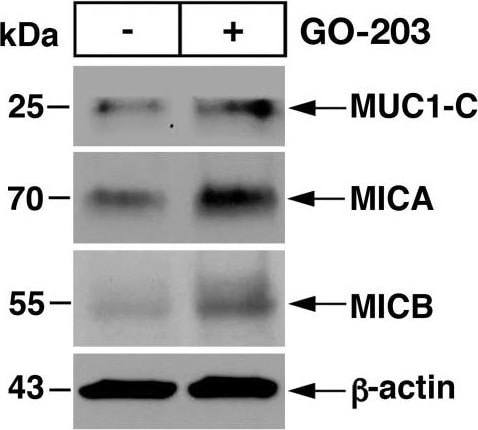
Western Blot: MICB Antibody - BSA Free [NBP2-56506] -
Pharmacologic inhibition of MUC1-C with GO-203 induces MICA/B expression. (A and B) RKO (A) and COLO 201 (B) cells treated with 5 μM GO-203 for 3 days were analyzed for MICA and MICB mRNA levels by qRT-PCR (left). The results (mean+/-SD of four determinations) are expressed as relative mRNA levels compared with that obtained for vehicle-treated cells (assigned a value of 1) (left). Lysates were immunoblotted with antibodies against the indicated proteins (right). (C) RKO cells expressing a tet-MUC1-C(AQA) vector and treated with vehicle or DOX for 7 days were analyzed for MUC1-C(AQA), MICA and MICB mRNA levels by qRT-PCR (left). The results (mean+/-SD of four determinations) are expressed as relative mRNA levels compared with that obtained for vehicle-treated cells (assigned a value of 1). (D and E) RKO (D) and COLO 201 (E) cells treated with 5 μM GO-203 for 3 days were analyzed for cell surface MICA (left) and MICB (right) expression by flow cytometry. (F) RKO cells treated with 5 μM GO-203 and/or 5 μM DEC for 5 days were analyzed for cell surface MICA and MICB expression by flow cytometry. The red profile depicts reactivity with the isotype control antibody. (G) RKO cells grown as tumorspheres (left) and treated with 5 μM GO-203 for 3 days were analyzed for cell surface MICA and MICB expression by flow cytometry (right). MICA, MHC class I chain-related polypeptide A; MICB, MHC class I chain-related polypeptide B. Image collected and cropped by CiteAb from the following open publication (https://pubmed.ncbi.nlm.nih.gov/36754452), licensed under a CC-BY license. Not internally tested by Novus Biologicals.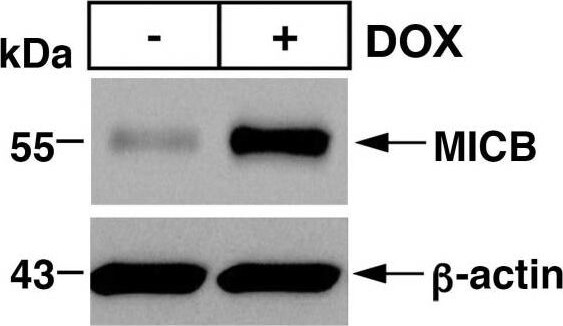
Western Blot: MICB Antibody - BSA Free [NBP2-56506] -
MUC1-C suppresses MICB expression. (A and B) RKO/tet-MUC1shRNA (A) and COLO 201/tet-MUC1shRNA (B) cells treated with vehicle or DOX for 7 days were analyzed for MICB mRNA levels by qRT-PCR (left). The results (mean+/-SD of four determinations) are expressed as relative mRNA levels compared with that obtained for vehicle-treated cells (assigned a value of 1) (left). Lysates were immunoblotted with antibodies against the indicated proteins (right). (C and D) RKO/tet-MUC1shRNA (C) and COLO 201/tet-MUC1shRNA (D) cells treated with vehicle or DOX for 7 days were analyzed for cell surface MICB expression by flow cytometry (left). Geometric MFI values for each histogram are indicated in the table (right). (E.) BT-549/tet-MUC1shRNA cells treated with vehicle or DOX for 7 days were analyzed for MICB mRNA levels by qRT-PCR (left). The results (mean+/-SD of four determinations) are expressed as relative mRNA levels compared with that obtained for vehicle-treated cells (assigned a value of 1) (left). Lysates were immunoblotted with antibodies against the indicated proteins (right). (F–H) BT-549/tet-MUC1shRNA (F), H1975/tet-MUC1shRNA (G) and DU145/tet-MUC1shRNA (H) cells treated with vehicle or DOX for 7 days were analyzed for cell surface MICB expression by flow cytometry. MICB, MHC class I chain-related polypeptide B. Image collected and cropped by CiteAb from the following open publication (https://pubmed.ncbi.nlm.nih.gov/36754452), licensed under a CC-BY license. Not internally tested by Novus Biologicals.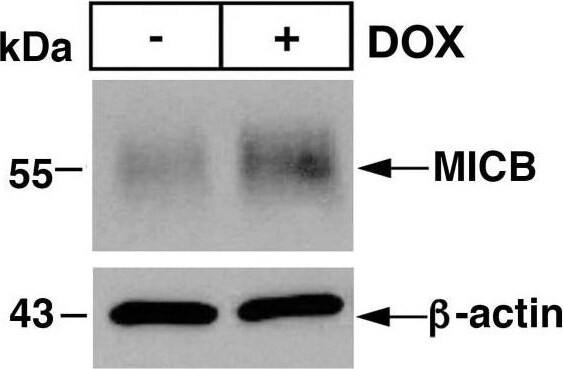
Western Blot: MICB Antibody - BSA Free [NBP2-56506] -
MUC1-C suppresses MICB expression. (A and B) RKO/tet-MUC1shRNA (A) and COLO 201/tet-MUC1shRNA (B) cells treated with vehicle or DOX for 7 days were analyzed for MICB mRNA levels by qRT-PCR (left). The results (mean+/-SD of four determinations) are expressed as relative mRNA levels compared with that obtained for vehicle-treated cells (assigned a value of 1) (left). Lysates were immunoblotted with antibodies against the indicated proteins (right). (C and D) RKO/tet-MUC1shRNA (C) and COLO 201/tet-MUC1shRNA (D) cells treated with vehicle or DOX for 7 days were analyzed for cell surface MICB expression by flow cytometry (left). Geometric MFI values for each histogram are indicated in the table (right). (E.) BT-549/tet-MUC1shRNA cells treated with vehicle or DOX for 7 days were analyzed for MICB mRNA levels by qRT-PCR (left). The results (mean+/-SD of four determinations) are expressed as relative mRNA levels compared with that obtained for vehicle-treated cells (assigned a value of 1) (left). Lysates were immunoblotted with antibodies against the indicated proteins (right). (F–H) BT-549/tet-MUC1shRNA (F), H1975/tet-MUC1shRNA (G) and DU145/tet-MUC1shRNA (H) cells treated with vehicle or DOX for 7 days were analyzed for cell surface MICB expression by flow cytometry. MICB, MHC class I chain-related polypeptide B. Image collected and cropped by CiteAb from the following open publication (https://pubmed.ncbi.nlm.nih.gov/36754452), licensed under a CC-BY license. Not internally tested by Novus Biologicals.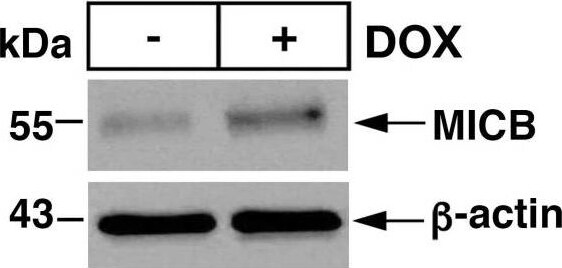
Western Blot: MICB Antibody - BSA Free [NBP2-56506] -
MUC1-C suppresses MICB expression. (A and B) RKO/tet-MUC1shRNA (A) and COLO 201/tet-MUC1shRNA (B) cells treated with vehicle or DOX for 7 days were analyzed for MICB mRNA levels by qRT-PCR (left). The results (mean+/-SD of four determinations) are expressed as relative mRNA levels compared with that obtained for vehicle-treated cells (assigned a value of 1) (left). Lysates were immunoblotted with antibodies against the indicated proteins (right). (C and D) RKO/tet-MUC1shRNA (C) and COLO 201/tet-MUC1shRNA (D) cells treated with vehicle or DOX for 7 days were analyzed for cell surface MICB expression by flow cytometry (left). Geometric MFI values for each histogram are indicated in the table (right). (E.) BT-549/tet-MUC1shRNA cells treated with vehicle or DOX for 7 days were analyzed for MICB mRNA levels by qRT-PCR (left). The results (mean+/-SD of four determinations) are expressed as relative mRNA levels compared with that obtained for vehicle-treated cells (assigned a value of 1) (left). Lysates were immunoblotted with antibodies against the indicated proteins (right). (F–H) BT-549/tet-MUC1shRNA (F), H1975/tet-MUC1shRNA (G) and DU145/tet-MUC1shRNA (H) cells treated with vehicle or DOX for 7 days were analyzed for cell surface MICB expression by flow cytometry. MICB, MHC class I chain-related polypeptide B. Image collected and cropped by CiteAb from the following open publication (https://pubmed.ncbi.nlm.nih.gov/36754452), licensed under a CC-BY license. Not internally tested by Novus Biologicals.Applications for MICB Antibody - BSA Free
Immunocytochemistry/ Immunofluorescence
Formulation, Preparation, and Storage
Purification
Formulation
Format
Preservative
Concentration
Shipping
Stability & Storage
Background: MICB
Long Name
Alternate Names
Gene Symbol
Additional MICB Products
Product Documents for MICB Antibody - BSA Free
Certificate of Analysis
To download a Certificate of Analysis, please enter a lot or batch number in the search box below.
Product Specific Notices for MICB Antibody - BSA Free
This product is for research use only and is not approved for use in humans or in clinical diagnosis. Primary Antibodies are guaranteed for 1 year from date of receipt.
Related Research Areas
Citations for MICB Antibody - BSA Free
 Powered by Bioz
Customer Reviews for MICB Antibody - BSA Free
There are currently no reviews for this product. Be the first to review MICB Antibody - BSA Free and earn rewards!
Have you used MICB Antibody - BSA Free?
Submit a review and receive an Amazon gift card!
$25/€18/£15/$25CAN/¥2500 for a review with an image
$10/€7/£6/$10CAN/¥1110 for a review without an image
Submit a review
Protocols
Find general support by application which include: protocols, troubleshooting, illustrated assays, videos and webinars.
- Appropriate Fixation of IHC/ICC Samples
- Cellular Response to Hypoxia Protocols
- ClariTSA™ Fluorophore Kits
- Detection & Visualization of Antibody Binding
- ICC Cell Smear Protocol for Suspension Cells
- ICC Immunocytochemistry Protocol Videos
- ICC for Adherent Cells
- Immunocytochemistry (ICC) Protocol
- Immunocytochemistry Troubleshooting
- Immunofluorescence of Organoids Embedded in Cultrex Basement Membrane Extract
- Immunohistochemistry (IHC) and Immunocytochemistry (ICC) Protocols
- Preparing Samples for IHC/ICC Experiments
- Preventing Non-Specific Staining (Non-Specific Binding)
- Primary Antibody Selection & Optimization
- Protocol for VisUCyte™ HRP Polymer Detection Reagent
- Protocol for the Fluorescent ICC Staining of Cell Smears - Graphic
- Protocol for the Fluorescent ICC Staining of Cultured Cells on Coverslips - Graphic
- Protocol for the Preparation and Fluorescent ICC Staining of Cells on Coverslips
- Protocol for the Preparation and Fluorescent ICC Staining of Non-adherent Cells
- Protocol for the Preparation and Fluorescent ICC Staining of Stem Cells on Coverslips
- Protocol for the Preparation of a Cell Smear for Non-adherent Cell ICC - Graphic
- TUNEL and Active Caspase-3 Detection by IHC/ICC Protocol
- The Importance of IHC/ICC Controls
- View all Protocols, Troubleshooting, Illustrated assays and Webinars