
The low affinity receptor for IgE, Fc epsilon RII (designated CD23) is a member of subgroup II of the C-type (Ca2+-dependent) lectin superfamily (1-4). Mouse CD23 is a
45-49 kDa type II transmembrane glycoprotein that binds mouse, but not human, IgE (1-4). The longest isoform is 331 amino acids (aa) in length and contains a 23 aa cytoplasmic domain, a 26 aa transmembrane segment, and a 282 aa extracellular domain (ECD). The ECD C-type lectin domain binds both protein and carbohydrate, with separate sites for binding IgE, CD21, and beta 2 and alpha v integrins (2). Coiled-coil topology within a connecting stalk contributes to oligomerization, which increases IgE affinity (1, 2). Mouse CD23 shares 88% aa sequence identity with rat CD23 and up to 57% aa identity with isoforms of human, equine, porcine and bovine CD23. Isoforms which vary in the cytoplasmic sequence include the “a” isoform, which begins with the sequence MEENEYS and is constitutively expressed by B cells, and the “b” isoform, which begins with MDTHHT and is induced by IL-4 on a variety of inflammatory cells, B cells and epithelia (2, 5-7). The isoforms differentially participate in IgE-mediated endocytosis and phagocytosis (2, 8-10). CD23b and two 309 aa mouse CD23b isoforms, lacking either exon 5 or 6, also display distinct endocytic properties on intestinal epithelia (6, 11). Several soluble forms of CD23 are mainly generated by metalloprotease (especially ADAM10) and cysteine protease activity, although potentially soluble mouse isoforms have also been sequenced (12-14). Both soluble and membrane-bound forms of CD23 include the lectin domain and show bioactivity. CD23 binding to monocyte integrins results in oxidative product generation and proinflammatory cytokine release (15). On human, but not mouse, B cells, sCD23 induces IgE secretion by binding CD21 (2, 9). In both, secreted IgE will bind B cell membrane CD23, rendering it unavailable for cleavage, and thus shutting down IgE production (2).
Mouse CD23/Fc epsilon RII APC‑conjugated Antibody
R&D Systems | Catalog # FAB6900A

Key Product Details
Species Reactivity
Applications
Label
Antibody Source
Product Specifications
Immunogen
Glu50-Pro331
Accession # P20693
Specificity
Clonality
Host
Isotype
Scientific Data Images for Mouse CD23/Fc epsilon RII APC‑conjugated Antibody
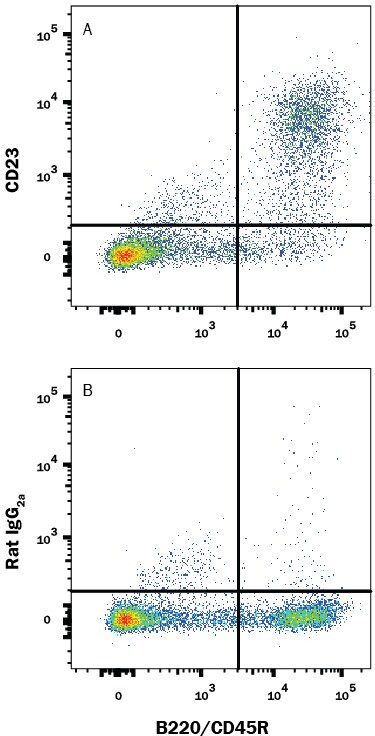
Detection of CD23/Fc epsilon RII in Mouse Splenocytes by Flow Cytometry.
Mouse splenocytes were stained with Rat Anti-Mouse B220/CD45R PE-conjugated Monoclonal Antibody (Catalog # FAB1217P) and either (A) Rat Anti-Mouse CD23/Fce RII APC-conjugated Monoclonal Antibody (Catalog # FAB6900A) or (B) Rat IgG2AAllophycocyanin Isotype Control (Catalog # IC006A). View our protocol for Staining Membrane-associated Proteins.Applications for Mouse CD23/Fc epsilon RII APC‑conjugated Antibody
Flow Cytometry
Sample: Mouse splenocytes
Spectra Viewer
Plan Your Experiments
Use our spectra viewer to interactively plan your experiments, assessing multiplexing options. View the excitation and emission spectra for our fluorescent dye range and other commonly used dyes.
Spectra Viewer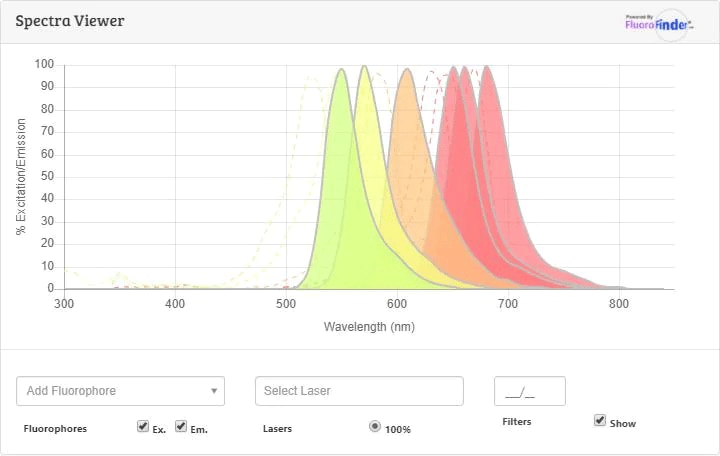
Flow Cytometry Panel Builder
Bio-Techne Knows Flow Cytometry
Save time and reduce costly mistakes by quickly finding compatible reagents using the Panel Builder Tool.
Advanced Features
- Spectra Viewer - Custom analysis of spectra from multiple fluorochromes
- Spillover Popups - Visualize the spectra of individual fluorochromes
- Antigen Density Selector - Match fluorochrome brightness with antigen density

Formulation, Preparation, and Storage
Purification
Formulation
Shipping
Stability & Storage
Background: CD23/Fc epsilon RII
References
- Kijimoto-Ochiai, S. (2002) Cell. Mol. Life Sci. 59:648.
- Gould, H. and B.J. Sutton (2008) Nat. Rev. Immunol. 8:205.
- Bettler, B. et al. (1989) Proc. Natl. Acad. Sci. USA 86:7566.
- Gollnick, S.O. et al. (1990) J. Immunol. 144:1974.
- Kondo, H. et al. (1994) Int. Arch. Allergy Immunol. 105:38.
- Yu, L.C.H. et al. (2003) Am. J. Physiol. Gastrointest. Liver Physiol. 285:G223.
- Sukumar, S. et al. (2006) J. Immunol. 176:4811.
- Karagiannis, S.N. et al. (2001) Immunology 103:319.
- Aubry, J-P. et al. (1992) Nature 358:505.
- Sarfati, M. and G. Delespeese (1988) J. Immunol. 141:2195.
- Montagnac, G. et al. (2005) Traffic 6:230.
- Weskamp, G. et al. (2006) Nat. Immunol. 7:1293.
- Schulz, O. et al. (1997) Eur. J. Immunol. 27:584.
- Entrez Accession # EDL21949, EDL21951.
- Lecoanet-Henchoz, S. et al. (1995) Immunity 3:119.
Long Name
Alternate Names
Gene Symbol
UniProt
Additional CD23/Fc epsilon RII Products
Product Documents for Mouse CD23/Fc epsilon RII APC‑conjugated Antibody
Certificate of Analysis
To download a Certificate of Analysis, please enter a lot or batch number in the search box below.
Note: Certificate of Analysis not available for kit components.
Product Specific Notices for Mouse CD23/Fc epsilon RII APC‑conjugated Antibody
For research use only
Related Research Areas
Customer Reviews for Mouse CD23/Fc epsilon RII APC‑conjugated Antibody
There are currently no reviews for this product. Be the first to review Mouse CD23/Fc epsilon RII APC‑conjugated Antibody and earn rewards!
Have you used Mouse CD23/Fc epsilon RII APC‑conjugated Antibody?
Submit a review and receive an Amazon gift card!
$25/€18/£15/$25CAN/¥2500 Yen for a review with an image
$10/€7/£6/$10CAN/¥1110 Yen for a review without an image
Submit a review
Protocols
Find general support by application which include: protocols, troubleshooting, illustrated assays, videos and webinars.
- 7-Amino Actinomycin D (7-AAD) Cell Viability Flow Cytometry Protocol
- Extracellular Membrane Flow Cytometry Protocol
- Flow Cytometry Protocol for Cell Surface Markers
- Flow Cytometry Protocol for Staining Membrane Associated Proteins
- Flow Cytometry Staining Protocols
- Flow Cytometry Troubleshooting Guide
- Intracellular Flow Cytometry Protocol Using Alcohol (Methanol)
- Intracellular Flow Cytometry Protocol Using Detergents
- Intracellular Nuclear Staining Flow Cytometry Protocol Using Detergents
- Intracellular Staining Flow Cytometry Protocol Using Alcohol Permeabilization
- Intracellular Staining Flow Cytometry Protocol Using Detergents to Permeabilize Cells
- Propidium Iodide Cell Viability Flow Cytometry Protocol
- Protocol for Liperfluo
- Protocol for the Characterization of Human Th22 Cells
- Protocol for the Characterization of Human Th9 Cells
- Protocol: Annexin V and PI Staining by Flow Cytometry
- Protocol: Annexin V and PI Staining for Apoptosis by Flow Cytometry
- Troubleshooting Guide: Fluorokine Flow Cytometry Kits
- View all Protocols, Troubleshooting, Illustrated assays and Webinars