

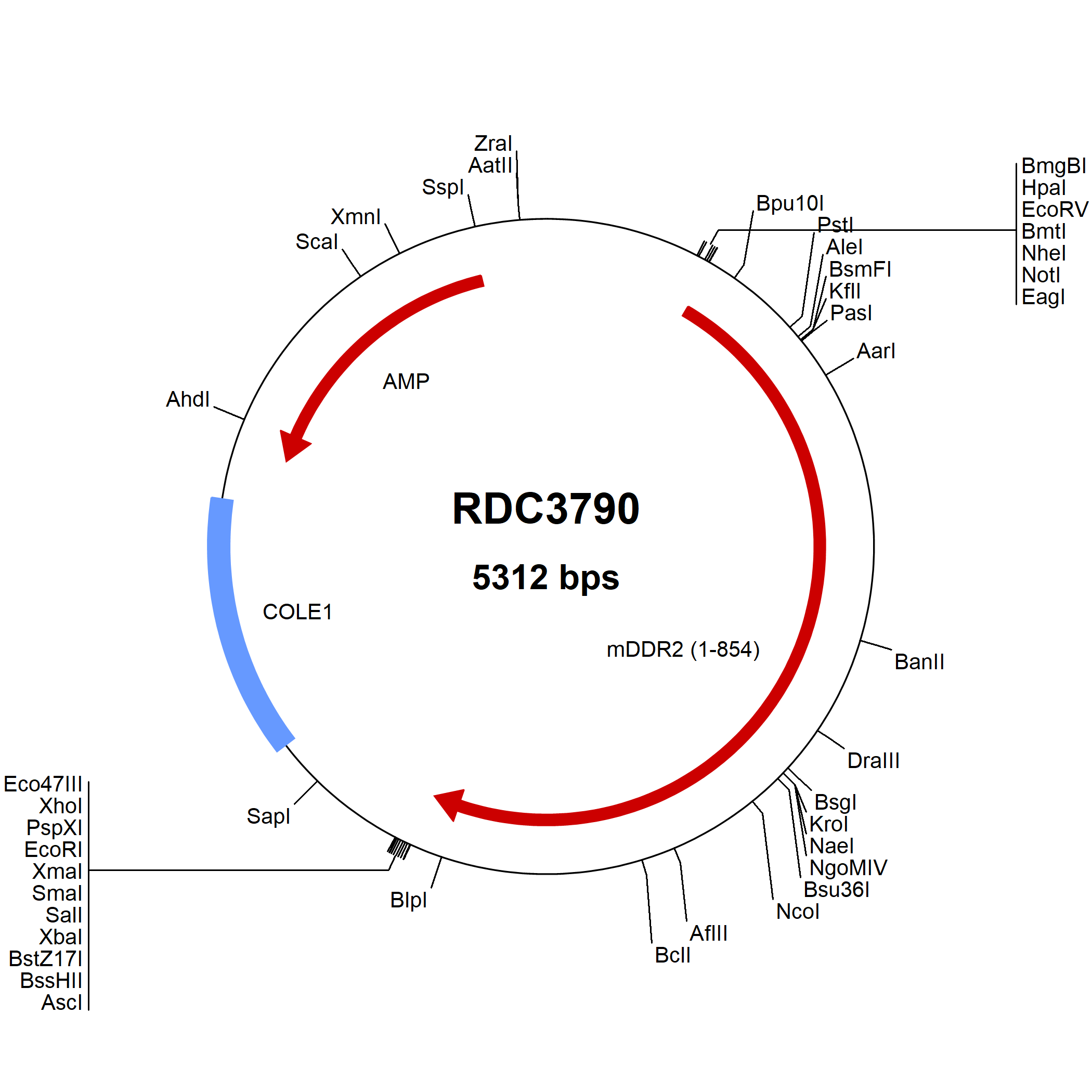
DDR2, also known as TYR010 and TKT, is a widely expressed 130 kDa type I transmembrane glycoprotein belonging to the discoidin-like domain containing subfamily of receptor tyrosine kinases. Mature human DDR2 consists of a 378 amino acid (aa) extracellular domain (ECD) that includes the discoidin like domain, a 22 aa transmembrane segment, and a 434 aa cytoplasmic domain that includes the kinase domain. Within the ECD, human DDR2 shares 53% aa sequence identity with DDR1 and 97% aa sequence identity with mouse DDR2. The discoidin-like domain mediates DDR2 interactions with collagens I, III, and X. Collagens II and V are less efficacious ligands.
DDR2 selectively recognizes the triple helical structure of collagen compared to monomeric or denatured collagen. Within collagen II, the D2 period is required for DDR2 binding, and the D1 period is additionally required to trigger DDR2 auto-phosphorylation. The ECD of DDR2 exists as a noncovalent dimer in solution, and dimerization of the receptor greatly enhances collagen binding. DDR2 interaction with collagen I inhibits collagen fibrillogenesis and alters collagen fiber morphology. Ligand binding induces DDR2 auto-phosphorylation in the cytoplasmic domain, which promotes associations with Shc and Src. In addition to the above mechanism, DDR2 exhibits a distinct interaction with collagen X. A region other than the discoidin-like domain of DDR2 recognizes the non-helical NC1 domain of collagen X, and this interaction does not lead to receptor auto-phosphorylation. Activation of DDR2 by collagen induces upregulation of MMP1, 2, and 13 as well as DDR2 itself. DDR2 is implicated in collagenous matrix destruction and cell invasiveness. DDR2 is also upregulated in several pathological conditions, including hepatic fibrosis following injury, rheumatoid and osteoarthritis, and smooth muscle cell hyperplasia.

