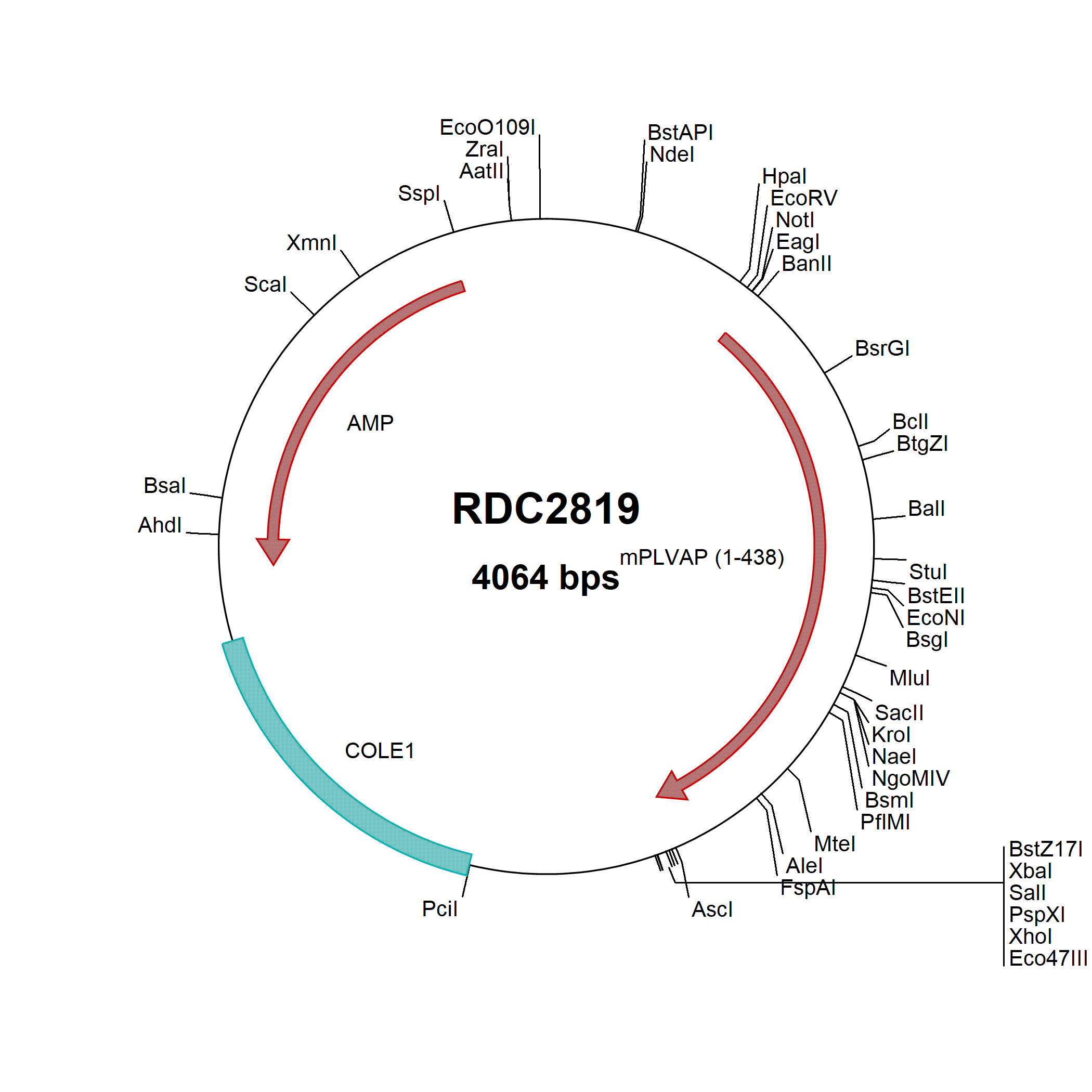
Mouse PLVAP (NP_115774) VersaClone cDNA

R&D Systems | Catalog # RDC2819

R&D Systems
Loading...

Key Product Details

Species

Mouse

Accession Number

Loading...

Formulation, Preparation, and Storage

Shipping

The product is shipped at ambient temperature. Upon receipt, store it immediately at the temperature recommended below.

Storage

Store the unopened product at -20 to -70 °C. Use a manual defrost freezer and avoid repeated freeze-thaw cycles. Do not use past expiration date.

Background: PLVAP

PLVAP (Plasmalemma vesicle associated protein) is a membrane associated protein of caveolae and is found in fenestral and stomatal diaphragms in fenestrated endothelia and transendothelial channels. Normally in skeletal and cardiac muscle, PLVAP expression is limited to small arterioles and venules; however, under conditions of inflammation, it can be induced on previously non expressing vessels in cardiac muscle. In the central nervous system (CNS), the panendothelial cell antigen expression is developmentally regulated. During embryonic development, the antigen is found on brain vasculature up to day 16 of gestation, after which it disappears. The cessation of PLVAP expression in the CNS may be associated with the establishment of the blood brain barrier, which begins on day 16 of gestation. In the adult mouse, inflammation in the CNS can lead to re expression of the panendothelial cell antigen. This antibody was raised by a genetic immunization technique. Genetic immunization can be used to generate antibodies by directly delivering antigen-coding DNA into the animal, rather than injecting a protein or peptide (Tang et al. PubMed: 1545867; Chambers and Johnston PubMed: 12910245; Barry and Johnston PubMed: 9234514). The animal`s cells produce the protein, which stimulates the animal`s immune system to produce antibodies against that particular protein. A vector coding for a partial fusion protein was used for genetic immunisation of a mouse and the resulting serum was tested in Western blot against an E.coli lysate containing that partial fusion protein. Genetic immunization offers enormous advantages over the traditional protein-based immunization method. DNA is faster, cheaper and easier to produce and can be produced by standard techniques readily amenable to automation. Furthermore, the antibodies generated by genetic immunization are usually of superior quality with regard to specificity, affinity and recognizing the native protein.

Long Name

Plasmalemma Vesicle Associated Protein

Alternate Names

FELS, gp68, PV-1, PV1

Entrez Gene IDs

83483 (Human); 84094 (Mouse); 56765 (Rat)

Gene Symbol

PLVAP

UniProt

Additional PLVAP Products

Product Documents for Mouse PLVAP (NP_115774) VersaClone cDNA

Certificate of Analysis

To download a Certificate of Analysis, please enter a lot or batch number in the search box below.

Note: Certificate of Analysis not available for kit components.

Product Specific Notices for Mouse PLVAP (NP_115774) VersaClone cDNA

For research use only

Customer Reviews for Mouse PLVAP (NP_115774) VersaClone cDNA

There are currently no reviews for this product. Be the first to review Mouse PLVAP (NP_115774) VersaClone cDNA and earn rewards!

Have you used Mouse PLVAP (NP_115774) VersaClone cDNA?

Submit a review and receive an Amazon gift card!

$25/€18/£15/$25CAN/¥2500 Yen for a review with an image

$10/€7/£6/$10CAN/¥1110 Yen for a review without an image

Submit a review

Amazon Gift Card

FAQs

No product specific FAQs exist for this product.

View all FAQs for cDNA Clones