
QuikChIP Kit (ChIP)
Novus Biologicals | Catalog # NBP2-29902

Loading...
Key Product Details
Species
Human, Mouse, Bacteria
Applications
Chromatin Immunoprecipitation, Immunoprecipitation
Kit Type
Kit (ChIP)
Product Summary for QuikChIP Kit (ChIP)
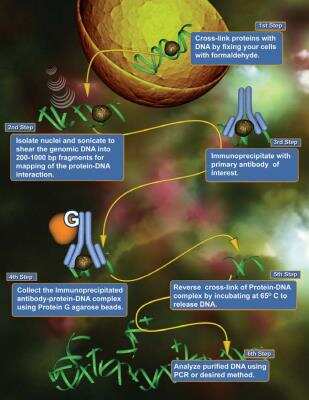
The QuikChIP(TM) Kit contains components for 25 ChIP assays optimized for use with transcriptionally active chromatin in adherent or suspension mammalian cells. The protocol is optimized for use with one 10 cm plate containing 5 x 10^6 cells per preparation. Each ChIP assay requires approximately 1 x 10^6 cells. Thus, a 10 cm plate (one preparation) of cells will provide DNA sufficient for five ChIP assays.
Features:
Quick and simple.
Optimized ready-to-use buffers and protocol are included.
Can be used for both histone and non-histone proteins.
Reagents for 25 ChIP assays and sheared DNA preparations.
Features:
Loading...
Product Specifications
Applications
Immunoprecipitation (reported in scientific literature (PMID 21957289))
Reactivity Notes
Mouse reactivity reported in scientific literature (PMID: 23709694). Bacteria reactivity reported in scientific literature (PMID: 24363348). Human reactivity reported in scientific literature (PMID: 21086175).
Scientific Data Images for QuikChIP Kit (ChIP)
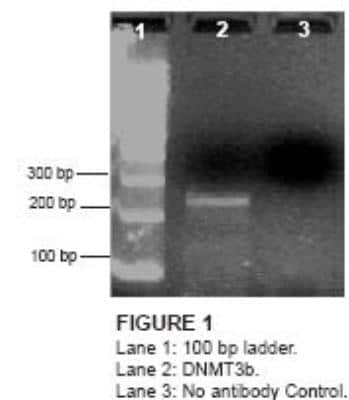
Chromatin Immunoprecipitation: Quick ChIP Kit [NBP2-29902] - Human MCF-7 cells were fixed for 10 minutes with 1% formaldehyde. The cells were lysed and the chromatin sonicated (200-1000 bp fragments). Chromatin was immunoprecipitated using DNMT3b mAb, (Lane 2) and a no antibody control (Lane 3). The PCR amplification was performed with primers specific to the progesterone receptor (PR) promoter region as follows: 94C 5 min, 94C 30 sec, 59C 30 sec 40 cycles, 72C 30 sec, 72C 10 min. Following PCR, 20 ul of each sample was analyzed on a 2% agarose gel and visualized by UV-illumination following ethidium bromide staining. PCR product was observed in the DNMT3b mAb ChIP (Lane 2) and not in the control (Lane 3).
Quick ChIP Kit [NBP2-29902]
Kit Contents for QuikChIP Kit (ChIP)
- 0.5M EDTA (250 uL)
- 100X PIC (2 x 0.75 mL)
- 100X PMSF (2 x 0.75 mL)
- 10X Glycine (25 mL)
- 10X PBS (55 mL)
- 1M NaHCO3 (1.25 mL)
- 1M Tris-HCl pH 6.5 (500 uL)
- 20% SDS (625 uL)
- 5M NaCl (500 uL)
- ChIP Dilution Buffer (50 mL)
- Proteinase K at 10 mg/mL (60 uL)
- RNase A at 10 mg/mL (60 uL)
- Salmon Sperm DNA/Protein A/G Agarose (2 x 1.75 mL)
- SDS Lysis Buffer (25 mL)
- Wash Buffer A (25 mL)
- Wash Buffer B (25 mL)
- Wash Buffer C (25 mL)
- Wash Buffer D (25 mL)
Formulation, Preparation, and Storage
Concentration
Concentration is not relevant for this product. Please see the protocols for proper use of this product.
Shipping
The product is shipped with polar packs. Upon receipt, store it immediately at the temperature recommended below.
Storage
Storage of components varies. See protocol for specific instructions.
Background: QuikChIP
Additional QuikChIP Products
Product Documents for QuikChIP Kit (ChIP)
Certificate of Analysis
To download a Certificate of Analysis, please enter a lot or batch number in the search box below.
Product Specific Notices for QuikChIP Kit (ChIP)
This product is for research use only and is not approved for use in humans or in clinical diagnosis. Kits are guaranteed for 6 months from date of receipt.
Citations for QuikChIP Kit (ChIP)
 Powered by Bioz
Customer Reviews for QuikChIP Kit (ChIP)
There are currently no reviews for this product. Be the first to review QuikChIP Kit (ChIP) and earn rewards!
Have you used QuikChIP Kit (ChIP)?
Submit a review and receive an Amazon gift card!
$25/€18/£15/$25CAN/¥2500 for a review with an image
$10/€7/£6/$10CAN/¥1110 for a review without an image
Submit a review
Protocols
View specific protocols for QuikChIP Kit (ChIP) (NBP2-29902):
TRITON X-100
Hazard Information
Chemical Name: TRITON X-100
Chemical Formula: (C2-H4-O)nC14-H22-O CAS Number: 9002-93-1
EEC-No: n/a
First Aid Measures
Eye Contact: Can causes eye irritation.
Skin Contact: Causes skin irritation and is toxic if absorbed through skin. Inhalation: May be
harmful if inhaled. Causes respiratory tract irritation. Ingestion: Harmful if swallowed.
Accidental Release Measures
If inhaled, move person into fresh air. If not breathing give artificial respiration and consult a
physician.
In case of skin contact, wash off with soap and plenty of water.
In case of eye contact, rinse thoroughly with plenty of water for at least 15 minutes.
If swallowed do NOT induce vomiting. Rinse mouth with water and consult a physician.
Handling and Storage
Handling: Avoid contact with skin and eyes. Keep container tightly closed and store and handle in a
cool, dry, well-ventilated place.
Exposure Controls / Personal Protection Ventilation: Handle in a well-ventilated area Gloves:
Handle with rubber or latex gloves
Eye Protection: Safety glasses, goggles or face shield to protect from splash hazard
Physical and Chemical Properties
Form: Liquid
Color: Colorless
Odor: Odorless
Melting Point: 6 degrees C (42.8 degrees F)
Boiling Temperature: 270 degrees C (518 degrees F) Density: No data available
Vapor Pressure: No data available Solubility in Water: Very soluble Flash Point: No data available
Explosion limits: No data available
Ignition Temperature: No data available
Stability and Reactivity
Stable under recommended storage conditions.
Disposal/Spill Considerations
Small Spill: Dilute with water and mop up, or absorb with an inert dry material and place in an
appropriate waste disposal container. Finish cleaning by spreading water on the contaminated
surface and dispose of according to local and regional authority requirements.
Large Spill:Absorb with an inert material and put the spilled material in an appropriate waste
disposal. Finish cleaning by spreading water on the contaminated surface and allow to evacuate
through the sanitary system.
Sodium Dodecyl Sulphate
Hazard Information
Chemical Name: Sodium Dodecyl Sulphate Chemical Formula: NaC12H25O4S
CAS Number: 151-21-3
EEC-No: 205-788-1
First Aid Measures
Eye Contact: Can causes eye irritation.
Skin Contact: Causes skin irritation and is toxic if absorbed through skin. Inhalation: May be
harmful if inhaled. Causes respiratory tract irritation. Ingestion: Harmful if swallowed.
Accidental Release Measures
If inhaled, move person into fresh air. If not breathing give artificial respiration and consult a
physician.
In case of skin contact, wash off with soap and plenty of water.
In case of eye contact, rinse thoroughly with plenty of water for at least 15 minutes.
If swallowed do NOT induce vomiting. Rinse mouth with water and consult a physician.
Handling and Storage
Handling: Avoid contact with skin and eyes. Avoid formation of dust and aerosols. Handle powder in
a fume hood. Keep container tightly closed in a cool, dry, well-ventilated place.
Exposure Controls / Personal Protection Ventilation: Handle powder in a fume hood Gloves: Handle
with rubber or latex gloves
Eye Protection: Safety glasses, goggles or face shield
Physical and Chemical Properties
Form: Solid Color: White Odor: Odorless
Melting Point: No data available Boiling Temperature: No data available Density: No data available
Vapor Pressure: No data available Solubility in Water: Very soluble Flash Point: No data available
Explosion limits: No data available
Ignition Temperature: No data available
Stability and Reactivity
Stable under recommended storage conditions.
Disposal Considerations
Contain spill collect with a vacuum cleaner or by wet-brushing and place in a container for
disposal according to local regulations. Keep in suitable, closed containers for disposal.
EDTA
Hazard Information
Chemical Name: Ethylenediaminetetraacetic Acid Tetrasodium Salt, Dihydrate Chemical Formula: C10H12N2Na4O8.2H2O
CAS Number: 10378-23-1
First Aid Measures
Eye Contact: Can cause slight eye irritation. Skin Contact: Can cause slight skin irritation.
Inhalation: Can cause slight respiratory tract irritation.
Ingestion: Harmful if swallowed.
Accidental Release Measures
If inhaled, move person into fresh air. If not breathing give artificial respiration and consult a
physician.
In case of skin contact, wash off with soap and plenty of water.
In case of eye contact, rinse thoroughly with plenty of water for at least 15 minutes.
If swallowed do NOT induce vomiting. Rinse mouth with water and consult a physician.
Handling and Storage
Handling: Avoid contact with skin and eyes. Keep container tightly closed in a cool, dry, well-
ventilated place.
Exposure Controls / Personal Protection Ventilation: Handle in a well-ventilated area Gloves:
Handle with rubber or latex gloves
Eye Protection: Safety glasses, goggles or face shield
Physical and Chemical Properties
Form: Solid Color: White
Odor: No data available
Melting Point: No data available Boiling Temperature: No data available Density: No data available
Vapor Pressure: No data available Solubility in Water: soluble
Flash Point: > 93.3 degrees C (200 degrees F) Explosion limits: No data available Ignition Temperature: No data
available
Stability and Reactivity
Stable under recommended storage conditions.
Disposal Considerations
Small Spill: Use appropriate tools to put the spilled solid in a convenient waste disposal container. Finish cleaning by spreading water on the contaminated surface and dispose of according to local and regional authority requirements.
Large Spill: Use a shovel to put the material into a convenient waste disposal container. Finish cleaning by spreading water on the contaminated surface and allow to evacuate through the sanitary system.
Glycine (Glycerine)
Hazard Information
Chemical Name: Glycine (Glycerine) Chemical Formula: C2H5NO2
CAS Number: 56-40-6
First Aid Measures
Eye Contact: Can cause slight eye irritation. Skin Contact: Can cause slight skin irritation.
Inhalation: Can cause slight respiratory tract irritation. Ingestion: Harmful if swallowed.
Accidental Release Measures
If inhaled, move person into fresh air. If not breathing give artificial respiration and consult a
physician.
In case of skin contact, wash off with soap and plenty of water.
In case of eye contact, rinse thoroughly with plenty of water for at least 15 minutes.
If swallowed do NOT induce vomiting. Rinse mouth with water and consult a physician.
Handling and Storage
Handling: Avoid contact with skin and eyes. Keep container tightly closed in a cool, dry, well-
ventilated place.
Exposure Controls / Personal Protection Ventilation: Handle in a well-ventilated area Gloves:
Handle with rubber or latex gloves
Eye Protection: Safety glasses, goggles or face shield to prevent splash hazard
Physical and Chemical Properties
Form: Liquid Color: Colorless Odor: Odorless
Melting Point: Decomposition temperature: Starts to decompose at 233 degrees C (451.4 degrees F); Completely
sintered at 280 deg. C.
Boiling Temperature: No data available Density: No data available
Vapor Pressure: No data available Solubility in Water: soluble
Flash Point: >176.67 degrees C (350 degrees F)
Explosion limits: No data available Ignition Temperature: No data available
Stability and Reactivity
Stable under recommended storage conditions.
Disposal Considerations
Small Spill: Use appropriate tools to put the spill in a convenient waste disposal container.
Finish cleaning by spreading water on the contaminated surface and dispose of according to local
and regional authority requirements.
Large Spill: Use a shovel to put the material into a convenient waste disposal container. Finish cleaning by spreading water on the contaminated surface and allow to evacuate through the sanitary system.
PMSF
Hazard Information
Chemical Name: Phenylmethylsulfonyl fluoride Chemical Formula: C7H7FO2S
CAS Number: 329-98-6
First Aid Measures
Eye Contact: Can cause slight eye irritation. Skin Contact: Can cause slight skin irritation.
Inhalation: Can cause slight respiratory tract irritation. Ingestion: Harmful if swallowed.
Accidental Release Measures
If inhaled, move person into fresh air. If not breathing give artificial respiration and consult a
physician.
In case of skin contact, wash off with soap and plenty of water.
In case of eye contact, rinse thoroughly with plenty of water for at least 15 minutes.
If swallowed do NOT induce vomiting. Rinse mouth with water and consult a physician.
Handling and Storage
Handling: Avoid contact with skin and eyes. Keep container tightly closed in a cool, dry, well-
ventilated place.
Exposure Controls / Personal Protection Ventilation: Handle in a well-ventilated area Gloves:
Handle with rubber or latex gloves
Eye Protection: Safety glasses, goggles or face shield
Physical and Chemical Properties
Form: Solid
Color: No data available Odor: No data available Melting Point: 92 degrees C (197.6 degrees F)
Boiling Temperature: No data available Density: No data available
Vapor Pressure: No data available Solubility in Water: soluble
Flash Point: No data available Explosion limits: No data available Ignition Temperature: No data
available
Stability and Reactivity
Stable under recommended storage conditions.
Disposal Considerations
Small Spill: Use appropriate tools to put the spilled solid in a convenient waste disposal
container.
Large Spill: Corrosive solid. Stop leak if without risk. Do not get water inside container. Do not
touch spilled material. Use water spray to reduce vapors. Prevent entry into sewers, basements or
confined areas; dike if needed. Eliminate all ignition sources. Call for assistance on disposal.
Protease Inhibitor Cocktail
Hazard Information
Chemical Name: 4-(2-Aminoethyl) benzenesulfonylfluoride hydrochloride Chemical Formula: C8H10FNO2S
HCl
CAS Number: 30827-99-7
First Aid Measures
Eye Contact: Can cause slight eye irritation. Skin Contact: Can cause slight skin irritation.
Inhalation: Can cause slight respiratory tract irritation. Ingestion: Harmful if swallowed.
Accidental Release Measures
If inhaled, move person into fresh air. If not breathing give artificial respiration and consult a
physician.
In case of skin contact, wash off with soap and plenty of water.
In case of eye contact, rinse thoroughly with plenty of water for at least 15 minutes.
If swallowed do NOT induce vomiting. Rinse mouth with water and consult a physician.
Handling and Storage
Handling: Avoid contact with skin and eyes. Keep container tightly closed in a cool, dry, well-
ventilated place.
Exposure Controls / Personal Protection Ventilation: Handle in a well-ventilated area Gloves:
Handle with rubber or latex gloves
Eye Protection: Safety glasses, goggles or face shield
Physical and Chemical Properties
Form: Solid Color: beige
Odor: No data available Melting Point: 183 degrees C (361 degrees F)
Boiling Temperature: No data available Density: No data available
Vapor Pressure: No data available Solubility in Water: soluble
Flash Point: No data available Explosion limits: No data available Ignition Temperature: No data
available
Stability and Reactivity
Stable under recommended storage conditions.
Disposal Considerations
Small Spill: Use appropriate tools to put the spilled solid in a convenient waste disposal container.
Large Spill: Corrosive solid. Stop leak if without risk. Do not get water inside container. Do not
touch spilled material. Use water spray to reduce vapors. Prevent entry into sewers, basements or
confined areas; dike if needed. Eliminate all ignition sources. Call for assistance on disposal.
Salmon sperm DNA
Hazard Information
Chemical Name: Salmon sperm DNA Chemical Formula: n/a
CAS Number: 100403-24-5
EEC-No: 309-566-6
First Aid Measures
Eye Contact: May cause eye irritation. Skin Contact: May cause skin irritation. Inhalation: May be
harmful if inhaled. Ingestion: May be harmful if swallowed.
Accidental Release Measures
If inhaled, move person into fresh air. If not breathing give artificial respiration and consult a
physician.
In case of skin contact, wash off with soap and plenty of water.
In case of eye contact, rinse thoroughly with plenty of water for at least 15 minutes.
If swallowed do NOT induce vomiting. Rinse mouth with water and consult a physician.
Handling and Storage
Handling: Avoid contact with skin and eyes. Avoid formation of dust and aerosols. Handle powder in
a well-ventilated area. Keep container tightly closed in a cool, dry, well-ventilated place.
Exposure Controls / Personal Protection Ventilation: Handle powder in a well-ventilated area
Gloves: Handle with rubber or latex gloves
Eye Protection: Safety glasses, goggles or face shield
Physical and Chemical Properties
Form: Solid Color: White
Odor: No data available
Melting Point: No data available Boiling Temperature: No data available Density: No data available
Vapor Pressure: No data available Solubility in Water: soluble
Flash Point: No data available Explosion limits: No data available Ignition Temperature: No data
available
Stability and Reactivity
Stable under recommended storage conditions.
Disposal Considerations
Absorb on sand or vermiculite and place in closed containers for disposal. Dispose contaminated
material as waste according to all federal, state and local environmental regulations.. Ventilate
area and wash spill site after material clean-up is complete.
Proteinase K
Hazard Information
Chemical Name: Proteinase K, from Tritirachium album CAS Number: 39450-01-6
First Aid Measures
Eye Contact: Can cause slight eye irritation. Skin Contact: Can cause slight skin irritation.
Inhalation: Can cause slight respiratory tract irritation.
Ingestion: Harmful if swallowed.
Accidental Release Measures
If inhaled, move person into fresh air. If not breathing give artificial respiration and consult a
physician.
In case of skin contact, wash off with soap and plenty of water.
In case of eye contact, rinse thoroughly with plenty of water for at least 15 minutes.
If swallowed do NOT induce vomiting. Rinse mouth with water and consult a physician.
Handling and Storage
Handling: Avoid contact with skin and eyes. Keep container tightly closed in a cool, dry, well-ventilated place.
Exposure Controls / Personal Protection Ventilation: Handle in a well-ventilated area Gloves:
Handle with rubber or latex gloves
Eye Protection: Safety glasses, goggles or face shield to prevent splash hazard
Physical and Chemical Properties
Form: Solid
Color: No data available Odor: No data available
Melting Point: No data available Boiling Temperature: No data available Density: No data available
Vapor Pressure: No data available Solubility in Water: soluble
Flash Point: No data available Explosion limits: No data available Ignition Temperature: No data
available
Stability and Reactivity
Stable under recommended storage conditions.
Disposal Considerations
Small Spill: Use appropriate tools to put the spill in a convenient waste disposal container.
Finish cleaning by spreading water on the contaminated surface and dispose of according to local and
regional authority requirements.
Large Spill: Use a shovel to put the material into a convenient waste disposal container. Finish
cleaning by spreading water on the contaminated surface and allow to evacuate through the sanitary
system.
Find general support by application which include: protocols, troubleshooting, illustrated assays, videos and webinars.
FAQs
No product specific FAQs exist for this product.
View all FAQs for Supplemental Kits and ReagentsLoading...