
Recombinant A. Muciniphila M60 domain-containing peptidase
R&D Systems | Catalog # 11479-M6

Loading...
Key Product Details
- R&D Systems E. coli-derived Recombinant A. Muciniphila M60 domain-containing peptidase (11479-M6)
- Quality control testing to verify active proteins with lot specific assays by in-house scientists
- All R&D Systems proteins are covered with a 100% guarantee
Source
E. coli
Accession Number
Applications
Enzyme Activity
Loading...
Product Specifications
Source
E. coli-derived akkermansia muciniphila M60 domain-containing protein
Ala21-Glu506 with an N-terminal Met and C-terminal 6-His tag
Ala21-Glu506 with an N-terminal Met and C-terminal 6-His tag
Purity
>90%, by SDS-PAGE visualized with Silver Staining and quantitative densitometry by Coomassie® Blue Staining.
Endotoxin Level
<1.0 EU per 1 μg of the protein by the LAL method.
N-terminal Sequence Analysis
Met & Ala21
Predicted Molecular Mass
56 kDa
SDS-PAGE
52-57 kDa, under reducing conditions
Activity
Measured by its ability to digest MUC16.
>90% of MUC16 is digested by rAm M60 peptidase, as measured under the described conditions.
Scientific Data Images for Recombinant A. Muciniphila M60 domain-containing peptidase
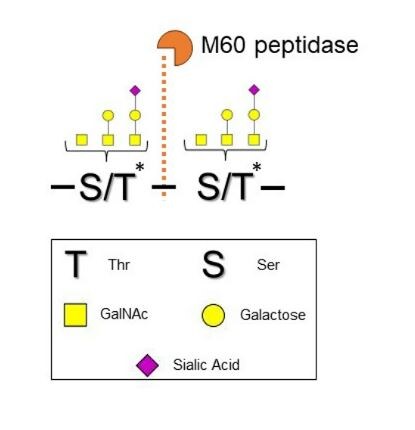
Recombinant A. Muciniphila M60 domain-containing peptidase His-tag Protein Enzyme Activity Diagram.
Recombinant A. Muciniphila M60 domain-containing peptidase His-tag Protein (Cat # 11479-M6) cleaves glycoproteins N-terminally to glycosylated Ser/Thr residues that are near but not next to the cleavage residue. Specificity requires two adjacent truncated O-glycans and M60 peptidase cleaves between the two residues. * represents the residue for which M60 peptidase has recognition. Sialyated glycan substrates in diagram are less preferred.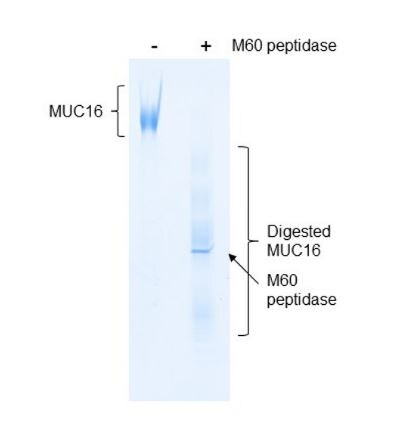
Recombinant A. Muciniophila M60 domain-containing peptidase His-tag Protein Enzyme Activity Assay.
Recombinant A. Muciniphila M60 domain-containing peptidase His-tag Protein (Cat # 11479-M6) is measured by its ability to digest Recombinant Human CA125/MUC16 Protein, CF (5609-MU) and detected via SDS-PAGE gel.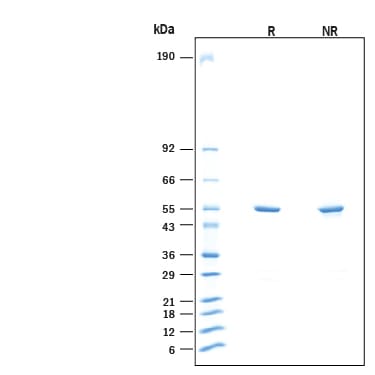
Recombinant A. Muciniphila M60 domain-containing peptidase His-tag Protein SDS-PAGE.
2 μg/lane of Recombinant A. Muciniphila M60 domain-containing peptidase His-tag Protein (Catalog # 11479-M6) was resolved with SDS-PAGE under reducing (R) and non-reducing (NR) conditions and visualized by Coomassie® Blue staining, showing bands at 52-57 kDa, under reducing conditions.Formulation, Preparation, and Storage
11479-M6
| Formulation | Supplied as a 0.2 μm filtered solution in Tris and NaCl. |
| Shipping | The product is shipped with polar packs. Upon receipt, store it immediately at the temperature recommended below. |
| Stability & Storage | Use a manual defrost freezer and avoid repeated freeze-thaw cycles.
|
Background: muciniphila M60 domain-containing
References
- Rawlings, N.D. et al. (2014) Nucl. Acids Res. 42: D503.
- Shon, D.J. et. al. (2022) J. Biol. Chem. 298: 101917.
- Taleb, V. et. al. (2022) Nat. Commun. 13: 4324.
- Shon, D.J. et. al. (2020) Proc. Natl. Acad USA 117: 21299.
- Kudelka, M.R. et. al. (2015) Adv. Cancer Res. 126:53.
- Yamada, T. et al. (2019) EbioMedicine 48: 513.
- Hansson, G.C. et. al. (2020) Annu. Rev. Biochem. 89: 769.
- Pruss, K.M. et. al. (2021) ISME J. 15: 577.
- Molaaghaee-Rouzbahani, S. et. al. (2023) Sci. Rep. 13:3237.
- Labourel, A. et. al. (2023) Essays Biochem. 67:331.
Long Name
Akkermansia muciniphila Peptidase M60 domain-containing protein
Alternate Names
Akkermansia muciniphila ATCC BAA-835 Peptidase M60, Amuc_0627, conserved hypothetical protein [Akkermansia mucini, M60 family metallopeptidase [Akkermansia muciniphi
UniProt
Additional muciniphila M60 domain-containing Products
Product Documents for Recombinant A. Muciniphila M60 domain-containing peptidase
Certificate of Analysis
To download a Certificate of Analysis, please enter a lot or batch number in the search box below.
Note: Certificate of Analysis not available for kit components.
Product Specific Notices for Recombinant A. Muciniphila M60 domain-containing peptidase
For research use only
Customer Reviews for Recombinant A. Muciniphila M60 domain-containing peptidase
There are currently no reviews for this product. Be the first to review Recombinant A. Muciniphila M60 domain-containing peptidase and earn rewards!
Have you used Recombinant A. Muciniphila M60 domain-containing peptidase?
Submit a review and receive an Amazon gift card!
$25/€18/£15/$25CAN/¥2500 Yen for a review with an image
$10/€7/£6/$10CAN/¥1110 Yen for a review without an image
Submit a review
Protocols
View specific protocols for Recombinant A. Muciniphila M60 domain-containing peptidase (11479-M6):
Materials
- Assay Buffer: 50 mM MES, pH 6.5
- Recombinant A. Muciniphila M60 domain-containing peptidase His-tag (rAm M60 peptidase) (Catalog # 11479-M6)
- Substrate: Recombinant Human CA125/MUC16 Protein (rhMUC16) (Catalog # 5609-MU)
- 4-20% SDS-PAGE Gel Gel loading dye
- Gel Imager/Densitometer
- Dilute rAm M60 peptidase to 25 µg/mL with Assay Buffer.
- Dilute rhMUC16 to 100 µg/mL with Assay Buffer.
- Combine 10 µL of rAm M60 peptidase and 10 µL of rhMUC16 in a tube.
- Create a negative control by adding 10 µL of rhMUC16 and 10 µL of Assay Buffer.
- Incubate reactions and controls at 37 °C for 24 hours.
- Add gel loading dye to all tubes.
- Load the total reaction volume on a 4-20% SDS-PAGE gel and run down 80% of the gel, minimally.
- Stain the gel and acquire image.
- Use densitometry to calculate the percent digestion of rhMUC16 by rAm M60 peptidase.
Per Reaction:
- rAm M60 peptidase: 0.25 μg
- rhMUC16: 1 μg
Loading...