
Recombinant Cynomolgus Fibroblast Activation Protein alpha
R&D Systems | Catalog # 10278-SE

Key Product Details
- Recombinant Cynomolgus FAP Protein supports tumor stroma-targeted therapeutic development.
- R&D Systems CHO-derived Recombinant Cynomolgus Fibroblast Activation Protein alpha (10278-SE)
- Quality control testing to verify active proteins with lot specific assays by in-house scientists
- All R&D Systems proteins are covered with a 100% guarantee
Source
Accession Number
Applications
Product Specifications
Source
Leu26-Asp760
Purity
Endotoxin Level
N-terminal Sequence Analysis
Predicted Molecular Mass
SDS-PAGE
Activity
The specific activity is >2500 pmol/min/μg, as measured under the described conditions.
Scientific Data Images for Recombinant Cynomolgus Fibroblast Activation Protein alpha
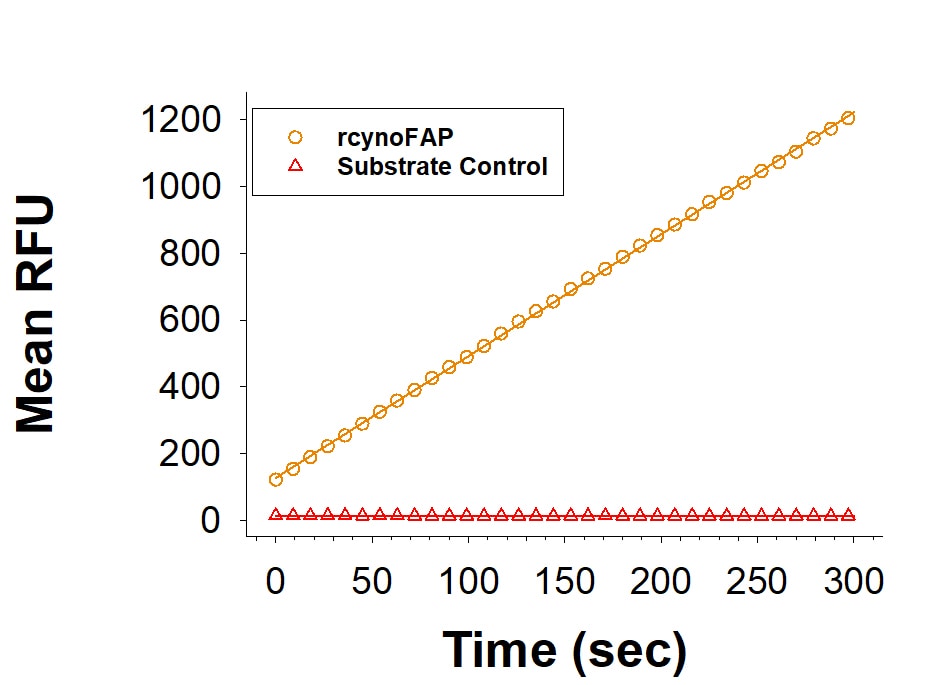
Recombinant Cynomolgus Fibroblast Activation Protein alpha Enzyme Activity
Recombinant Cynomolgus Fibroblast Activation Protein (Catalog # 10278-SE) is measured by its ability to convert the substrate benzyloxycarbonyl-Gly-Pro-7-amido-4-methylcoumarin (Z-GP-AMC) to Z-Gly-Pro and 7-amino-4-methlycoumarin (AMC).Formulation, Preparation, and Storage
10278-SE
| Formulation | Supplied as a 0.2 μm filtered solution in Tris, NaCl and Glycerol. |
| Shipping | The product is shipped with polar packs. Upon receipt, store it immediately at the temperature recommended below. |
| Stability & Storage | Use a manual defrost freezer and avoid repeated freeze-thaw cycles.
|
Background: Fibroblast Activation Protein alpha/FAP
References
- Zi, F. et al. (2015) Mol. Med. Rep. 11:3203.
- Pineiro-Sanchez, M.L. et al. (1997) J. Biol. Chem. 272:7595.
- Lay, A.J. et. al. (2019) Front. Biosci. 24:1.
- Park, J.E. et al. (1999) J. Biol. Chem. 274:36505.
- Aertgeerts, K. et al. (2005) J. Biol. Chem. 280:19441.
- Keane, F.M. et al. (2011) FEBS J. 278:1316.
- Rettig, W.J. et al. (1988) Proc. Natl. Acad. Sci. USA 85:3110.
- Bauer, S. et al. (2006) Arthritis Res. 8:R171.
- Jiang, G.M. et al. (2016) Oncotarget 7:33472.
- Cheng, J.D. et al. (2002) Cancer Res. 62:4767.
- Kraman, M. et al. (2010) Science 330:827.
- Busek, P. et al. (2018) Front. Biosci. 23:1933.
Alternate Names
Gene Symbol
UniProt
Additional Fibroblast Activation Protein alpha/FAP Products
- All Products for Fibroblast Activation Protein alpha/FAP
- Fibroblast Activation Protein alpha/FAP cDNA Clones
- Fibroblast Activation Protein alpha/FAP ELISA Kits
- Fibroblast Activation Protein alpha/FAP Lysates
- Fibroblast Activation Protein alpha/FAP Primary Antibodies
- Fibroblast Activation Protein alpha/FAP Proteins and Enzymes
- Fibroblast Activation Protein alpha/FAP Simple Plex
Product Documents for Recombinant Cynomolgus Fibroblast Activation Protein alpha
Certificate of Analysis
To download a Certificate of Analysis, please enter a lot or batch number in the search box below.
Note: Certificate of Analysis not available for kit components.
Product Specific Notices for Recombinant Cynomolgus Fibroblast Activation Protein alpha
For research use only
Related Research Areas
Customer Reviews for Recombinant Cynomolgus Fibroblast Activation Protein alpha
There are currently no reviews for this product. Be the first to review Recombinant Cynomolgus Fibroblast Activation Protein alpha and earn rewards!
Have you used Recombinant Cynomolgus Fibroblast Activation Protein alpha?
Submit a review and receive an Amazon gift card!
$25/€18/£15/$25CAN/¥2500 for a review with an image
$10/€7/£6/$10CAN/¥1110 for a review without an image
Submit a review
Protocols
View specific protocols for Recombinant Cynomolgus Fibroblast Activation Protein alpha (10278-SE):
- Assay Buffer: 50 mM Tris, 1 M NaCl, 1 mg/mL BSA, pH 7.5
- Recombinant Cynomolgus Monkey Fibroblast Activation Protein alpha /FAP (cynoFAP) (Catalog # 10278-SE)
- Substrate: Z-Gly-Pro-AMC (Bachem, Catalog # I-1145), 10 mM stock in DMSO
- F16 Black Maxisorp Plate (Nunc, Catalog # 475515)
- Fluorescent Plate Reader (Model: SpectraMax Gemini EM by Molecular Devices) or equivalent
- Dilute rcynoFAP to 0.2 µg/mL in Assay Buffer.
- Dilute Substrate to 100 µM in Assay Buffer.
- Load in plate 50 µL of 0.2 µg/mL rcynoFAP, and start the reaction by adding 50 µL of 100 µM Substrate. Include a Substrate Blank containing 50 µL Assay Buffer and 50 µL of 100 µM Substrate.
- Read at excitation and emission wavelengths of 380 nm and 460 nm (top read), respectively, in kinetic mode of 5 minutes.
- Calculate specific activity:
Specific Activity (pmol/min/µg) = | Adjusted Vmax* (RFU/min) x Conversion Factor** (pmol/RFU) |
| amount of enzyme (µg) |
*Adjusted for Substrate Blank
**Derived using calibration 7-amino, 4-Methyl Coumarin (Sigma, Catalog # A9891).
- rcynoFAP: 0.01 µg
- Substrate: 50 µM
FAQs for Recombinant Cynomolgus Fibroblast Activation Protein alpha
-
Q: Does this enzyme have a tag?
A: No, this enzyme does not have a tag. Please refer to the Source section on the product-specific page or product datasheet for sequence information.