
Recombinant F. tularensis Cpf1 Protein, CF
R&D Systems | Catalog # 10343-C1

Loading...
Key Product Details
- R&D Systems E. coli-derived Recombinant F. tularensis Cpf1 Protein (10343-C1)
- Quality control testing to verify active proteins with lot specific assays by in-house scientists
- All R&D Systems proteins are covered with a 100% guarantee
Source
E. coli
Accession Number
Applications
Enzyme Activity
Loading...
Product Specifications
Source
E. coli-derived f. tularensis Cpf1 protein
| APKKKRKVGIHGVPAA | F. tularensis Cpf1 (Ser2-Asn1300) Accession # WP_003034647.1 |
KRPAATKKAGQAKKKKGG | HHHHHH |
| N-terminus | C-terminus | ||
Purity
>90%, by SDS-PAGE visualized with Silver Staining and quantitative densitometry by Coomassie® Blue Staining.
Endotoxin Level
<0.10 EU per 1 μg of the protein by the LAL method.
N-terminal Sequence Analysis
Ala
Predicted Molecular Mass
156 kDa
SDS-PAGE
110-135 kDa, under reducing conditions
Activity
Measured by its ability to cleave a targeted DNA substrate.
rF. tularensis Cpf1 achieves >80% substrate cleavage, as measured under the described conditions.
rF. tularensis Cpf1 achieves >80% substrate cleavage, as measured under the described conditions.
Scientific Data Images for Recombinant F. tularensis Cpf1 Protein, CF
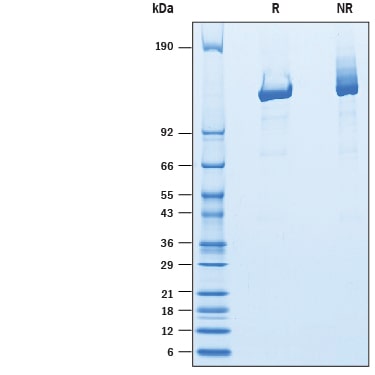
Recombinant F. tularensis Cpf1 Protein SDS-PAGE
2 μg/lane of Recombinant HumanF. tularensisCpt1 Protein (Catalog # 10343-C1) was resolved with SDS-PAGE under reducing (R) and non-reducing (NR) conditions and visualized by Coomassie® Blue staining, showing bands at 110-135 kDa.Formulation, Preparation, and Storage
10343-C1
| Formulation | Supplied as a 0.2 μm filtered solution in Tris, NaCl, EDTA, Glycerol and TCEP. |
| Shipping | The product is shipped with polar packs. Upon receipt, store it immediately at the temperature recommended below. |
| Stability & Storage | Use a manual defrost freezer and avoid repeated freeze-thaw cycles.
|
Background: Cpf1
References
- Jinek, M. et al. (2012) Science 337:816.
- Zetsche, B. et al. (2015) Cell 163:759.
- Sandler J.D. and Joung J.K. (2014) Nat Biotechnol. 32:347.
- Koonin E.V. et al. (2017) Curr. Opin. Micrbiol. 37:67.
- Bayat H. et al. (2018) Curr. Micribiol. 75:107.
- Fonfara, I. et al. (2016) Nature 532:517.
- Moreno-Mateo, M.A. et al. (2017) Nat. Commun 8:2024.
- Joung K.J. et al. (2016) Nat. Biotechnol. 34:869.
- Kim, H et al. (2017) Nat. Commun. 8:14406.
- Kim, Y. et al. (2016) Nat. Biotechnol. 34:808.
- Port, F. and Bullock, S.L. (2016) Nat Methods 13:852.
- Cong, L. et al. (2013) Science 339:819.
Long Name
CRISPR-associated Endonuclease Cas12a
Alternate Names
Cas12a
UniProt
Additional Cpf1 Products
Product Documents for Recombinant F. tularensis Cpf1 Protein, CF
Certificate of Analysis
To download a Certificate of Analysis, please enter a lot or batch number in the search box below.
Note: Certificate of Analysis not available for kit components.
Product Specific Notices for Recombinant F. tularensis Cpf1 Protein, CF
For research use only
Customer Reviews for Recombinant F. tularensis Cpf1 Protein, CF
There are currently no reviews for this product. Be the first to review Recombinant F. tularensis Cpf1 Protein, CF and earn rewards!
Have you used Recombinant F. tularensis Cpf1 Protein, CF?
Submit a review and receive an Amazon gift card!
$25/€18/£15/$25CAN/¥2500 for a review with an image
$10/€7/£6/$10CAN/¥1110 for a review without an image
Submit a review
Protocols
View specific protocols for Recombinant F. tularensis Cpf1 Protein, CF (10343-C1):
Materials
- Assay Buffer: 50 mM NaCl, 10 mM Tris-HCl, 10 mM MgCl2, 100 µg/ml BSA, pH 7.9
- Recombinant F. tularensis Cpf1 (rF.t.Cpf1) (Catalog # 10343-C1)
- DNA Substrate: PBR322 vector (NEB, Catalog # N3033S) digested with EcoRI-HF (NEB, Catalog # R3101S)*
- Integrated DNA Technologies (IDT) Alt-R Cpf1 crRNA, targeting sequence: TGCCGCCTCGGCGAGCACAT
- Ultrapure DNase/RNase-Free Distilled Water (Invitrogen, Catalog # 10977015), to prepare Assay Buffer
- DNA gel
- TAE Buffer, 25X Liquid Concentrate (VWR, Catalog # 97062-386)
- Ethidium Bromide, 10 mg/mL (Amresco, Catalog # X328)
*Digest was gel purified using gel purification kit and eluted in EB buffer (10 mM Tris-HCl, pH 8.5).
- Prepare RNP Complex:
a. 200 nM crRNA (2 µL addition from 3 µM stock prepared in Assay Buffer)
b. 0.35 µg rF.t.Cpf1
c. Add Assay Buffer for a final RNP Complex volume of 23 µL
d. Incubate for 5 minutes at 25 °C - Mix RNP Complex with 7 µL of 8.6 ng/µL of DNA Substrate (diluted in Assay Buffer, if possible).
- Incubate for 20 minutes at 37 °C.
- Incubate for 10 minutes at 65 °C to dissociate enzyme from DNA.
- Load total reaction with loading dye on a 1.25% agarose gel.
- Run gel at 140V for 40 minutes.
- Soak gel in 200 mL of 1X TAE Buffer with 150 µL of 10 mg/mL Ethidium Bromide for 1 hour.
- Use imaging software to detect and quantify hydrolysis of the DNA substrate.
- rF.t.Cpf1: 0.35 µg
- DNA Substrate: 60 ng
- crRNA: 200 nM
Loading...