
ZAP70 is a non-receptor protein tyrosine kinase (part of the Syk/ZAP70 family) that is involved in signaling by the T-cell antigen receptor (TCR). Ligation of the TCR/CD3 receptor in Jurkat T-cells induces phosphoprotein complexes that contain ZAP70 (1). TCR zeta chains are initially phosphorylated by p56Lck that lead to the recruitment of ZAP70 via its SH2 domain. ZAP70 in turn phosphorylates other proteins in the TCR-phosphoprotein complex. One of the natural substrates for ZAP70 is the zeta-chain dimer of the TCR/CD3 complex (2).
Recombinant Human Active ZAP70 Protein, CF
R&D Systems | Catalog # 3709-KS

Loading...
Key Product Details
- R&D Systems Sf 9 (baculovirus)-derived Recombinant Human Active ZAP70 Protein (3709-KS)
- Quality control testing to verify active proteins with lot specific assays by in-house scientists
- All R&D Systems proteins are covered with a 100% guarantee
Source
Sf 9 (baculovirus)
Accession Number
Applications
Bioactivity
Loading...
Product Specifications
Source
Spodoptera frugiperda, Sf 9 (baculovirus)-derived human ZAP70 protein
Purity
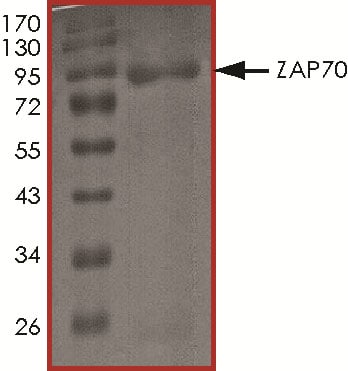
>90%, by SDS-PAGE under reducing conditions and visualized by Colloidal Coomassie® Blue stain at 5 μg per lane.
N-terminal Sequence Analysis
Using an N-terminal GST tag
SDS-PAGE
96 kDa
Activity
The specific activity of ZAP70 was determined to be 13 nmol/min/mg using a Poly (Glu:Tyr, 4:1) synthetic peptide substrate.
Scientific Data Images for Recombinant Human Active ZAP70 Protein, CF
Recombinant Human Active ZAP70 Protein SDS-PAGE.
The approximate molecular weight is 96 kDa and the purity is > 90%.Formulation, Preparation, and Storage
3709-KS
| Formulation | Supplied in 50 mM Tris-HCl, pH 7.5, 150 mM NaCl, 10 mM Glutathione, 0.1 mM EDTA, 0.25 mM DTT, 0.1 mM PMSF, 25% Glycerol. |
| Shipping | The product is shipped with dry ice or equivalent. Upon receipt, store it immediately at the temperature recommended below. |
| Stability & Storage | This product is stable at ≤ ‑70 °C for up to 1 year from the date of receipt. For optimal storage, aliquot into smaller quantities after centrifugation and store at recommended temperature. Avoid repeated freeze-thaw cycles. |
Background: ZAP70
References
- Duplay, P. et al. (1994) J. Exp. Med. 179:1163.
- Chan, A.C. et al. (1994) J. Immunol. 152:4758.
Long Name
Zeta-chain [TCR] Associated Protein Kinase 70 kDa
Alternate Names
mrtle, mur, SRK, STD, TZK
Gene Symbol
ZAP70
UniProt
Additional ZAP70 Products
Product Documents for Recombinant Human Active ZAP70 Protein, CF
Certificate of Analysis
To download a Certificate of Analysis, please enter a lot or batch number in the search box below.
Note: Certificate of Analysis not available for kit components.
Product Specific Notices for Recombinant Human Active ZAP70 Protein, CF
For research use only
Related Research Areas
Citations for Recombinant Human Active ZAP70 Protein, CF
 Powered by Bioz
Customer Reviews for Recombinant Human Active ZAP70 Protein, CF
There are currently no reviews for this product. Be the first to review Recombinant Human Active ZAP70 Protein, CF and earn rewards!
Have you used Recombinant Human Active ZAP70 Protein, CF?
Submit a review and receive an Amazon gift card!
$25/€18/£15/$25CAN/¥2500 for a review with an image
$10/€7/£6/$10CAN/¥1110 for a review without an image
Submit a review
Protocols
View specific protocols for Recombinant Human Active ZAP70 Protein, CF (3709-KS):
Materials
- Active Kinase - Active ZAP70 (0.1 μg/μL) diluted with Kinase Dilution Buffer X and assayed as outlined in sample activity plot. Note: These are suggested working dilutions and it is recommended that the researcher perform a serial dilution of Active ZAP70 for optimal results.
- Kinase Assay Buffer III (5X) - 200 mM Tris-HCl, pH 7.4, 100 mM MgCl2, and 0.5 mg/mL BSA. Add fresh DTT prior to use to a final concentration of 250 μM.
- Kinase Dilution Buffer X - 40 mM Tris-HCl, pH 7.4, 20 mM MgCl2, 2.5 mM MnCl2, and 0.1 mg/mL BSA. Add fresh DTT prior to use to a final concentration of 50 μM.
- ADP-Glo™ Kinase Assay Kit - 10 mM of ATP Solution, 10 mM of ADP Solution, ADP-Glo™ Reagent, and Kinase Detection Reagent.
- Substrate - Poly (4:1 Glu:Tyr) synthetic peptide substrate diluted in 25 mM Tris-HCl to a final concentration of 1 mg/mL.
- Cofactor: 2.5 M MnCl2 - Diluted in distilled water to a working concentration of 1 M.
- Thaw the Active ZAP70, Kinase Assay Buffer III (5X), and Substrate on ice. Prepare a 15 μL enzyme dilution with Kinase Dilution Buffer X at the desired concentration, in a pre-chilled 96-well plate.
- Prepare a Substrate/ATP mixture as follows (25 μM ATP example):
a. 10 mM ATP Solution: 1 μL
b. Kinase Assay Buffer III (5X): 78 μL
c. Substrate at 1 mg/mL: 80 μL
d. 1 M MnCl2: 1 μL - Transfer the following reaction components prepared in Steps 1 and 2 to a 384-well opaque plate, bringing the reaction volume up to 5 μL:
a. Diluted Active ZAP70: 3 μL
b. Substrate/ATP (mix as prepared in Step 2). This initiates the reaction: 2 μL - Set up the blank control as outlined in Step 2, excluding the addition of the kinase. Replace the kinase with an equal volume of Kinase Dilution Buffer X.
- Incubate at ambient temperature for 40 minutes.
- After the 40 minute incubation period, terminate the reaction and deplete the remaining ATP by adding 5 μL of ADP-Glo™ Reagent. Spin down and shake the 384-well plate. Then incubate the reaction mixture for another 40 minutes at ambient temperature.
- Then add 10 μL of the Kinase Detection Reagent to the 384-well plate and incubate the reaction mixture for another 30 minutes at ambient temperature.
- Read the 384-well reaction plate using the Luminescence Module Protocol on a GloMax®-Multi Microplate Multimode Reader.
- Determine the corrected activity (RLU) by removing the blank control value (see step 4) for each sample and calculate the kinase specific activity as outlined below.
Calculation of Specific Activity of ADP (RLU/pmol)
From ADP standard curve, determine RLU/pmol of ADP
Kinase Specific Activity (SA) (pmol/minutes/μg or nmol/minutes/mg)
Corrected RLU from reaction / [(SA of ADP in RLU/pmol) x (Reaction time in minutes) x (Enzyme amount in μg or mg)]
Loading...