
Activins and inhibins, members of the TGF-beta superfamily, are disulfide-linked dimeric proteins that were originally purified from gonadal fluids as proteins that stimulated or inhibited, respectively, pituitary follicle stimulating hormone (FSH) release. These proteins have since been shown to have a wide range of biological activities including: mesoderm induction, neural cell differentiation, bone remodeling, hematopoiesis and reproductive physiology. Activins/inhibins are produced as precursor proteins with an amino-terminal propeptide that is cleaved to release the carboxy-terminal bioactive ligands. Activins are homodimers or heterodimers of the various beta subunit isoforms, while inhibins are heterodimers of a unique alpha subunit and one of the various beta subunits. Five beta subunits (mammalian beta A, beta B, beta C, beta E and Xenopus beta D) have been cloned. The activin/inhibin nomenclature reflects the subunit composition of the proteins: activin A ( beta A - beta A), activin B ( beta B - beta B), activin AB ( beta A ‑ beta B), inhibin A ( alpha - beta A) and inhibin B ( alpha - beta B). At present, little is known about the contribution of the other beta subunits to activin or inhibin formation and biology. At the amino acid sequence level, the mature human beta B subunit is greater than 98% identical to mouse beta B, while the human and mouse alpha subunits share approximately 80% identity. Similarly to other TGF-beta family members, activins exert their biological activities through binding to the heterodimeric complex composed of two membrane spanning serine-threonine kinases designated as type I and type II. Two forms of activin receptor type I (Act RI-A and Act RI-B) and two forms of activin receptor type II (Act RII-A and Act RII-B) have been identified. Activin binds directly to Act RII, the complex then associates with Act RI and initiates signaling. Besides activins, Act RII has been shown to bind certain other TGF-beta superfamily members. Inhibin A has been shown to bind with low‑affinity to Act RII. The existence of a distinct inhibin-specific receptor and/or signal transduction pathway has been hypothesized.
Recombinant Human Activin B Protein, CF
R&D Systems | Catalog # 11517-AB

Loading...
Key Product Details
- Recombinant Human Activin B protein is a tgf-beta family protein that regulates cell differentiation, development, and tissue homeostasis
- Applications include cell culture for bioactivity and cell stimulation
- Quality control testing to verify active proteins with lot specific assays by in-house scientists
- All R&D Systems proteins are covered with a 100% guarantee
Source
CHO
Accession Number
Structure / Form
Disulfide-linked homodimer
Applications
Bioactivity
Loading...
Product Specifications
Source
Chinese Hamster Ovary cell line, CHO-derived human Activin B protein
Gly293-Ala407
Gly293-Ala407
Purity
>95%, by SDS-PAGE visualized with Silver Staining and quantitative densitometry by Coomassie® Blue Staining.
Endotoxin Level
<0.10 EU per 1 μg of the protein by the LAL method.
N-terminal Sequence Analysis
Gly293
Predicted Molecular Mass
13 kDa
SDS-PAGE
10-13 kDa, under reducing conditions.
Activity
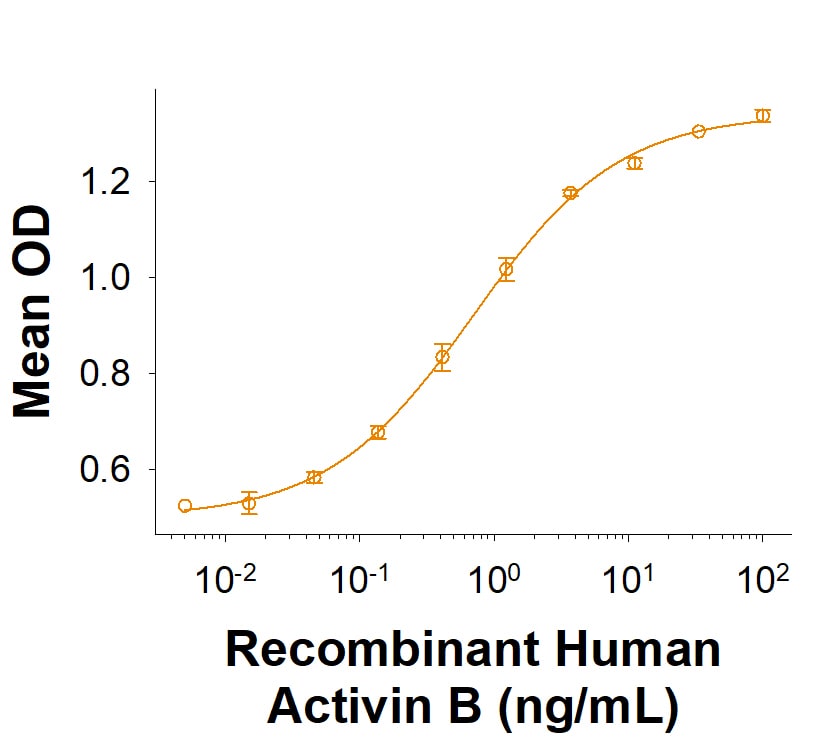
Measured by its ability to induce hemoglobin expression in K562 human chronic myelogenous leukemia cells. Schwall, R.H. et al. (1991) Method Enzymol. 198:340.
The ED50 for this effect is 0.200-4.00 ng/mL.
The ED50 for this effect is 0.200-4.00 ng/mL.
Scientific Data Images for Recombinant Human Activin B Protein, CF
Recombinant Human Activin B Protein Bioactivity.
Measured by its ability to induce hemoglobin expression in K562 human chronic myelogenous leukemia cells. The ED50 for this effect is 0.200‑4.00 ng/mL.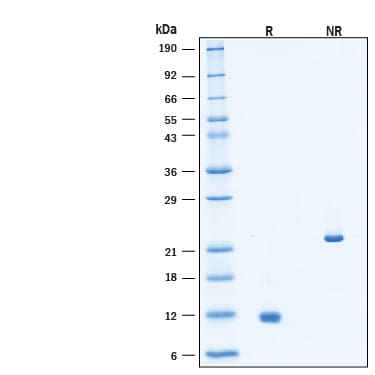
Recombinant Human Activin B Protein SDS-PAGE.
2 μg/lane of Recombinant Human Activin B Protein (Catalog # 11517-AB) was resolved with SDS-PAGE under reducing (R) and non-reducing (NR) conditions and visualized by Coomassie® Blue staining, showing bands at 10-13 kDa and 20-26 kDa, respectively.Formulation, Preparation, and Storage
11517-AB
| Formulation | Lyophilized from a 0.2 μm filtered solution in Acetonitrile and TFA with Trehalose. |
| Reconstitution | Reconstitute at 100 μg/mL in 4 mM HCl. |
| Shipping | The product is shipped at ambient temperature. Upon receipt, store it immediately at the temperature recommended below. |
| Stability & Storage | Use a manual defrost freezer and avoid repeated freeze-thaw cycles.
|
Calculators
Background: Activin B
References
- Woodruff, T.K. (1998) Biochemical Pharmacology 55:953.
- Ying, S.Y. et al. (1997) Proc. Soc. Exp. Biol. Med. 214:114.
Alternate Names
activin AB beta polypeptide, Activin beta-B chain, INHBB, inhibin beta B chain, inhibin, beta B, inhibin, beta B (activin AB beta polypeptide), Inhibin, beta-2
Gene Symbol
INHBB
UniProt
Additional Activin B Products
Product Documents for Recombinant Human Activin B Protein, CF
Certificate of Analysis
To download a Certificate of Analysis, please enter a lot or batch number in the search box below.
Note: Certificate of Analysis not available for kit components.
Product Specific Notices for Recombinant Human Activin B Protein, CF
For research use only
Related Research Areas
Citations for Recombinant Human Activin B Protein, CF
 Powered by Bioz
Customer Reviews for Recombinant Human Activin B Protein, CF
There are currently no reviews for this product. Be the first to review Recombinant Human Activin B Protein, CF and earn rewards!
Have you used Recombinant Human Activin B Protein, CF?
Submit a review and receive an Amazon gift card!
$25/€18/£15/$25CAN/¥2500 for a review with an image
$10/€7/£6/$10CAN/¥1110 for a review without an image
Submit a review
Loading...