
The human asialoglycoprotein receptor (ASGPR) is an endocytic recycling receptor that belongs to the long-form subfamily of the C-type/Ca+2-dependent lectin family (1, 2, 3). It is a complex of two noncovalently-linked subunits, a major 46 kDa glycoprotein (ASGR1) and a minor 50 kDa glycoprotein (ASGR2). The major human ASGPR subunit, ASGR1 (also H1), is synthesized as a 291 amino acid (aa) type II transmembrane (TM) glycoprotein. It contains a 40 aa cytoplasmic region, a 21 aa TM segment, and a 230 aa extracellular domain (ECD) (4 - 6). The cytoplasmic region contains one palmitoylation site at Cys36 that is essential for ligand endocytosis and dissociation (7). The ECD contains two important structural regions. The first is a stalk region of 62 aa (aa 61-123) that contributes to noncovalent oligomerization. The second is a 118 aa, carbohydrate-binding, Ca+2-dependent C-type lectin domain (aa 161-278) that is stabilized by three Ca+2 ions (3, 8). Human ASGR1 ECD is 79% aa identical to mouse ASGR1 ECD. There are two minor (ASGR2) subunits that interact with ASGR1/H1 in a mutually exclusive manner to generate a functional ASGPR (9). They represent alternate splice forms of a type II TM protein. Termed H2b and H2c, H2b differs from H2c only by the presence of a 19 aa insert in its cytoplasmic region. This insert is significant because it allows serine phosphorylation of the cytoplasmic tail and provides for the majority of ASGPR ligand internalization (9). The stoichiometry of a functional ASGPR is unclear, but is suggested to be either a 2:2, 3:1 or 3:2 ratio of ASGR1/H1:ASGR2/H2 (9, 10, 11). ASGPR is found on hepatocytes and a subset of T cells (6, 12). ASGPR is reported to bind Gal (nonreducing), GalNAc, and sialic acid alpha 2,6Gal and GalNAc (3, 13, 14, 15). This is generally within the context of triantennary or tetraantennary configurations (2). The sialic acid terminations are of particular interest because molecules with these motifs most likely represent the endogenous ligands for ASGPR (14).
Recombinant Human ASGR1/ASGPR1 Fc Chimera Protein, CF
R&D Systems | Catalog # 10255-AS

Loading...
Key Product Details
- R&D Systems HEK293-derived Recombinant Human ASGR1/ASGPR1 Fc Chimera Protein (10255-AS)
- Quality control testing to verify active proteins with lot specific assays by in-house scientists
- All R&D Systems proteins are covered with a 100% guarantee
Source
HEK293
Accession Number
Structure / Form
Disulfide-linked homodimer
Applications
Binding Activity
Loading...
Product Specifications
Source
Human embryonic kidney cell, HEK293-derived human ASGR1/ASGPR1 protein
| MD | Human IgG1 (Pro100-Lys330) |
IEGR | Human ASGR1 (Asn63-Leu291) Accession # P07306-1 |
| N-terminus | C-terminus | ||
Purity
>95%, by SDS-PAGE visualized with Silver Staining and quantitative densitometry by Coomassie® Blue Staining.
Endotoxin Level
<0.10 EU per 1 μg of the protein by the LAL method.
N-terminal Sequence Analysis
Met
Predicted Molecular Mass
53 kDa
SDS-PAGE
59-71 kDa, under reducing conditions
Activity
Measured by its binding ability in a functional ELISA.
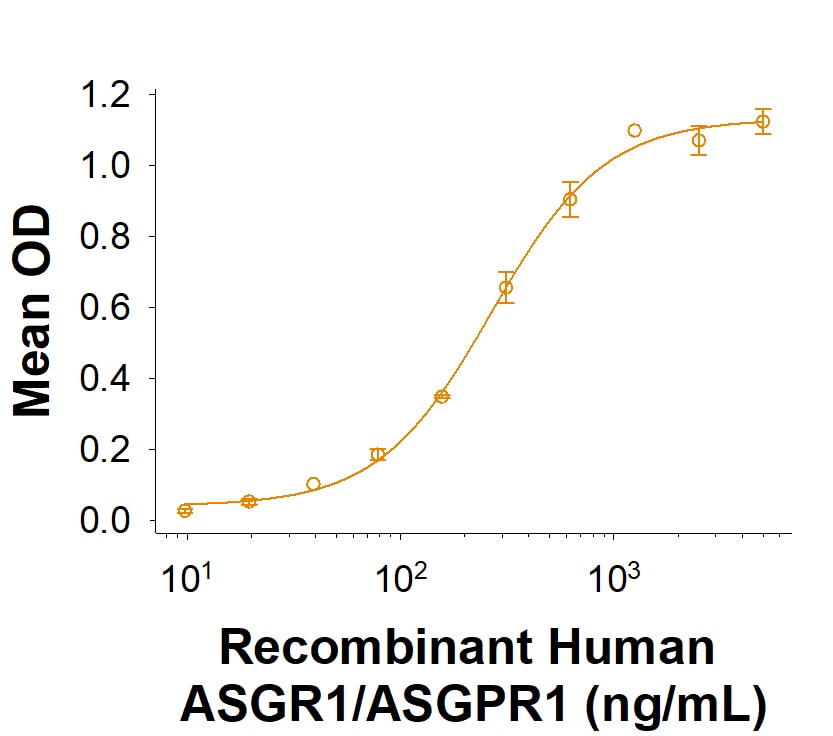
Immobilized Recombinant Human ASGR1/ASGPR1 Fc Chimera (Catalog # 10255-AS) binds human plasma von Willebrand Factor with an ED50 of 0.15-0.9 μg/mL.
Immobilized Recombinant Human ASGR1/ASGPR1 Fc Chimera (Catalog # 10255-AS) binds human plasma von Willebrand Factor with an ED50 of 0.15-0.9 μg/mL.
Scientific Data Images for Recombinant Human ASGR1/ASGPR1 Fc Chimera Protein, CF
Recombinant Human ASGR1/ASGPR1 Fc Chimera Protein Bioactivity
Immobilized Recombinant Human ASGR-1/ASGPR1 Fc Chimera (Catalog # 10255-AS) binds human plasma von Willebrand Factor with an ED50 of 150-900 ng/mL.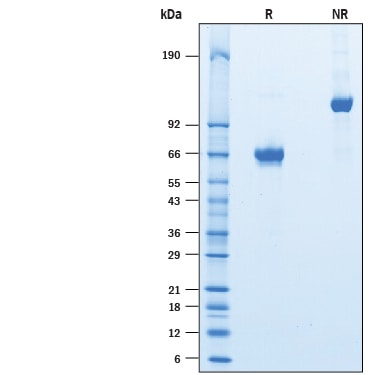
Recombinant Human ASGR1/ASGPR1 Fc Chimera Protein SDS-PAGE
2 μg/lane of Recombinant Human ASGR1/ASGPR1 Fc Chimera (Catalog # 10255-AS) was resolved with SDS-PAGE under reducing (R) and non-reducing (NR) conditions and visualized by Coomassie® Blue staining, showing bands at 59-71 kDa and 120-140 kDa, respectively.Formulation, Preparation, and Storage
10255-AS
| Formulation | Lyophilized from a 0.2 μm filtered solution in PBS. |
| Reconstitution | Reconstitute at 500 μg/mL in PBS. |
| Shipping | The product is shipped at ambient temperature. Upon receipt, store it immediately at the temperature recommended below. |
| Stability & Storage | Use a manual defrost freezer and avoid repeated freeze-thaw cycles.
|
Calculators
Background: ASGR1/ASGPR1
References
- Stockert, R. J. (1995) Physiol. Rev. 75:591.
- Weigel, P.H. and J.H.N. Yik (2002) Biochim. Biophys. Acta 1572:341.
- Meier, M. et al. (2000) J. Mol. Biol. 300:857.
- Spiess, M. et al. (1985) J. Biol. Chem. 260:1979.
- Spiess, M. and H.F. Lodish (1986) Cell 44:177.
- Bischoff, J. et al. (1988) J. Cell Biol. 106:1067.
- Yik, J.H.N. et al. (2002) J. Biol. Chem. 277:40844.
- Monroe, R.S. and B.E. Huber (1994) Gene 148:237.
- Yik, J.H.N. et al. (2002) J. Biol. Chem. 277:23076.
- Bider, M.D. et al. (1996) J. Biol. Chem. 271:31996.
- Lodish, H. (1991) Trends Biochem. Sci. 16:374.
- Park, J-H. et al. (2006) Biotechnol. Lett. 28:1061.
- Westerlind, U. et al. (2004) Glyconj. J. 21:227.
- Park, E.I. et al. (2005) Proc. Natl. Acad. Sci. USA 102:17125.
- Park, E.I. et al. (2003) J. Biol. Chem. 278:4597.
Long Name
Asialoglycoprotein Receptor 1
Alternate Names
ASGPR1, CLEC4H1, MHL1, RHL1
Gene Symbol
ASGR1
UniProt
Additional ASGR1/ASGPR1 Products
Product Documents for Recombinant Human ASGR1/ASGPR1 Fc Chimera Protein, CF
Certificate of Analysis
To download a Certificate of Analysis, please enter a lot or batch number in the search box below.
Note: Certificate of Analysis not available for kit components.
Product Specific Notices for Recombinant Human ASGR1/ASGPR1 Fc Chimera Protein, CF
For research use only
Related Research Areas
Citations for Recombinant Human ASGR1/ASGPR1 Fc Chimera Protein, CF
 Powered by Bioz
Customer Reviews for Recombinant Human ASGR1/ASGPR1 Fc Chimera Protein, CF
There are currently no reviews for this product. Be the first to review Recombinant Human ASGR1/ASGPR1 Fc Chimera Protein, CF and earn rewards!
Have you used Recombinant Human ASGR1/ASGPR1 Fc Chimera Protein, CF?
Submit a review and receive an Amazon gift card!
$25/€18/£15/$25CAN/¥2500 for a review with an image
$10/€7/£6/$10CAN/¥1110 for a review without an image
Submit a review
Loading...