
Recombinant Human BCAT1 Protein, CF
R&D Systems | Catalog # 9536-BA

Loading...
Key Product Details
- R&D Systems E. coli-derived Recombinant Human BCAT1 Protein (9536-BA)
- Quality control testing to verify active proteins with lot specific assays by in-house scientists
- All R&D Systems proteins are covered with a 100% guarantee
Source
E. coli
Accession Number
Applications
Enzyme Activity
Loading...
Product Specifications
Source
E. coli-derived human BCAT1 protein
Lys2-Ser386
with an N-terminal Met and 6-His tag
Lys2-Ser386
with an N-terminal Met and 6-His tag
Purity
>95%, by SDS-PAGE visualized with Silver Staining and quantitative densitometry by Coomassie® Blue Staining.
Endotoxin Level
<0.10 EU per 1 μg of the protein by the LAL method.
N-terminal Sequence Analysis
Met
Predicted Molecular Mass
44 kDa
SDS-PAGE
40-45 kDa, reducing conditions
Activity
Measured by its ability to convert leucine and alpha-ketoglutarate to alpha-ketoisocaproate and glutamate.
The specific activity is >9,000 pmol/min/μg, as measured under the described conditions.
The specific activity is >9,000 pmol/min/μg, as measured under the described conditions.
Scientific Data Images for Recombinant Human BCAT1 Protein, CF
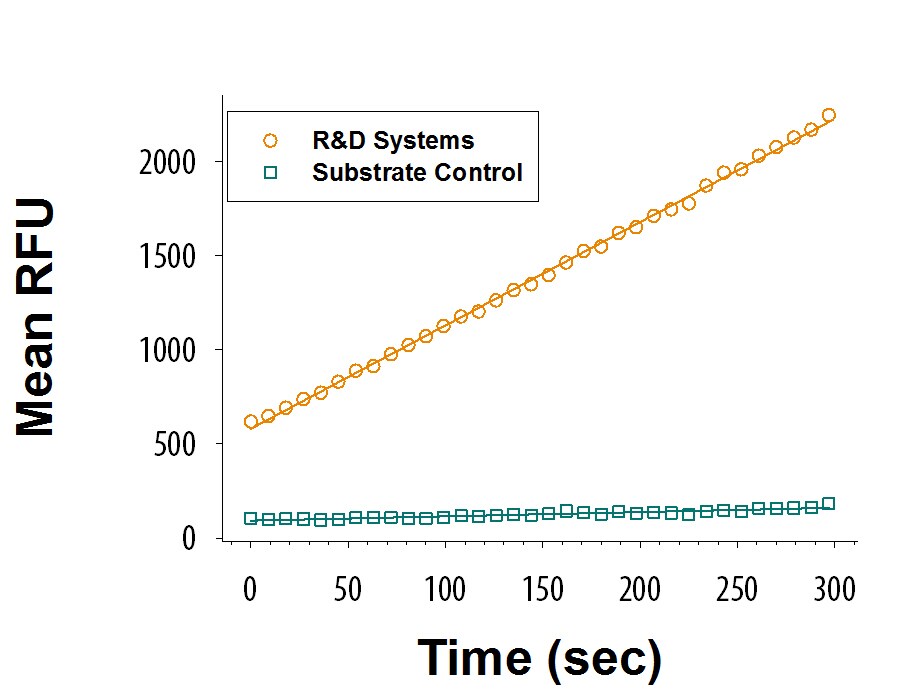
Recombinant Human BCAT1 Protein Enzyme Activity
Recombinant Human BCAT1 (Catalog # 9536-BA) is measured by its ability to convert leucine and alpha-ketoglutarate to alpha-ketoisocaproate and glutamate.Formulation, Preparation, and Storage
9536-BA
| Formulation | Supplied as a 0.2 μm filtered solution in Tris, NaCl, DTT and Glycerol. |
| Shipping | The product is shipped with dry ice or equivalent. Upon receipt, store it immediately at the temperature recommended below. |
| Stability & Storage | Use a manual defrost freezer and avoid repeated freeze-thaw cycles.
|
Background: BCAT1
References
- Hutson, S. (2001) Prog. Nucleic. Acid Res. Mol. Biol. 70:175
- Suryawan, A. et al. (1998) Am. J. Clin. Nutr. 68:72.
- Hall, T.R. et al. (1993) J. Biol. Chem. 268:3092.
- Yennawar, N. H. (2006) J. Biol. Chem. 281:39660.
- Coles, S.J. et al. (2012) Acta.Biochim. Biophys. Sin. 44:172.
- El Hindy, M. et al. (2014) Antioxid. Redox Signal 20:2497.
- Ashby, E.L. et al. (2017) Neurochem. Res. 42:306.
- Zhang, L. and J. Han (2017) Biochem. Biophys. Res. Commun. 486:224.
- Zhu, W. et al. (2017) Mol. Carcinog. 56:1570.
- Zheng, Y.H. et al. (2016) Liver Int. 36:1836.
- Young, G.P. et al. (2016) Cancer Med. 5:2763.
- Pedersen, S.K. (2015) BMC Cancer. 15:654.
- Diaz-Lagares, A. et al. (2016) Clin. Cancer Res. 22:3361.
Long Name
Branched Chain Amino Acid Transaminase 1
Alternate Names
BCAT-1, BCATC, BCT1, EC 2.6.1.42, ECA39, PNAS121, PP18
Gene Symbol
BCAT1
UniProt
Additional BCAT1 Products
Product Documents for Recombinant Human BCAT1 Protein, CF
Certificate of Analysis
To download a Certificate of Analysis, please enter a lot or batch number in the search box below.
Note: Certificate of Analysis not available for kit components.
Product Specific Notices for Recombinant Human BCAT1 Protein, CF
For research use only
Customer Reviews for Recombinant Human BCAT1 Protein, CF
There are currently no reviews for this product. Be the first to review Recombinant Human BCAT1 Protein, CF and earn rewards!
Have you used Recombinant Human BCAT1 Protein, CF?
Submit a review and receive an Amazon gift card!
$25/€18/£15/$25CAN/¥2500 for a review with an image
$10/€7/£6/$10CAN/¥1110 for a review without an image
Submit a review
Protocols
View specific protocols for Recombinant Human BCAT1 Protein, CF (9536-BA):
Materials
- Assay Buffer: 50 mM Tris, 0.05% Tween-20, pH 8.0
- Recombinant Human BCAT1 (rhBCAT1) (Catalog # 9536-BA)
- Recombinant Human NQO-1 (rhNQO-1) (Catalog # 7567-DH)
- Glutamate dehydrogenase (GIDH) (Sigma, Catalog # G7882), 200 U/mL sock in 50 mM Tris, 0.05% Tween-20, pH 8.0
- Nicotinamide adenine dinucleotide ( beta -NAD) (Sigma, Catalog # N6522), 100 mM stock in deionized water
- Resazurin (Catalog # AR002)
- alpha -Ketoglutaric Acid (Sigma, Catalog # K2010), 1 M stock in deionized water
- L-Leucine (EMD Biosciences, Inc., Catalog # 4330), 100 mM stock in deionized water
- F16 Black Maxisorp Plate (Nunc, Catalog # 475515)
- Fluorescent Plate Reader (Model: SpectraMax Gemini EM by Molecular Devices) or equivalent
- Dilute rhBCAT1 to 0.04 µg/mL in Assay Buffer.
- Dilute alpha -Ketoglutaric Acid to 100 mM in Assay Buffer.
- Prepare Substrate Mixture containing 100 U/mL GIDH, 2 mM beta -NAD, 40 µM Resazurin, 1 mM alpha -Ketoglutaric Acid, 4 mM L-Leucine, and 4 µg/mL rhNQO-1 in Assay Buffer.
- Load 50 µL of 0.04 µg/mL rhBCAT-1 in a plate, and start the reaction by adding 50 µL of Substrate Mixture. Include a Substrate Blank containing 50 µL Assay Buffer and 50 µL of Substrate Mixture.
- Read at excitation and emission wavelengths of 540 nm and 585 nm (top read), respectively, in kinetic mode for 8 minutes with a 3 minute lag time in kinetic mode.
- Calculate specific activity:
Specific Activity (pmol/min/µg) = | Adjusted Vmax* (RFU/min) x Conversion Factor** (pmol/RFU) |
| amount of enzyme (µg) |
*Adjusted for Substrate Blank.
**Derived using calibration standard Resorufin (Sigma, Catalog # R3257).
Per Well:
- rhBCAT1: 0.002 µg
- GIDH: 5 U
- beta -NAD: 1 mM
- rhNQO-1: 0.2 µg
- Resazurin: 0.02 mM
- alpha -Ketoglutaric Acid: 0.5 mM
- L-Leucine: 2 mM
Loading...