
The classical complement pathway plays a major role in innate immunity against infection. This pathway is triggered by C1, a multimolecular complex composed of the recognition protein C1q and two serine proteases, C1r and C1s. Following the C1q recognition, C1r is autoactivated, and in turn activates C1s, which cleaves C4 and C2, the C1 substrates (1). Both C1r and C1s activation involve cleavage of a specific Arg-Ile bond, converting single-chain proenzymes into active proteases of disulfide bond-linked chains (A and B) (2). The A chains contain multiple domains in the order of CUB1-EGF-CUB2-CCP1-CCP2-Activation Peptide. The B chains contain the serine protease catalytic domain. The full-length (amino acid residues 1-705) of human C1r was expressed, which had the Leu152 natural variant (3). The purified protein corresponded to the processed active form, with A and B chains starting at residue Ser18 and Ile464, respectively.
Recombinant Human Complement Component C1r Protein, CF
R&D Systems | Catalog # 1807-SE


Loading...
Key Product Details
- R&D Systems NS0-derived Recombinant Human Complement Component C1r Protein (1807-SE)
- Quality control testing to verify active proteins with lot specific assays by in-house scientists
- All R&D Systems proteins are covered with a 100% guarantee
Source
NS0
Accession Number
Structure / Form
Disulfide-linked heterodimer
Applications
Enzyme Activity
Loading...
Product Specifications
Source
Mouse myeloma cell line, NS0-derived human Complement Component C1r protein
Met1-Asp705, with a C-terminal 10-His tag
Met1-Asp705, with a C-terminal 10-His tag
Purity
>95%, by SDS-PAGE under reducing conditions and visualized by silver stain.
Endotoxin Level
<1.0 EU per 1 μg of the protein by the LAL method.
N-terminal Sequence Analysis
Ser18 (A chain) & Ile464 (B chain)
Predicted Molecular Mass
51 kDa (A chain) & 28 kDa (B chain)
SDS-PAGE
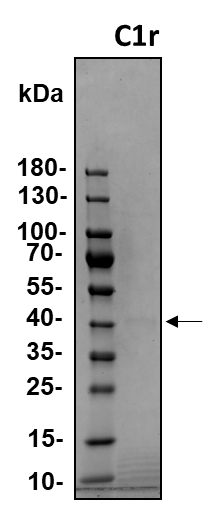
60 kDa & 40 kDa, reducing conditions
Activity
Measured by its ability to cleave a colorimetric peptide substrate, N-carbobenzyloxy-Gly-Arg-ThioBenzyl ester (Z-GR-SBzl), in the presence of 5,5’Dithio-bis (2-nitrobenzoic acid) (DTNB). Edwards, K.M. et al. (1999) J. Biol. Chem. 274:30468.
The specific activity is >1,500 pmol/min/µg, as measured under the described conditions.
The specific activity is >1,500 pmol/min/µg, as measured under the described conditions.
Reviewed Applications
Read 1 review rated 5 using 1807-SE in the following applications:
Formulation, Preparation, and Storage
1807-SE
| Formulation | Lyophilized from a 0.2 μm filtered solution in Tris and NaCl. |
| Reconstitution | Reconstitute at 100 μg/mL in sterile 50 mM Tris and 150 mM NaCl, pH 7.5. |
| Shipping | The product is shipped at ambient temperature. Upon receipt, store it immediately at the temperature recommended below. |
| Stability & Storage | Use a manual defrost freezer and avoid repeated freeze-thaw cycles.
|
Calculators
Background: Complement Component C1r
References
- Arlaud, G.J. et al. (2002) Biochem. Soc. Trans. 30:1001.
- Lacroix, M. et al. (2001) J. Biol. Chem. 276:36233.
- Journet A. and M. Tosi (1986) Biochem. J. 240:783.
Alternate Names
C1r
Entrez Gene IDs
715 (Human)
Gene Symbol
C1R
UniProt
Additional Complement Component C1r Products
Product Documents for Recombinant Human Complement Component C1r Protein, CF
Certificate of Analysis
To download a Certificate of Analysis, please enter a lot or batch number in the search box below.
Note: Certificate of Analysis not available for kit components.
Product Specific Notices for Recombinant Human Complement Component C1r Protein, CF
For research use only
Related Research Areas
Citations for Recombinant Human Complement Component C1r Protein, CF
 Powered by Bioz
Customer Reviews for Recombinant Human Complement Component C1r Protein, CF (1)
5 out of 5
1 Customer Rating
Have you used Recombinant Human Complement Component C1r Protein, CF?
Submit a review and receive an Amazon gift card!
$25/€18/£15/$25CAN/¥2500 for a review with an image
$10/€7/£6/$10CAN/¥1110 for a review without an image
Submit a review
Customer Images
Showing
1
-
1 of
1 review
Showing All
Filter By:
-
Application: SDS-PAGE ControlVerified Customer | Posted 10/12/2019

There are no reviews that match your criteria.
Protocols
View specific protocols for Recombinant Human Complement Component C1r Protein, CF (1807-SE):
Materials
*Adjusted for Substrate Blank
**Using the extinction coefficient 13260 M-1cm-1
***Using the path correction 0.320 cm
Note: the output of many spectrophotometers is in mOD. Per Well:
- Assay Buffer: 50 mM Tris, pH 7.5
- Recombinant Human Complement Component C1r (rhC1r) (Catalog # 1807-SE)
- Substrate: Z-Gly-Arg-SBzl (MP Biomedicals, Catalog # SB007), 10 mM stock in DMSO
- 5,5’Dithio-bis (2-nitrobenzoic acid) (DTNB) (Sigma, Catalog # D-8130), 10 mM stock in DMSO
- 96 well Clear Plate (Costar, Catalog # 92592)
- Plate Reader (Model: SpectraMax Plus by Molecular Devices) or equivalent
- Dilute rhC1r to 2 ng/µL in Assay Buffer.
- Dilute Substrate to 200 µM in Assay Buffer with 200 µM of DTNB.
- Load 50 µL of the diluted rhC1r into a clear plate, and start the reaction by adding 50 µL of the Substrate/DTNB mixture to wells. Include a Substrate Blank containing 50 µL Assay Buffer and 50 µL Substrate Mixture without any rhC1r.
- Read in kinetic mode for 5 minutes at an absorbance of 405 nm.
- Calculate specific activity:
|
Specific Activity (pmol/min/µg) = |
Adjusted Vmax* (OD/min) x well volume (L) x 1012 pmol/mol |
| ext. coeff** (M-1cm-1) x path corr.*** (cm) x amount of enzyme (µg) |
*Adjusted for Substrate Blank
**Using the extinction coefficient 13260 M-1cm-1
***Using the path correction 0.320 cm
Note: the output of many spectrophotometers is in mOD. Per Well:
- rhC1r: 0.100 µg
- DTNB: 100 µM
- Substrate: 100 µM
Loading...