
Recombinant Human Dihydroorotate Dehydrogenase Protein, CF
R&D Systems | Catalog # 10062-DD

Key Product Details
- R&D Systems E. coli-derived Recombinant Human Dihydroorotate Dehydrogenase Protein (10062-DD)
- Quality control testing to verify active proteins with lot specific assays by in-house scientists
- All R&D Systems proteins are covered with a 100% guarantee
Source
Accession Number
Applications
Product Specifications
Source
Thr31 - Arg395
with N-terminal Met and 6-His tag
Purity
Endotoxin Level
N-terminal Sequence Analysis
Predicted Molecular Mass
SDS-PAGE
Activity
The specific activity is >15000 pmol/min/μg, as measured under the described conditions.
Scientific Data Images for Recombinant Human Dihydroorotate Dehydrogenase Protein, CF
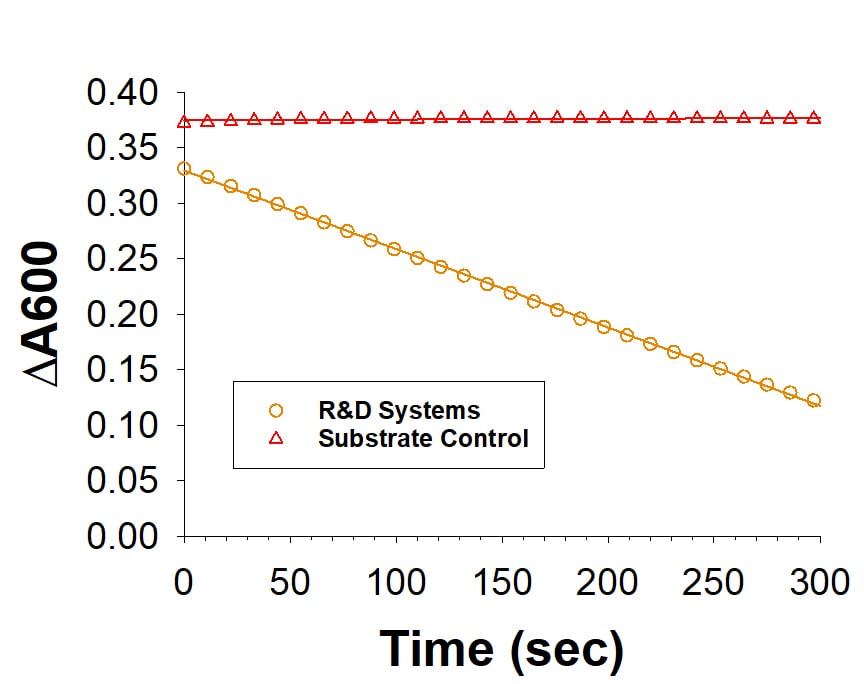
Recombinant Human Dihydroorotate Dehydrogenase Protein Binding Activity
Recombinant Human DHODH (Catalog # 10062-DD) is measured by its reduction of 2,6-dichloroindophenol during oxidation of dihydroorotate.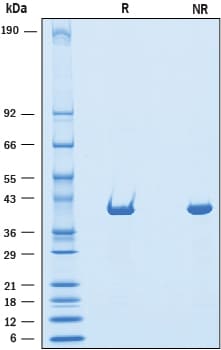
Recombinant Human Dihydroorotate Dehydrogenase Protein SDS-PAGE
2 μg/lane of Recombinant Human DHODH was resolved with SDS-PAGE under reducing (R) and non-reducing (NR) conditions and visualized by Coomassie® Blue staining, showing a band at 41 kDa.Formulation, Preparation, and Storage
10062-DD
| Formulation | Supplied as a 0.2 μm filtered solution in Tris, NaCl and Glycerol. |
| Shipping | The product is shipped with polar packs. Upon receipt, store it immediately at the temperature recommended below. |
| Stability & Storage | Use a manual defrost freezer and avoid repeated freeze-thaw cycles.
|
Background: DHODH
References
- Liu, S. et al. (2000) Structure. 8:25.
- Reis, R. A. G. et al. (2017) Arch. Biochem. Biophys. 632:175.
- Copeland, R. A. et al. (2000) J. Biol. Chem. 275:33373.
- Singh, A. et al. (2017) Eur. J. Med. Chem. 125:640.
- Baumann, P. et al. (2009) Mol. Cancer Ther. 8:366.
- Zhu, S. et al. (2013) PLoS One. 8:e71555.
- Lewis, T. A. et al. (2016) ACS Med. Chem. Lett. 7:1112.
- Koundinya, M. et al. (2018) Cell Chem. Biol. 21:705.
- Herrmann, M. L. et al. (2000) Immunopharmacology. 47:273.
- Li, E. K. et al. (2004) Clin. Ther. 26:447.
- Warnke, C. et al. (2013) Clin. Neurol. Neurosurg. 115:S90.
- O'Connor, P. et al. (2016) Neurology 86:920.
- Wang, Q. Y. et al. (2011) J. Virol. 85:6548.
- Smee, D. F. et al. (2012) Antivir. Chem. Chemother. 22:263.
- Skerlj, R. T. et al. (2011) ACS Med. Chem. Lett. 2:708.
- Ohishi, T. et al. (2018) Helicobacter 23:e12470.
- Oliver, J. D. et al. (2016) Proc. Natl. Acad. Sci. USA 113:12809.
- Fang, J. et al. (2012) Biosci. Rep. 32:631.
Long Name
Alternate Names
Gene Symbol
UniProt
Additional DHODH Products
Product Documents for Recombinant Human Dihydroorotate Dehydrogenase Protein, CF
Certificate of Analysis
To download a Certificate of Analysis, please enter a lot or batch number in the search box below.
Note: Certificate of Analysis not available for kit components.
Product Specific Notices for Recombinant Human Dihydroorotate Dehydrogenase Protein, CF
For research use only
Related Research Areas
Citations for Recombinant Human Dihydroorotate Dehydrogenase Protein, CF
 Powered by Bioz
Customer Reviews for Recombinant Human Dihydroorotate Dehydrogenase Protein, CF
There are currently no reviews for this product. Be the first to review Recombinant Human Dihydroorotate Dehydrogenase Protein, CF and earn rewards!
Have you used Recombinant Human Dihydroorotate Dehydrogenase Protein, CF?
Submit a review and receive an Amazon gift card!
$25/€18/£15/$25CAN/¥2500 for a review with an image
$10/€7/£6/$10CAN/¥1110 for a review without an image
Submit a review
Protocols
View specific protocols for Recombinant Human Dihydroorotate Dehydrogenase Protein, CF (10062-DD):
- Assay Buffer: 50 mM Tris, 150 mM KCl, 0.1% Triton® X-100, pH 8.0
- Recombinant Human DHODH His-tag (rhDHODH) (Catalog # 10062-DD)
- L-Dihydroorotic acid (Sigma, Catalog # D7128), 40 mM stock in DMF
- Decylubiquinone (Sigma, Catalog # D7911), 20 mM stock in DMSO
- 2,6-Dichloroindophenol sodium salt hydrate (DPIP) (Sigma, Catalog # D1878), 2 mM in Absolute Ethanol
- 96-well Clear Plate
(Catalog #
DY990)
- Plate Reader (Model: SpectraMax Plus by Molecular Devices) or equivalent
- Dilute rhDHODH to 0.4 µg/mL in Assay Buffer.
- Prepare Substrate Mixture containing 2 mM L-Dihydroorotic acid, 0.2 mM Decylubiquinone and 0.12 mM DPIP in Assay Buffer.
- Load 50 µL of 0.4 µg/mL rhDHODH to plate, and start the reaction by adding 50 µL of Substrate Mixture. Include a Substrate Blank containing 50 µL Assay Buffer and 50 µL of Substrate Mixture.
- Immediately read plate in kinetic mode for 5 minutes at 600 nm (absorbance).
- Calculate specific activity:
Specific Activity (pmol/min/µg) = | Adjusted Vmax* (OD/min) x (-1) x well volume (L) x 1012 pmol/mol |
| ext. coeff** (M-1cm-1) x path corr.*** (cm) x amount of enzyme (µg) |
*Adjusted for Substrate Blank
**Using the extinction coefficient 21,000 M-1 cm-1.
***Using the path correction 0.32 cm.
Note: the output of many spectrophotometers is in mOD.
Per Well:
- rhDHODH: 0.02 µg
- L-Dihydroorotic acid: 1 mM
- Decylubiquinone: 0.1 mM
- DPIP: 0.06 mM