
Recombinant Human FGF-9, Animal-Free Protein
R&D Systems | Catalog # Qk039

Key Product Details
Source
Accession Number
Applications
Product Specifications
Source
Endotoxin Level
Predicted Molecular Mass
SDS-PAGE
Activity
Mycoplasma
Scientific Data Images for Recombinant Human FGF-9, Animal-Free Protein
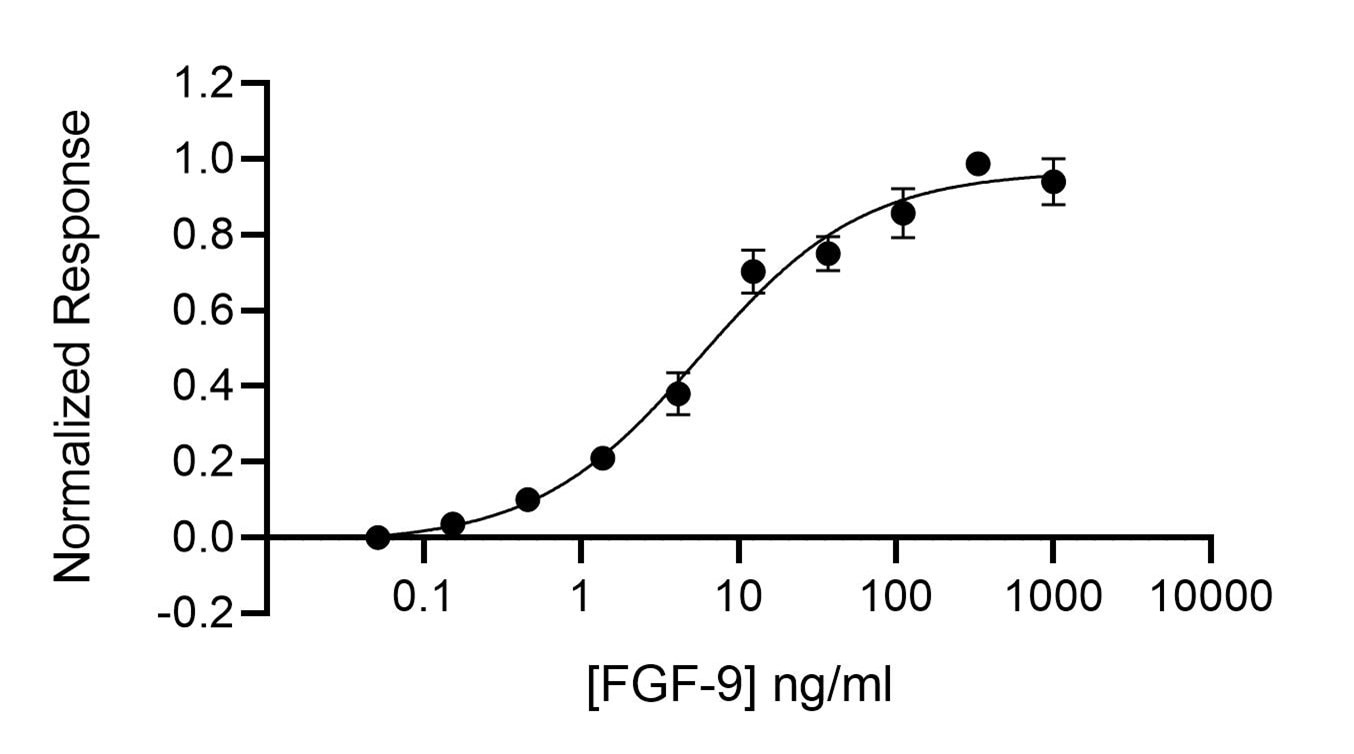
Recombinant Human FGF-9, Animal-Free Protein Bioactivity
FGF-9 activity is determined using the Promega serum response element luciferase reporter assay (*) in transfected HEK293T cells. Cells are treated in triplicate with a serial dilution of FGF-9 for 3 hours. Firefly luciferase activity is measured and normalized to the control Renilla luciferase activity. EC50 = 5.7 ng/ml (0.25 nM).*Promega pGL4.33[luc2P/SRE/Hygro] #E1340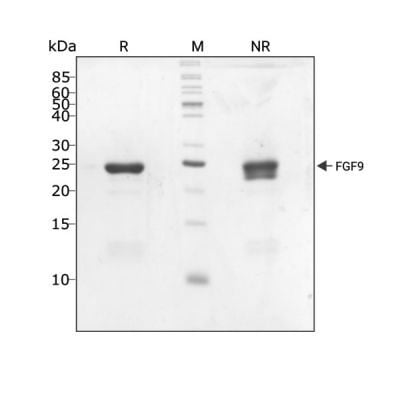
Recombinant Human FGF-9, Animal-Free Protein SDS-PAGE
FGF-9 protein migrates as a single band at 23 kDa in non-reducing (NR) conditions and upon reduction (R). No contaminating protein bands are visible. Purified recombinant protein (3 µg) was resolved using 15% w/v SDS-PAGE in reduced (+ beta -mercaptothanol, R) and non-reduced (NR) conditions and stained with Coomassie Brilliant Blue R250.Formulation, Preparation, and Storage
Qk039
| Formulation | Lyophilized from HEPES/NaCl |
| Reconstitution | Resuspend in water at >100 µg/ml, prepare single use aliquots, add carrier protein if desired. |
| Shipping | The product is shipped lyophilized at ambient temperture, on ice blocks or dry ice. Shipping at ambient temperture does not affect the bioactivity or stability of the protein. Upon reciept, store immediately at the conditions stated below. |
| Stability & Storage | Store lyophilized protein between -20 and -80 °C until the date of expiry. Avoid freeze-thaw cycles. |
Calculators
Background: FGF-9
References
- Mohammadi, M. et al. (2005) Cytokine Growth Factor Rev. 16:107.
- Itoh, N. and D.M. Ornitz (2008) Dev. Dyn. 237:18.
- Miyamoto, M. et al. (1993) Mol. Cell. Biol. 13:4251.
- Santos-Ocampo, S. et al. (1996) J. Biol. Chem. 271:1726.
- Plotnikov, A.N. et al. (2001) J. Biol. Chem. 276:4322.
- Harada, M. et al. (2009) Nat. Genet. 41:289.
- Wu, X.L. et al. (2009) Am. J. Hum. Genet. 85:53.
- Colvin, J.S. et al. (1999) Dev. Dyn. 216:72.
- Lin, Y. et al. (2009) Dev. Biol. 329:44.
- Hung, I.H. et al. (2007) Dev. Biol. 307:300.
- Colvin, J.S. et al. (2001) Dev. Dyn 128:2095.
- Krejci, P. et al. (2009) Hum. Mutat. 30:1245.
- Leushacke, M. et al. (2011) PLoS ONE 6:e23381.
- Hendrix, N.D. et al. (2006) Cancer Res. 66:1354.
- Abdel-Rahman, W.M. et al. (2008) Hum. Mutat. 29:390.
Long Name
Alternate Names
Gene Symbol
UniProt
Additional FGF-9 Products
Product Documents for Recombinant Human FGF-9, Animal-Free Protein
Certificate of Analysis
To download a Certificate of Analysis, please enter a lot or batch number in the search box below.
Note: Certificate of Analysis not available for kit components.
Product Specific Notices for Recombinant Human FGF-9, Animal-Free Protein
The above product was manufactured, tested and released by R&D System's contract manufacturer, Qkine Ltd, at 1 Murdoch House, Cambridge, UK, CB5 8HW. The product is for research use only and not for the diagnostic or theraputic use.
For research use only
Related Research Areas
Customer Reviews for Recombinant Human FGF-9, Animal-Free Protein
There are currently no reviews for this product. Be the first to review Recombinant Human FGF-9, Animal-Free Protein and earn rewards!
Have you used Recombinant Human FGF-9, Animal-Free Protein?
Submit a review and receive an Amazon gift card!
$25/€18/£15/$25CAN/¥2500 for a review with an image
$10/€7/£6/$10CAN/¥1110 for a review without an image
Submit a review