
R&D Systems Antibody Validation

Antibody Validation & Quality Control For Reproducible Results
Antibody validation is the process of confirming that an antibody binds the intended target with specificity and performs reliably in the relevant application. Inconsistent antibody performance remains a major source of poor experimental reproducibility, with one estimate suggesting that over half of antibody products may fail to perform as expected. For this reason, researchers need antibodies supported by rigorous validation and transparent data.
Backed by decades of expertise in antibody design, development, and manufacturing, we have continuously refined our quality control processes to enhance antibody performance. These efforts are further supported through participation in external antibody characterization initiatives and by providing publication citations and customer review information, where available. Together with application-specific validation strategies and transparent data presentation practices, these resources help researchers assess antibody performance and interpret results with greater confidence.
R&D Systems Antibodies: Exceptional Quality, Proven Applications
Every in-house R&D Systems antibody product, including both off-the-shelf and custom options, goes through our proprietary development processes and validation workflow. To provide our customers with antibodies with reproducible application performance, R&D Systems processes apply three integral technical approaches:
- Rational Immunogen Design
- Diversified Immunization Strategies
- Enhanced Validation & Verification
A select portion of our R&D Systems antibody portfolio, along with a broad range of Novus antibodies, is sourced from trusted partners with specialized expertise in niche targets, expanding the options available to researchers. Through collaborations with innovative antibody developers, Bio-Techne is able to make unique and hard-to-access reagents available to the broader scientific community. Before any antibody is added to our catalog, it undergoes a rigorous scientific and data review to ensure it meets our quality standards. These products are backed by the same performance guarantee as antibodies developed internally by Bio-Techne.
1. Rational Immunogen Design
Creating an antibody that provides reproducible, optimal performance starts with thoughtful immunogen selection. Our R&D Systems scientists design immunogens that lead to better antibodies.
Our in-house protein experts direct the immunogen design process. When appropriate, they opt for full-length proteins expressed in mammalian cells. Through this approach, we can ensure immunogens are properly folded, bioactive, and appropriately glycosylated so that they behave just as they would in native conditions. Though more difficult to accomplish compared to peptides or protein fragment immunogen approaches, our process yields antibodies that are purposely suited for customer assays.
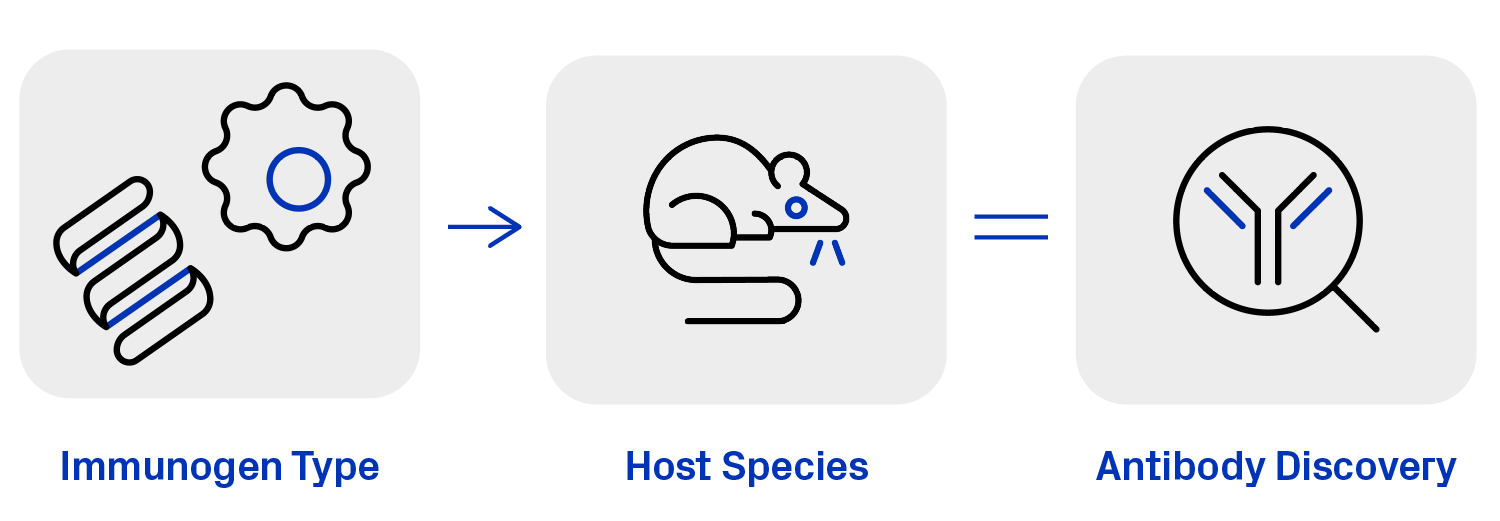
The resulting antibodies show high selectivity, affinity, and biological relevance. While full-length protein immunogens often provide ideal performance, there are also many cases where a specific antibody target or application necessitates the design of peptide and whole-cell immunogens. The latter is particularly valuable for binding membrane-bound receptors, like GPCR targeting antibodies
2. Diversified Immunization Strategies
With an immunogen selected, our scientists then determine which immunization strategy is best suited for the target antibody. Through years of development, we have built a range of immunization protocols, each offering unique advantages depending on the target and intended application. This flexibility helps us generate antibodies with the optimal combination of specificity, sensitivity, and performance.
We can also immunize different species, including mouse, rabbit, and goat hosts. We can even immunize multiple hosts with the same immunogen and study the resulting antibodies to collect the best option for specific applications.
3. Enhanced Validation & Verification
R&D Systems scientists perform extensive in-house validation on self-manufactured products with a keen focus on customer application to provide the highest standards of antibody reproducibility.
To provide a wide range of solutions for diverse research needs, our antibody catalog includes those developed by high-quality, trusted, partners across the life science community who provide validation data to accompany the product. This data is included in product datasheets and on product webpages.
Application-Led Antibody Validation
Our in-house validation cycle explores antibody performance in relevant applications like Western blots, flow cytometry, IHC, and other immunoassays. R&D Systems testing processes use multiple approaches to evaluate antibody specificity. Depending on the antibody and intended application, these approaches may include knockout validation, biological validation, positive and negative controls, and recombinant protein family testing. Where applicable, we take validation further to functional assays like blocking, neutralization, and receptor activation studies to confirm biological activity.
R&D Systems scientists run these application validation studies using lysates from primary cells, cell lines, transfectants, and tissue microarrays commonly used in our customers’ experiments.
R&D Systems scientists also perform platform-specific validation on our in-house technologies, like Lunaphore COMET™ and Simple Western™ platforms. For customers who use or are considering our instrument platforms, this creates an added layer of confidence that the antibodies will perform as expected.
To assess specificity more deeply, R&D Systems also runs cell-based assays to verify that binding only occurs in the presence of the target, helping to avoid off-target or nonspecific binding.
As most antibody validation experts recommend, this begins with cell studies comparing wild-type cells and isogenic knockout lines lacking the target. In this context, only the wild-type cells show antibody binding. Similarly, our antibody quality control team also uses biological or chemical stimulation assays to verify that target binding only occurs in the appropriate biological context. To illustrate this, using our Hif-1 alpha antibody as an example, we check that binding only occurs in hypoxic conditions since it is only expressed then.
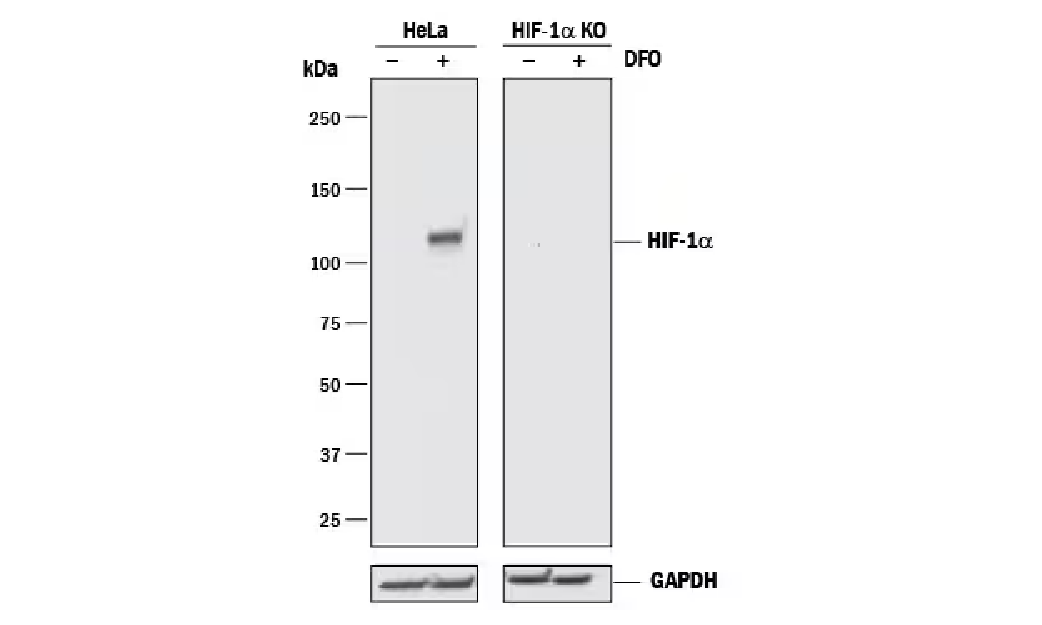
Western Blot Shows Human HIF-1 alpha/HIF1A alpha/HIF1A Specificity. Western blot shows lysates of Wild-type and and HIF-1 alpha/HIF1A knockout cell line (KO) untreated (-) or treated (+) with 1 mM DFO overnight. PVDF membrane was probed with 1 µg/mL of Mouse Anti-Human/Mouse/Rat HIF-1 alpha/HIF1A Monoclonal Antibody (Catalog # MAB1536) followed by HRP-conjugated Anti-Mouse IgG Secondary Antibody (Catalog # HAF018). GAPDH (Catalog # MAB5718) is shown as a loading control.
Understanding Validation Badges
The example above reflects two antibody validation approaches applied across the portfolio: knockout validation and biological validation. Badges on product pages identify the type of supporting evidence used to characterize antibody performance. These badges help researchers quickly understand how specificity or biological relevance was assessed.
- KO – Knockout validation. Antibody specificity is evaluated by comparing signal in a parental sample with a gene knockout control in which target expression has been eliminated.
- BV – Biological validation. Antibody performance is assessed across biologically relevant tissues or treatment conditions to confirm expected staining or detection patterns.
- O – Orthogonal validation. Antibody-based detection is compared with an antibody-independent method, such as RNA expression analysis or in-situ hybridization (ISH) to confirm that the observed signal matches expected target expression.
- IA – Independent antibody validation. Results are confirmed with a second antibody against the same target, ideally recognizing a different epitope, to verify a consistent expression pattern.
Ongoing Antibody Quality Control and Lot Confirmation
To help ensure consistent performance, R&D Systems processes include validation of every subsequent antibody lot against a standardized reference. By re-testing lots, we can help maintain reproducible results in customer experiments. If lots do not perform consistently due to hybridoma drift or any other change, we discontinue the product immediately and develop a comparable alternative.
Data Integrity & Image Handling
We are committed to presenting antibody data that accurately reflects experimental results.
- Images are presented to reflect experimental results without alteration that changes interpretation
- Experimental context is clearly defined, including application, sample type, and controls
- Image quality supports interpretation, with appropriate labeling and detail
Adjustments (e.g., contrast or cropping) may be applied for clarity. Where applicable, product images may be accompanied by supporting data or additional experimental context to help clarify the result shown. Additional experimental data may be available upon request for select products. When available, this may include:
- Uncropped or full-length blots
- Replicates or supporting datasets
- Expanded experimental details
Availability depends on data source (internal vs. community), dataset age and application. Contact Technical Support with the product number, application, and specific request. We will make reasonable efforts to provide available data or clarify experimental context.
External Antibody Characterization Partnerships
Improving antibody reproducibility requires a collective effort across the scientific community. To help drive progress, the R&D Systems team actively partners with external organizations and researchers on initiatives aimed at enhancing antibody validation standards and best practices.

YCharOS is a public-interest, open-science company with the mission of characterizing commercially available reagent antibodies for every human protein.
Check out this Nature Protocols paper on YCharOS, which shares a consensus-built platform for antibody characterization, including input from our expert antibody team.

Human Cell Differentiation Molecules (HCDM) is an organization that runs Human Leucocyte Differentiation Antigens (HLDA) Workshops and names and characterizes CD molecules.
The HLDA has designated a sizable collection of R&D Systems developed antibody clones as definitive CD markers. Browse our HLDA-qualified CD Markers.
Citations and Customer Reviews

Beyond in-house validation, customer experience is a vital feedback loop for our antibody reproducibility efforts. For transparency, we display publication citations and reviews on every product page in our portfolio so that users can see how other customers successfully use our antibodies in their experiments. Look for these key indicators on the product pages to show how customers have used our antibodies.
100% Guarantee & Expert Technical Support
Even after our antibodies leave our facilities, we continue to stand behind R&D Systems and Novus products with a 100% performance guarantee. If a product does not perform as expected, we will, in accordance with our Terms and Conditions, either replace the product at no additional cost or provide a refund.
Should you encounter any problem with our antibodies, our technical support team is ready to help and answer your questions.