
Recombinant Human GALT His-tag Protein, CF
R&D Systems | Catalog # 11776-GT

Loading...
Key Product Details
Source
E. coli
Accession Number
Applications
Enzyme Activity
Loading...
Product Specifications
Source
E. coli-derived human GALT protein
Ser2-Ala379, with an N-terminal Met and 6-His tag
Ser2-Ala379, with an N-terminal Met and 6-His tag
Purity
>95%, by SDS-PAGE visualized with Silver Staining and quantitative densitometry by Coomassie® Blue Staining.
Endotoxin Level
<1.0 EU per 1 μg of the protein by the LAL method.
N-terminal Sequence Analysis
Met
Predicted Molecular Mass
44 kDa
SDS-PAGE
40-45 kDa, under reducing conditions.
Activity
Measured by its ability to hydrolyze UDP-Glucose.
The specific activity is >1400 pmol/min/μg, as measured under the described conditions.
The specific activity is >1400 pmol/min/μg, as measured under the described conditions.
Scientific Data Images for Recombinant Human GALT His-tag Protein, CF
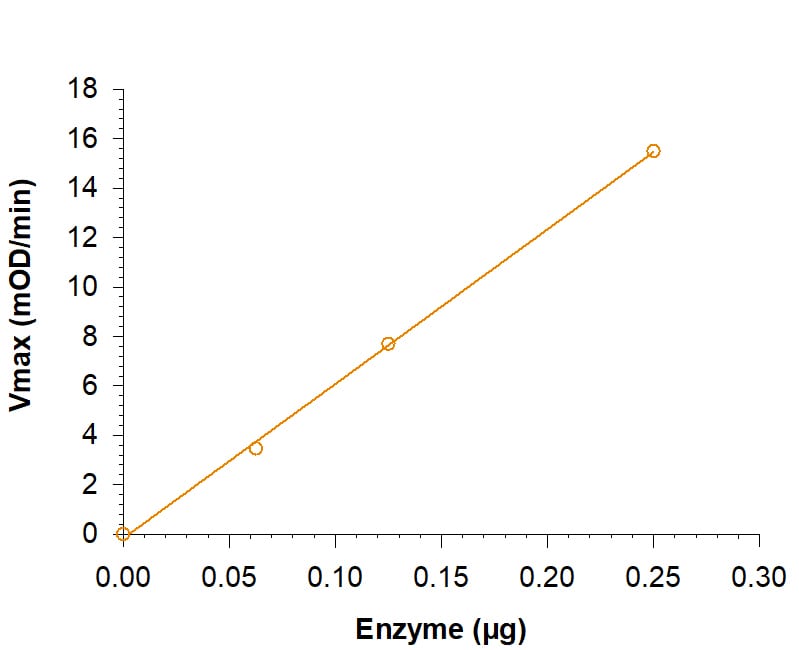
Recombinant Human GALT His-tag Enzyme Activity.
Recombinant Human GALT His-tag (Catalog # 11776-GT) is measured by its ability to hydrolyze UDP-Glucose.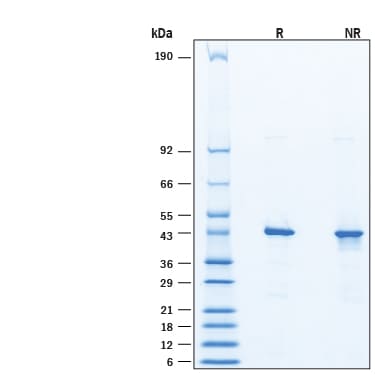
Recombinant Human GALT His-tag SDS-PAGE.
2 μg/lane of Recombinant Human GALT His-tag (Catalog # 11776-GT) was resolved with SDS-PAGE under reducing (R) and non-reducing (NR) conditions and visualized by Coomassie® Blue staining, showing bands at 40-45 kDa, under reducing conditions.Formulation, Preparation, and Storage
11776-GT
| Formulation | Supplied as a 0.2 μm filtered solution in Tris, NaCl and TCEP. |
| Shipping | The product is shipped with dry ice or equivalent. Upon receipt, store it immediately at the temperature recommended below. |
| Stability & Storage | Use a manual defrost freezer and avoid repeated freeze-thaw cycles.
|
Background: GALT
References
- Elsas, L.J. and K. Lai. (1998) Genet. Med. 1:40.
- Brenner, C. (2002) Biochemistry 41:9003.
- McCorvie, T.J. et al (2016) Hu. Mol. Genet. 25:2234.
- Weckbecker, G. and D.O. Keppler. (1982) Eur. J. Biochem. 128:163.
- Donnell, G. et al (1963) Pediatrics 31:802.
- Lai, K. et al (2003) Glycobiology 13:285.
- Staubach, S. et al. (2012) J. Proteome Res. 11: 906.
- Coss, K.P. et al. (2014) J. Proteome Res. 13: 385.
- Maratha, A. et al. (2016) Eur. J. Hum. Genet. 24:976.
- Tang, M. et al. (2012) Hum. Mutat. 33: 1107.
- Coelho, A.I. et al. (2014) Mol. Genet. Genomic Med. 2:484.
- Banford, S. et al. (2021) J. Pers. Med. 11:106.
- Delnoy, B. et al. (2021) J. Pers. Med. 11:75.
- Pasquali, M. et al. (2018) Genet. Med. 20:3.
Long Name
galactose-1-phosphate uridylyltransferase
Alternate Names
EC 2.7.7.12, Gal-1-P uridylyltransferase, galactose-1-phosphate uridyl transferase, galactose-1-phosphate uridylyltransferase, UDP-glucose--hexose-1-phosphate uridylyltransferase
Gene Symbol
GALT
UniProt
Additional GALT Products
Product Documents for Recombinant Human GALT His-tag Protein, CF
Certificate of Analysis
To download a Certificate of Analysis, please enter a lot or batch number in the search box below.
Note: Certificate of Analysis not available for kit components.
Product Specific Notices for Recombinant Human GALT His-tag Protein, CF
For research use only
Customer Reviews for Recombinant Human GALT His-tag Protein, CF
There are currently no reviews for this product. Be the first to review Recombinant Human GALT His-tag Protein, CF and earn rewards!
Have you used Recombinant Human GALT His-tag Protein, CF?
Submit a review and receive an Amazon gift card!
$25/€18/£15/$25CAN/¥2500 for a review with an image
$10/€7/£6/$10CAN/¥1110 for a review without an image
Submit a review
Protocols
View specific protocols for Recombinant Human GALT His-tag Protein, CF (11776-GT):
Materials
- Assay Buffer: 50 mM Tris, 10 mM MnCl2, pH 7.0
- Enzyme: Recombinant Human GALT His-tag (rhGALT) (Catalog # 11776-GT)
- NADP+, 50 mM stock in deionized water
- Substrate: Galactose 1-phosphate, 50 mM stock in deionized water
- UDP-Glucose, 10 mM stock in 25% Ethanol/75% deionized water
- Coupling Enzyme: Recombinant Human G6PD His-tag (rhG6PD) (Catalog # 10096-DH)
- Coupling Enzyme: Recombinant Human PGM-1 N-His (rhPGM-1) (Catalog # 11681-P1)
- Clear 96-well Plate
- Plate Reader with Absorbance Read Capability
- Create a master mix containing 0.25 mM NADP+, 1 mM Galactose 1-phosphate, 0.25 mM UDP-Glucose, 20 µg/mL rhG6PD, and 40 µg/mL rhPGM-1 in Assay Buffer.
- Dilute rhGALT to 2.5 µg/mL in Assay Buffer.
- Load in a plate 50 µL of 2.5 µg/mL rhGALT, and start the reaction by adding 50 µL of master mix. Include a Control containing 50 µL of master mix and 50 µL of Assay Buffer.
- Read plate at 340 nm (absorbance) in kinetic mode for five minutes.
- Calculate specific activity:
Specific Activity (pmol/min/µg) = | Adjusted Vmax* (OD/min) x well volume (L) x 1012 pmol/mol |
| ext. coeff** (M-1cm-1) x path corr.*** (cm) x amount of enzyme (µg) |
*Adjusted for Control
**Using the extinction coefficient 6220 M-1cm-1
***Using the path correction 0.32 cm
Note: The output of many spectrophotometers is in mOD.
Per Well:
- rhGALT: 0.125 µg
- NADP+: 0.125 mM
- Galactose 1-phosphate: 0.5 mM
- UDP-Glucose: 0.125 mM
- rhG6PD: 1 µg
- rhPGM-1: 2 µg
Loading...