

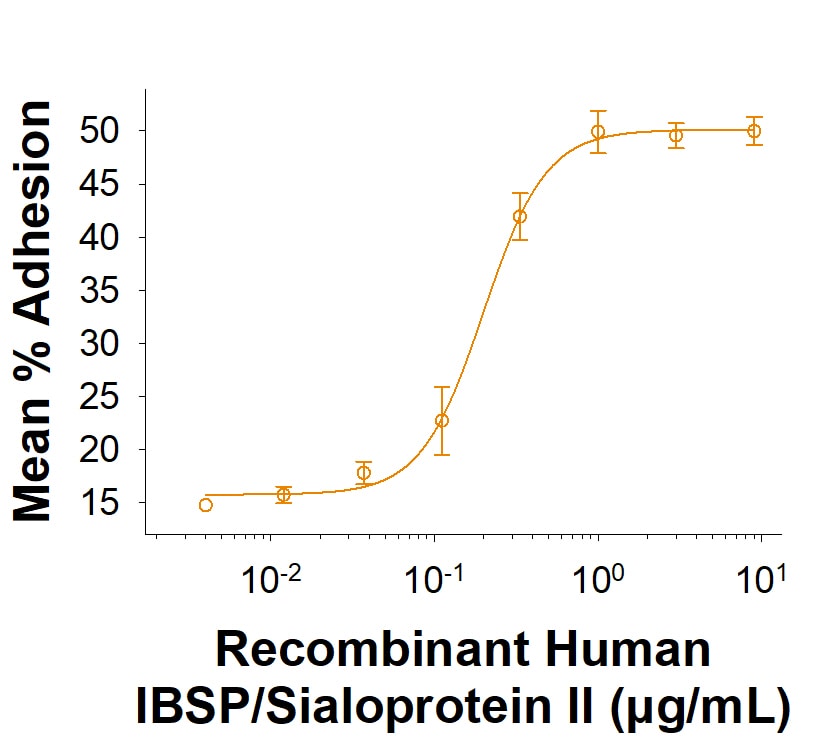
IBSP (integrin-binding sialoprotein; also BSP or bone sialoprotein (II)) is a 55 - 75 kDa, secreted, variably glycosylated, monomeric noncollagenous member of the SIBLING family of extracellular matrix (ECM) proteins (1 - 3). It is principally associated with the early stages of bone mineralization. BSP is synthesized as a 317 amino acid (aa) precursor that contains a 16 aa signal sequence and a 301 aa mature region (4 - 6). The mature segment is divided into a basic N-terminus (aa 17 - 62), a central region (aa 63 - 233), and an acidic C-terminus (aa 234 - 317) (7).
Functional segments associated with the mature molecule include a type I collagen binding domain (aa 19 - 46), two non-RGD cell binding sites (aa 30 - 57 and 261 - 281), an RGD alpha v beta 3 integrin-binding site (aa 286 - 288) and two potential hydroxyapatite (HAp) nucleation domains (aa 76 - 83 and 151 - 158) (3, 4, 8 - 11). HAp formation requires a BSP nucleation site composed of at least eight consecutive glutamic acid residues and, likely, a contribution from a BSP-associated co-nucleator (10, 12). BSP is highly glycosylated, sulfated, and phosphorylated. Phosphorylation may impact HAp growth, while carbohydrate may regulate cell adhesion (1, 3, 13). Mature human BSP is 70%, 72%, 78%, and 72% aa identical to porcine, rat, canine, and mouse BSP, respectively. BSP is synthesized by megakaryocytes/platelets, osteoblasts, osteocytes, odontoblasts, osteoclasts, and bone marrow stromal cells (14 - 17).
 Powered by Bioz
