Recombinant Human IL-17A (Human Cell-expressed) Protein
R&D Systems | Catalog # 7955-IL

Key Product Details
- R&D Systems HEK293-derived Recombinant Human IL-17A (Human Cell-expressed) Protein (7955-IL)
- Quality control testing to verify active proteins with lot specific assays by in-house scientists
- All R&D Systems proteins are covered with a 100% guarantee
Source
Accession Number
Structure / Form
Applications
Product Specifications
Source
Gly24-Ala155
Purity
Endotoxin Level
N-terminal Sequence Analysis
Predicted Molecular Mass
SDS-PAGE
28-38 kDa, non-reducing conditions
Activity
The ED50 for this effect is 0.12-1.2 ng/mL.
Measured by its ability to induce IL-6 secretion by NIH‑3T3 mouse embryonic fibroblast cells. Yao, Z. et al. (1995) Immunity 3:811.
The ED50 for this effect is 1.5-7.5 ng/mL.
Reviewed Applications
Read 3 reviews rated 4.3 using 7955-IL in the following applications:
Scientific Data Images for Recombinant Human IL-17A (Human Cell-expressed) Protein
Recombinant Human IL-17A (Human Cell-expressed) Protein Bioactivity
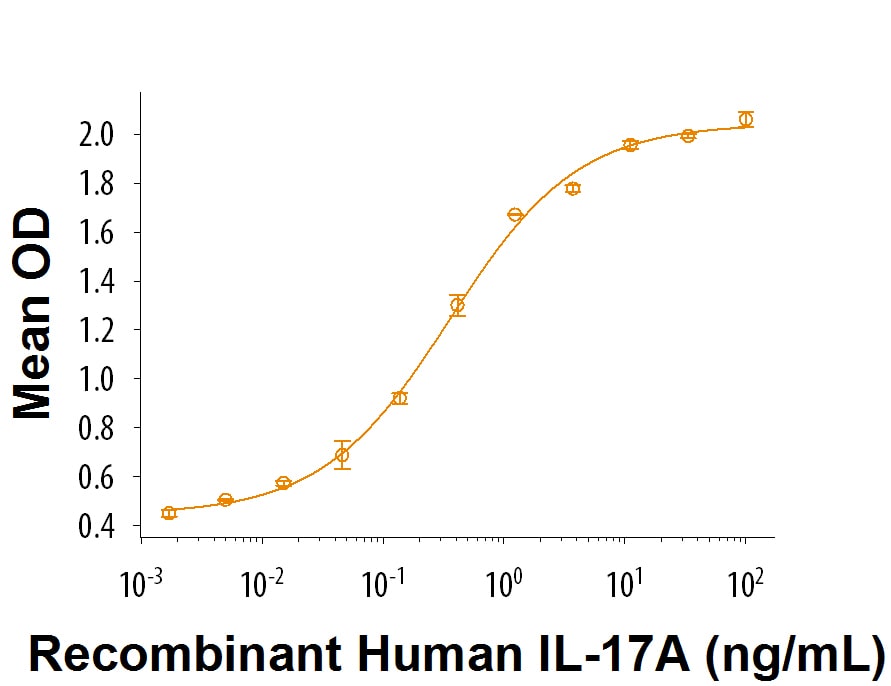
Recombinant Human IL-17 (Catalog # 7955-IL) induces CXCL1/GRO alpha secretion in HT‑29 human colon adenocarcinoma cells. The ED50 for this effect is 0.12‑1.2 ng/mL.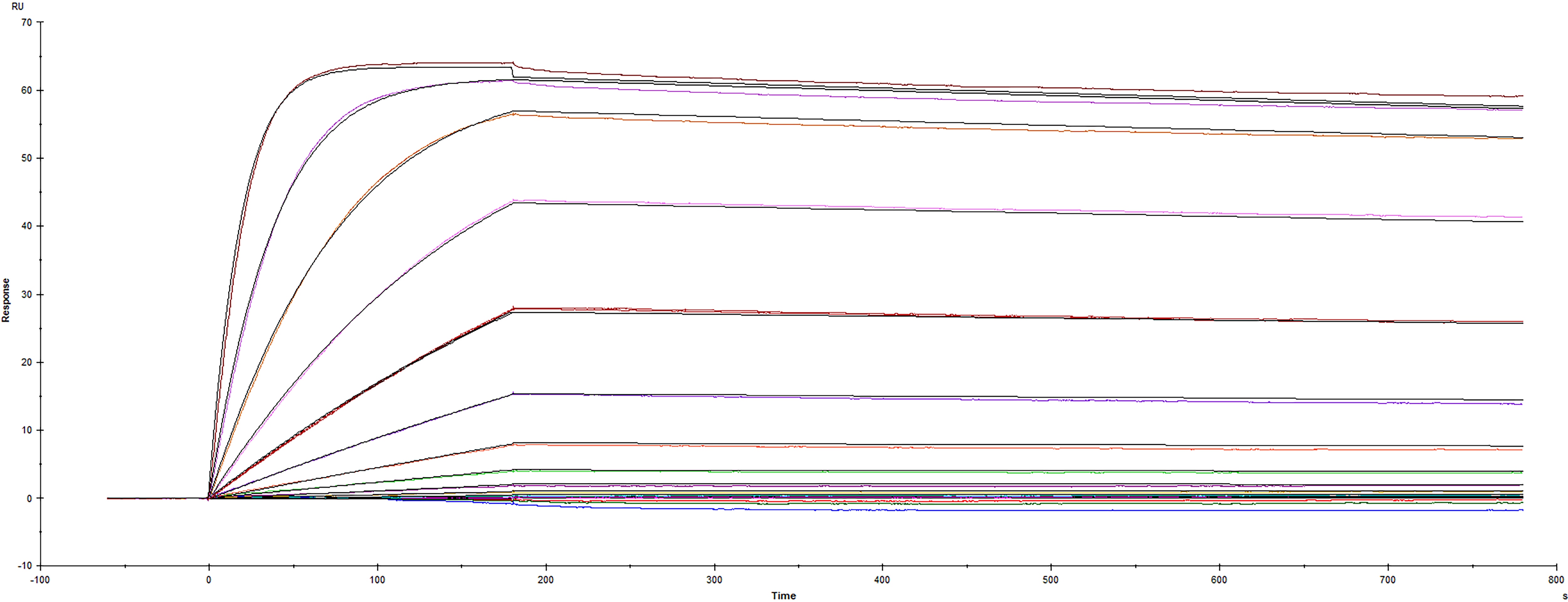
SPR Analysis of IL-17A Binding to Ixekizumab.
Binding of Recombinant Human IL-17/IL-17A (Catalog # 7955-IL) to Ixekizumab biosimilar antibody captured via Recombinant Protein A/G/L (NBP2-34985) was evaluated by Surface Plasmon Resonance (SPR). Analysis of the interaction was characterized based on a series of Recombinant Human IL-17/IL-17A concentrations, yielding an equilibrium dissociation constant (KD) of 19.5 pM. Representative sensorgrams are shown.Formulation, Preparation, and Storage
Carrier Free
What does CF mean?CF stands for Carrier Free (CF). We typically add Bovine Serum Albumin (BSA) as a carrier protein to our recombinant proteins. Adding a carrier protein enhances protein stability, increases shelf-life, and allows the recombinant protein to be stored at a more dilute concentration. The carrier free version does not contain BSA.
What formulation is right for me?In general, we advise purchasing the recombinant protein with BSA for use in cell or tissue culture, or as an ELISA standard. In contrast, the carrier free protein is recommended for applications, in which the presence of BSA could interfere.
Carrier: 7955-IL
| Formulation | Lyophilized from a 0.2 μm filtered solution in PBS with BSA as a carrier protein. |
| Reconstitution | Reconstitute at 100-500 μg/mL in PBS containing at least 0.1% human or bovine serum albumin. |
| Shipping | The product is shipped at ambient temperature. Upon receipt, store it immediately at the temperature recommended below. |
| Stability & Storage | Use a manual defrost freezer and avoid repeated freeze-thaw cycles.
|
Carrier Free: 7955-IL/CF
| Formulation | Lyophilized from a 0.2 μm filtered solution in PBS. |
| Reconstitution | Reconstitute at 100 μg/mL in PBS. |
| Shipping | The product is shipped at ambient temperature. Upon receipt, store it immediately at the temperature recommended below. |
| Stability & Storage | Use a manual defrost freezer and avoid repeated freeze-thaw cycles.
|
Calculators
Background: IL-17/IL-17A
References
- Gaffen, S.L. (2009) Nat. Rev. Immunol. 9:556.
- Cua, D.J. and C.M. Tato (2010) Nat. Rev. Immunol. 10:479.
- Yao, Z. et al. (1995) J. Immunol. 155:5483.
- Fossiez, F. et al. (1996) J. Exp. Med. 183:2593.
- Chang, S.H. and C. Dong (2007) Cell Res. 17:435.
- Wright, J.F. et al. (2007) J. Biol. Chem. 282:13447.
- Wright, J.F. et al. (2008) J. Immunol. 181:2799.
- Rong, Z. et al. (2009) Cell Res. 19:208.
- Cho, J.S. et al. (2010) J. Clin. Invest. 120:1762.
- Liang, S.C. et al. (2006) J. Exp. Med. 203:2271.
- Liang, S.C. et al. (2007) J. Immunol. 179:7791.
- O’Connor Jr., W. et al. (2009) Nat. Immunol. 10:603.
- Takahashi, N. et al. (2008) J. Exp. Med. 205:1755.
- Hsu, H. et al. (2008) Nat. Immunol. 9:166.
- Rohn, T.A. et al. (2006) Eur. J. Immunol. 36:2857.
- Wang, L. et al. (2009) J. Exp. Med. 206:1457.
- Kryczek, I. et al. (2009) Blood 114:357.
Long Name
Alternate Names
Entrez Gene IDs
Gene Symbol
UniProt
Additional IL-17/IL-17A Products
Product Documents for Recombinant Human IL-17A (Human Cell-expressed) Protein
Certificate of Analysis
To download a Certificate of Analysis, please enter a lot or batch number in the search box below.
Note: Certificate of Analysis not available for kit components.
Product Specific Notices for Recombinant Human IL-17A (Human Cell-expressed) Protein
For research use only
Citations for Recombinant Human IL-17A (Human Cell-expressed) Protein
 Powered by Bioz
Customer Reviews for Recombinant Human IL-17A (Human Cell-expressed) Protein (3)
Have you used Recombinant Human IL-17A (Human Cell-expressed) Protein?
Submit a review and receive an Amazon gift card!
$25/€18/£15/$25CAN/¥2500 for a review with an image
$10/€7/£6/$10CAN/¥1110 for a review without an image
Submit a review
-
Application: In vitro bioactivity in cell cultureVerified Customer | Posted 02/24/2021
-
Application: In vitro bioactivity in cell cultureVerified Customer | Posted 11/18/2020
-
Application: Cell ProliferationVerified Customer | Posted 06/04/2019
There are no reviews that match your criteria.
FAQs for Recombinant Human IL-17A (Human Cell-expressed) Protein
-
Q: The specifications section on the website for Recombinant Human IL-17/IL-17A, Catalog # 7955-IL, describes SDS-PAGE as a range of Molecular Weights. Why?
A: Recombinant Human IL-17/IL-17A, Catalog # 7955-IL, has one N-linked glycosylation site and seven O-linked glycosylation sites. The variable glycosylation results in multiple bands for this protein.
-
Q: What are the diferences between Recombinant Human IL-17A Protein, CF (Catalog # 317-ILB) and Recombinant Human IL-17A (Human Cell-expressed) Protein (Catalog # 7955-IL)?
A: There are multiple differences between Catalog # 317-ILB and 7955-IL.
- 317-ILB is raised in E. coli, while 7955-IL is raised in Human Embryonic Kidney (HEK293) cells.
- Human Cell-expressed 7955-IL has a lower endotoxin specification (<0.01 EU per 1 μg of the protein by the LAL method) compared to E. coli-expressed 317-ILB (<0.10 EU per 1 μg of the protein).
- Human Cell-expressed 7955-IL exhibits greater activity in the CXCL1/GRO alpha secretion assay in HT‑29 human colon adenocarcinoma cells (0.12 - 1.2 ng/mL) compared to E. coli-expressed 317-ILB (0.4-4.0 ng/mL).
-
Q: The specifications section on the website for Recombinant Human IL-17/IL-17A, Catalog # 7955-IL, describes SDS-PAGE as a range of Molecular Weights. Why?
A: Recombinant Human IL-17/IL-17A, Catalog # 7955-IL, has one N-linked glycosylation site and seven O-linked glycosylation sites. The variable glycosylation results in multiple bands for this protein.
-
Q: What are the diferences between Recombinant Human IL-17A Protein, CF (Catalog # 317-ILB) and Recombinant Human IL-17A (Human Cell-expressed) Protein (Catalog # 7955-IL)?
A: There are multiple differences between Catalog # 317-ILB and 7955-IL.
- 317-ILB is raised in E. coli, while 7955-IL is raised in Human Embryonic Kidney (HEK293) cells.
- Human Cell-expressed 7955-IL has a lower endotoxin specification (<0.01 EU per 1 μg of the protein by the LAL method) compared to E. coli-expressed 317-ILB (<0.10 EU per 1 μg of the protein).
- Human Cell-expressed 7955-IL exhibits greater activity in the CXCL1/GRO alpha secretion assay in HT‑29 human colon adenocarcinoma cells (0.12 - 1.2 ng/mL) compared to E. coli-expressed 317-ILB (0.4-4.0 ng/mL).
Associated Pathways