Interleukin-17F (also known as ML-1) is a of the IL-17 family of cytokines. Members of this family are involved in tissue homeostasis and demonstrate a structural motif termed a cysteine-knot that characterizes a large superfamily of growth factors. Although most cysteine-knot superfamily members use three intrachain disulfide bonds to create a knot, IL-17 family molecules generate the same structural form with only two disulfide links (1 - 3). Human IL-17F is secreted as a glycosylated, 45 kDa, disulfide-linked homodimer. It is synthesized as a 153 amino acid (aa) precursor that contains a 20 aa signal sequence and a 133 aa mature region. As noted, the molecule contains a cysteine-knot that is formed from two sets of paired beta -strands that are connected by disulfide linkages (4 - 6). There is potentially one additional isoform that utilizes an alternate start site. This adds an additional 10 aa at the N-terminus (1, 7).
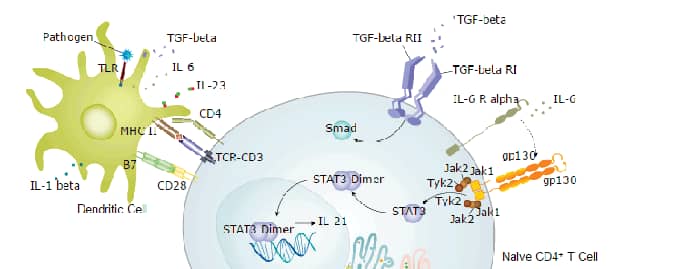
When induced, IL-17F is preferentially translated as the 153 aa precursor (1). Initially, IL-17F was also reported as IL-24 (7). Since that time, the IL-24 designation has been reassigned to MDA-7, a member of the IL-10 family of molecules (note: IL-17E is synonymous with IL-25). Mature human IL-17F is 59%, 56%, 44% and 52% aa identical to mature rat, mouse, canine and bovine IL-17F, respectively. Within the IL-17 family, IL-17F is most closely related to IL-17/IL-17A at 50% aa identity (6). Human IL-17F is active on mouse and porcine cells (6). IL-17F is produced by activated CD4+ T cells, mast cells, basophils and monocytes (1, 4), and is inducible by IL-23 (4, 8). Targets for IL-17F include respiratory epithelium and endothelial cells which produce proinflammatory cytokines that promote neutrophil activation and influx (4, 5, 9, 10).
 Powered by Bioz