
Recombinant Human KGF/FGF-7 Protein, CF
R&D Systems | Catalog # 11340-KG

Loading...
Key Product Details
- R&D Systems HEK293-derived Recombinant Human KGF/FGF-7 Protein (11340-KG)
- Quality control testing to verify active proteins with lot specific assays by in-house scientists
- All R&D Systems proteins are covered with a 100% guarantee
Source
HEK293
Accession Number
Applications
Bioactivity
Loading...
Product Specifications
Source
Human embryonic kidney cell, HEK293-derived human KGF/FGF-7 protein
Cys32-Thr194
Cys32-Thr194
Purity
>95%, by SDS-PAGE visualized with Silver Staining and quantitative densitometry by Coomassie® Blue Staining.
Endotoxin Level
<0.10 EU per 1 μg of the protein by the LAL method.
N-terminal Sequence Analysis
Cys32
Predicted Molecular Mass
19 kDa
SDS-PAGE
22-28 kDa, under reducing conditions.
Activity
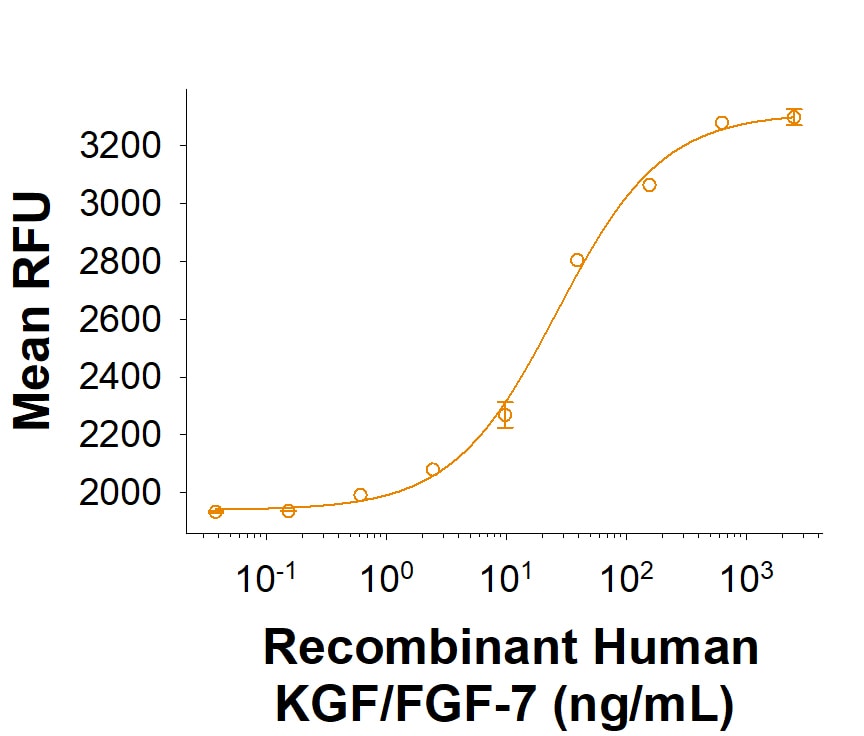
Measured in a serum-free cell proliferation assay using MCF‑7 human breast cancer cells. Karey, K.P. et al. (1988) Cancer Research 48:4083.
The ED50 for this effect is 25.0-250 ng/mL.
The ED50 for this effect is 25.0-250 ng/mL.
Scientific Data Images for Recombinant Human KGF/FGF-7 Protein, CF
Recombinant Human KGF/FGF‑7 Protein Bioactivity.
Recombinant Human KGF/FGF-7 Protein (Catalog # 11340-KG) stimulates cell proliferation of MCF-7 human breast cancer cells, The ED50 for this effect is 25.0-250 ng/mL.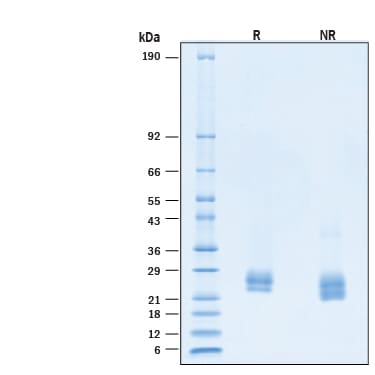
Recombinant Human KGF/FGF‑7 Protein SDS-PAGE.
2 μg/lane of Recombinant Human KGF/FGF‑7 Protein (Catalog # 11340-KG) was resolved with SDS-PAGE under reducing (R) and non-reducing (NR) conditions and visualized by Coomassie® Blue staining, showing bands at 22-28 kDa.Formulation, Preparation, and Storage
11340-KG
| Formulation | Lyophilized from a 0.2 μm filtered solution in MOPS, Na2SO4 and EDTA with Trehalose. |
| Reconstitution | Reconstitute 10 μg size at 100 μg/mL and all the other sizes at 250 μg/mL in PBS. |
| Shipping | The product is shipped at ambient temperature. Upon receipt, store it immediately at the temperature recommended below. |
| Stability & Storage | Use a manual defrost freezer and avoid repeated freeze-thaw cycles.
|
Calculators
Background: KGF/FGF-7
References
- Finch, P.W. and J.S. Rubin (2006) J. Natl. Cancer Inst. 98:812.
- Werner, S. et al. (2007) J. Invest. Dermatol. 127:998.
- Werner, S. (1998) Cytokine Growth Factor Rev. 9:153.
- Mason, I.J. et al. (1994) Mech. Dev. 45:15.
- Geer, D.J. et al. (2005) Am. J. Pathol. 167:1575.
- Niu, J. et al. (2007) J. Biol. Chem. 282:6001.
- Cardinali, G. et al. (2005) J. Invest. Dermatol. 125:1190.
- Qiao, J. et al. (1999) Development 126:547.
- Guo, L. et al. (1996) Genes Dev. 10:165.
- de Georgi, V. et al. (2007) Dermatol. Clin. 25:477.
- Hsu, Y-R. et al. (1999) Biochemistry 38:2523.
- Belleudi, F. et al. (2007) Traffic 8:1854.
- Vadija R. et al. (2016) J Chem Biol. 9:69.
Long Name
Keratinocyte Growth Factor
Alternate Names
FGF-7, FGF7, HBGF-7, HBGF7
Gene Symbol
FGF7
UniProt
Additional KGF/FGF-7 Products
Product Documents for Recombinant Human KGF/FGF-7 Protein, CF
Certificate of Analysis
To download a Certificate of Analysis, please enter a lot or batch number in the search box below.
Note: Certificate of Analysis not available for kit components.
Product Specific Notices for Recombinant Human KGF/FGF-7 Protein, CF
For research use only
Related Research Areas
Customer Reviews for Recombinant Human KGF/FGF-7 Protein, CF
There are currently no reviews for this product. Be the first to review Recombinant Human KGF/FGF-7 Protein, CF and earn rewards!
Have you used Recombinant Human KGF/FGF-7 Protein, CF?
Submit a review and receive an Amazon gift card!
$25/€18/£15/$25CAN/¥2500 for a review with an image
$10/€7/£6/$10CAN/¥1110 for a review without an image
Submit a review
Loading...
Associated Pathways
