
Recombinant Human Pancreatic Lipase/PNLIP HA-tag His-tag, CF
R&D Systems | Catalog # 11773-PL

Loading...
Key Product Details
Source
CHO
Accession Number
Applications
Enzyme Activity
Loading...
Product Specifications
Source
Chinese Hamster Ovary cell line, CHO-derived human Pancreatic Lipase protein
Lys17-Cys465, with N-terminal HA (YPYDVPDYA) and 6-His tags
Lys17-Cys465, with N-terminal HA (YPYDVPDYA) and 6-His tags
Purity
>95%, by SDS-PAGE visualized with Silver Staining and quantitative densitometry by Coomassie® Blue Staining.
Endotoxin Level
<0.10 EU per 1 μg of the protein by the LAL method.
N-terminal Sequence Analysis
Tyr
Predicted Molecular Mass
52 kDa
SDS-PAGE
50-55 kDa, under reducing conditions.
Activity
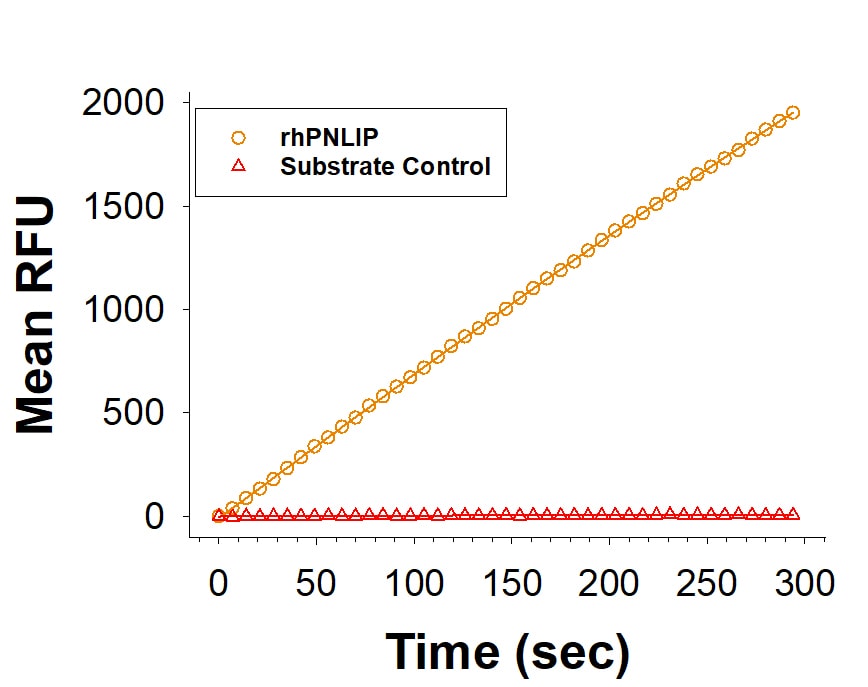
Measured by its ability to cleave a fluorogenic substrate, 4-Methylumbelliferyl oleate (4-MUO).
The specific activity is >750 pmol/min/μg, as measured under the described conditions.
Scientific Data Images for Recombinant Human Pancreatic Lipase/PNLIP HA-tag His-tag, CF
Recombinant Human Pancreatic Lipase/PNLIP HA-tag His-tag Enzyme Activity.
Recombinant Human Pancreatic Lipase/PNLIP HA-tag His-tag (Catalog # 11773-PL) is measured by its ability to cleave a fluorogenic substrate, 4-Methylumbelliferyl oleate (4-MUO).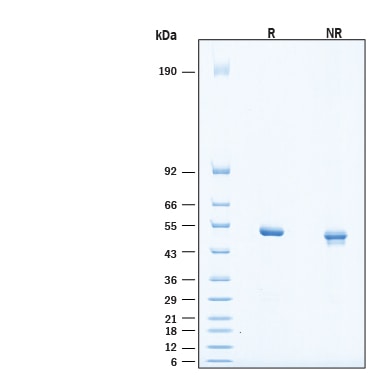
Recombinant Human Pancreatic Lipase/PNLIP HA-tag His-tag SDS-PAGE.
2 μg/lane of Recombinant Human Pancreatic Lipase/PNLIP HA-tag His-tag (Catalog # 11773-PL) was resolved with SDS-PAGE under reducing (R) and non-reducing (NR) conditions and visualized by Coomassie® Blue staining, showing bands at 50-55 kDa, under reducing conditions.Formulation, Preparation, and Storage
11773-PL
| Formulation | Supplied as a 0.2 μm filtered solution in Tris and NaCl. |
| Shipping | The product is shipped with polar packs. Upon receipt, store it immediately at the temperature recommended below. |
| Stability & Storage | Use a manual defrost freezer and avoid repeated freeze-thaw cycles.
|
Background: Pancreatic Lipase
References
- Winkler, F.K. et. al. (1990) Nature 343:771.
- Kumar, A. and S. Chauhan (2021) Life Sci. 271:119115.
- Lim, S.Y. et. al. (2022) Am. J. Vet Res. 83:1.
- Yadav, N. and A.T. Paul (2024) Drug Discov. Today 29:103855.
- Chatzigeorgiou, A. et. al. (2014) Hepatology 60:1196.
- Higgins, V. et. al. (2020) J. Clin. Endocrinol. Metab. 105:1228.
- Lee, S.S. and S. Kang (2015) J. Phys. Ther. Sci. 27:1903.
- Lopez-Jimenez, F. et. al. (2022) Eur. J. Prev. Cardiol. 29:2218.
- Subramaniyan, V. and Y.U. Hanim (2025) Int. J. Obes. 49:492.
- Uuh Narvaez, J.J. et. al. (2025) Molecules 30:2392.
- Szabo, A. et. al. (2015) Biochim. Biophys. Acta 1852:1372.
- Brennan, G.T. and M.W. Saif (2019) JOP 20:121.
- Zupancic, O. et. al. (2023) J. Control Release 362:381.
Long Name
Pancreatic triacylglycerol lipase
Alternate Names
PNLIP, PTL
Entrez Gene IDs
5406 (Human)
Gene Symbol
PNLIP
UniProt
Additional Pancreatic Lipase Products
Product Documents for Recombinant Human Pancreatic Lipase/PNLIP HA-tag His-tag, CF
Certificate of Analysis
To download a Certificate of Analysis, please enter a lot or batch number in the search box below.
Note: Certificate of Analysis not available for kit components.
Product Specific Notices for Recombinant Human Pancreatic Lipase/PNLIP HA-tag His-tag, CF
For research use only
Customer Reviews for Recombinant Human Pancreatic Lipase/PNLIP HA-tag His-tag, CF
There are currently no reviews for this product. Be the first to review Recombinant Human Pancreatic Lipase/PNLIP HA-tag His-tag, CF and earn rewards!
Have you used Recombinant Human Pancreatic Lipase/PNLIP HA-tag His-tag, CF?
Submit a review and receive an Amazon gift card!
$25/€18/£15/$25CAN/¥2500 for a review with an image
$10/€7/£6/$10CAN/¥1110 for a review without an image
Submit a review
Protocols
View specific protocols for Recombinant Human Pancreatic Lipase/PNLIP HA-tag His-tag, CF (11773-PL):
Materials
- Assay Buffer: 50 mM Tris, 200 mM NaCl, 5 mM CaCl2, pH 7.5
- Recombinant Human Pancreatic Lipase/PNLIP (rhPNLIP) (Catalog # 11773-PL)
- Substrate: 4-Methylumbelliferyl Oleate, 100 mM stock in DMSO
- Black 96-well Plate
- Plate Reader with Fluorescence Read Capability
- Dilute rhPNLIP to 0.5 µg/mL in Assay Buffer.
- Dilute Substrate to 0.5 mM in Assay Buffer.
- Load into a plate 50 µL of 0.5 µg/mL rhPNLIP and start the reaction by adding 50 µL of 0.5 mM Substrate. Include a Substrate Blank containing 50 µL of Assay Buffer and 50 µL of 0.5 mM Substrate.
- Read at excitation and emission wavelengths of 365 nm and 445 nm (top read), respectively, in kinetic mode for 5 minutes.
- Calculate specific activity:
Specific Activity (pmol/min/µg) = | Adjusted Vmax* (RFU/min) x Conversion Factor** (pmol/RFU) |
| amount of enzyme (µg) |
*Adjusted for Substrate Blank
**Derived using a fluorescent standard 4-Methylumbelliferone
Per Well:- rhPNLIP: 0.025 µg
- Substrate: 250 µM
Loading...