
Recombinant Human PGM1 His-tag Protein, CF
R&D Systems | Catalog # 11681-P1

Loading...
Key Product Details
- R&D Systems E. coli-derived Recombinant Human PGM1 His-tag Protein (11681-P1)
- Quality control testing to verify active proteins with lot specific assays by in-house scientists
- All R&D Systems proteins are covered with a 100% guarantee
Source
E. coli
Accession Number
Applications
Enzyme Activity
Loading...
Product Specifications
Source
E. coli-derived human PGM1 protein
Val2-Thr562, with an N-terminal Met and 6-His tag
Val2-Thr562, with an N-terminal Met and 6-His tag
Purity
>95%, by SDS-PAGE visualized with Silver Staining and quantitative densitometry by Coomassie® Blue Staining.
Endotoxin Level
<0.10 EU per 1 μg of the protein by the LAL method.
N-terminal Sequence Analysis
Met
Predicted Molecular Mass
62 kDa
SDS-PAGE
58-64 kDa, under reducing conditions
Activity
Measured by its ability to convert alpha -D-glucose 1-phosphate to alpha -D-glucose 6-phosphate in a coupled reaction.
The specific activity is >6500 pmol/min/μg, as measured under the described conditions.
Scientific Data Images for Recombinant Human PGM1 His-tag Protein, CF
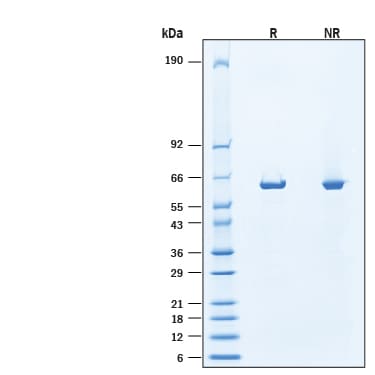
Recombinant Human PGM1 His-tag Protein SDS-PAGE.
2 μg/lane of Recombinant Human PGM1 His-tag Protein (Catalog # 11681-P1) was resolved with SDS-PAGE under reducing (R) and non-reducing (NR) conditions and visualized by Coomassie® Blue staining, showing bands at 58-64 kDa, under reducing conditions.Formulation, Preparation, and Storage
11681-P1
| Formulation | Supplied as a 0.2 μm filtered solution in Tris, NaCl and TCEP. |
| Shipping | The product is shipped with polar packs. Upon receipt, store it immediately at the temperature recommended below. |
| Stability & Storage | Use a manual defrost freezer and avoid repeated freeze-thaw cycles.
|
Background: PGM1
References
- Stiers, K.M. et al. (2016) J. Mol. Biol. 428:1493.
- Shackelford, G.S. et al. (2004) Protein Sci. 13:2130.
- Lee, Y. et al. (2014) J. Biol. Chem. 289:32010.
- Tegtmeyer, L.C. et al. (2014) N. Engl. J. Med. 370:533.
- Beamer, L.J. (2015) J. Inherit Metab. Dis. 38:243.
- Altassan, R et al. (2021) J. Inherit. Metab. Dis. 44:148.
- Fernlund, E. et al. (2019) Forensic Sci. Int. Genet. 43:102111.
- Morava, E. (2014) Mol. Genet. Metab. 112:275.
- Jin, G.Z. et al. (2018) PloS Biol. 16:e2006483.
- Li, Y. et al. (2020) Cancer Lett. 478:82.
- Cao, B. et al. (2021) Cancer Cell Int. 21:481.
- Zheng, Z. et al. (2022) Cancer Cell Int. 22:201.
- Zheng, Z. et al. (2022) Front. Oncol. 12:1060372.
Long Name
phosphoglucomutase 1
Alternate Names
CDG1T, GSD14
Gene Symbol
PGM1
UniProt
Additional PGM1 Products
Product Documents for Recombinant Human PGM1 His-tag Protein, CF
Certificate of Analysis
To download a Certificate of Analysis, please enter a lot or batch number in the search box below.
Note: Certificate of Analysis not available for kit components.
Product Specific Notices for Recombinant Human PGM1 His-tag Protein, CF
For research use only
Customer Reviews for Recombinant Human PGM1 His-tag Protein, CF
There are currently no reviews for this product. Be the first to review Recombinant Human PGM1 His-tag Protein, CF and earn rewards!
Have you used Recombinant Human PGM1 His-tag Protein, CF?
Submit a review and receive an Amazon gift card!
$25/€18/£15/$25CAN/¥2500 for a review with an image
$10/€7/£6/$10CAN/¥1110 for a review without an image
Submit a review
Protocols
View specific protocols for Recombinant Human PGM1 His-tag Protein, CF (11681-P1):
Materials
- Assay Buffer: 25 mM Tris, 1 mM MgCl2, pH 8.0
- Recombinant Human PGM1 His-tag (rhPGM1) (Catalog # 11681-PI)
- Coupling Enzyme: Recombinant Human G6PD His-tag (rhG6PD) (Catalog # 10096-DH)
- L-Cysteine, 50 mM stock in deionized water
- beta -Nicotinamide adenine dinucleotide phosphate (NADP+), 50 mM stock in deionized water
- Substrate: alpha -D-Glucose 1-phosphate, 10 mM stock in deionized water
- Clear 96-well Plate
- Plate Reader with Absorbance Read Capability
- Create a Master Mix containing 2 mM L-Cysteine, 2 mM NADP+, 5 µg/mL rhG6PD, and 0.1 µg/mL rhPGM1 in Assay Buffer. Include a Control containing the same master mix components in Assay Buffer, but without rhPGM1.
- Incubate the Master Mixes and Control at room temperature for 10 minutes.
- Dilute Substrate to 1 mM in Assay Buffer.
- Following incubation, load 50 µL of each master mix (including the Control) to the plate and start the reaction by adding 50 µL of 1 mM Substrate to all wells.
- Read plate at 340 nm (absorbance) in kinetic mode for 5 minutes.
- Calculate specific activity:
Specific Activity (pmol/min/µg) = | Adjusted Vmax* (OD/min) x well volume (L) x 1012 pmol/mol |
| ext. coeff** (M-1cm-1) x path corr.*** (cm) x amount of enzyme (µg) |
*Adjusted for Control
**Using the extinction coefficient 6220 M-1cm-1
***Using the path correction 0.32 cm
Note: The output of many spectrophotometers is in mOD.
Per Well:
- rhPGM1: 0.005 µg
- rhG6PD: 0.250 µg
- Substrate: 0.5 mM
- L-Cysteine: 1 mM
- NADP+: 1 mM
Loading...