
Recombinant Human PKLR Protein, CF
R&D Systems | Catalog # 8569-PK
Pyruvate Kinase Isozymes L/R


Loading...
Key Product Details
- R&D Systems E. coli-derived Recombinant Human PKLR Protein (8569-PK)
- Quality control testing to verify active proteins with lot specific assays by in-house scientists
- All R&D Systems proteins are covered with a 100% guarantee
Source
E. coli
Accession Number
Applications
Enzyme Activity
Loading...
Product Specifications
Source
E. coli-derived human PKLR protein
Leu47-Ser574, with N-terminal Met and 6-His tag
Leu47-Ser574, with N-terminal Met and 6-His tag
Purity
>85%, by SDS-PAGE under reducing conditions and visualized by Colloidal Coomassie® Blue stain at 5 μg per lane.
Endotoxin Level
<1.0 EU per 1 μg of the protein by the LAL method.
N-terminal Sequence Analysis
Met
Predicted Molecular Mass
58 kDa
SDS-PAGE
51-60 kDa, reducing conditions
Activity
Measured by its ability to transfer phosphate from phospho(enol)pyruvic acid monosodium salt hydrate (PEP) to adenosine 5'-diphosphate sodium salt (ADP).
The specific activity is >25,000 pmol/min/ug, as measured under the described conditions.
The specific activity is >25,000 pmol/min/ug, as measured under the described conditions.
Reviewed Applications
Read 1 review rated 5 using 8569-PK in the following applications:
Formulation, Preparation, and Storage
8569-PK
| Formulation | Supplied as a 0.2 μm filtered solution in Tris, NaCl and DTT. |
| Shipping | The product is shipped with dry ice or equivalent. Upon receipt, store it immediately at the temperature recommended below. |
| Stability & Storage | Use a manual defrost freezer and avoid repeated freeze-thaw cycles.
|
Background: PKLR
1,6-bisphosphate (4). Mutation of PKLR is a frequent cause of hereditary non-spherocytic hemolytic anemia (5-8).
References
- Kanno, H. et al. (1991) Proc. Natl. Acad. Sci. U.S.A. 88:8218.
- Tani, K. et al. (1988) Proc. Natl. Acad. Sci. U.S.A. 85:1792.
- Kanno, H. et al. (1992) Biochem. Biophys. Res. Commun. 188:516.
- Valentini G. et al. (2002) J. Biol. Chem. 277:23807.
- Baronciani, L. and Beutler, E. (1993) Proc. Natl. Acad. Sci. U.S.A. 90:4324.
- Beutler E. and Baronciani L. (1996) Hum. Mutat. 7:1.
- Baronciani, L. et al. (1996) Blood Cells Mol. Dis. 22:259.
- Van Wijk, R. et al. (2009) Hum. Mutat. 30:446.
Long Name
Pyruvate Kinase, Liver And RBC
Alternate Names
PK1, PKL, Pyruvate Kinase 1, RPK
Gene Symbol
PKLR
UniProt
Additional PKLR Products
Product Documents for Recombinant Human PKLR Protein, CF
Certificate of Analysis
To download a Certificate of Analysis, please enter a lot or batch number in the search box below.
Note: Certificate of Analysis not available for kit components.
Product Specific Notices for Recombinant Human PKLR Protein, CF
For research use only
Related Research Areas
Citations for Recombinant Human PKLR Protein, CF
 Powered by Bioz
Customer Reviews for Recombinant Human PKLR Protein, CF (1)
5 out of 5
1 Customer Rating
Have you used Recombinant Human PKLR Protein, CF?
Submit a review and receive an Amazon gift card!
$25/€18/£15/$25CAN/¥2500 for a review with an image
$10/€7/£6/$10CAN/¥1110 for a review without an image
Submit a review
Customer Images
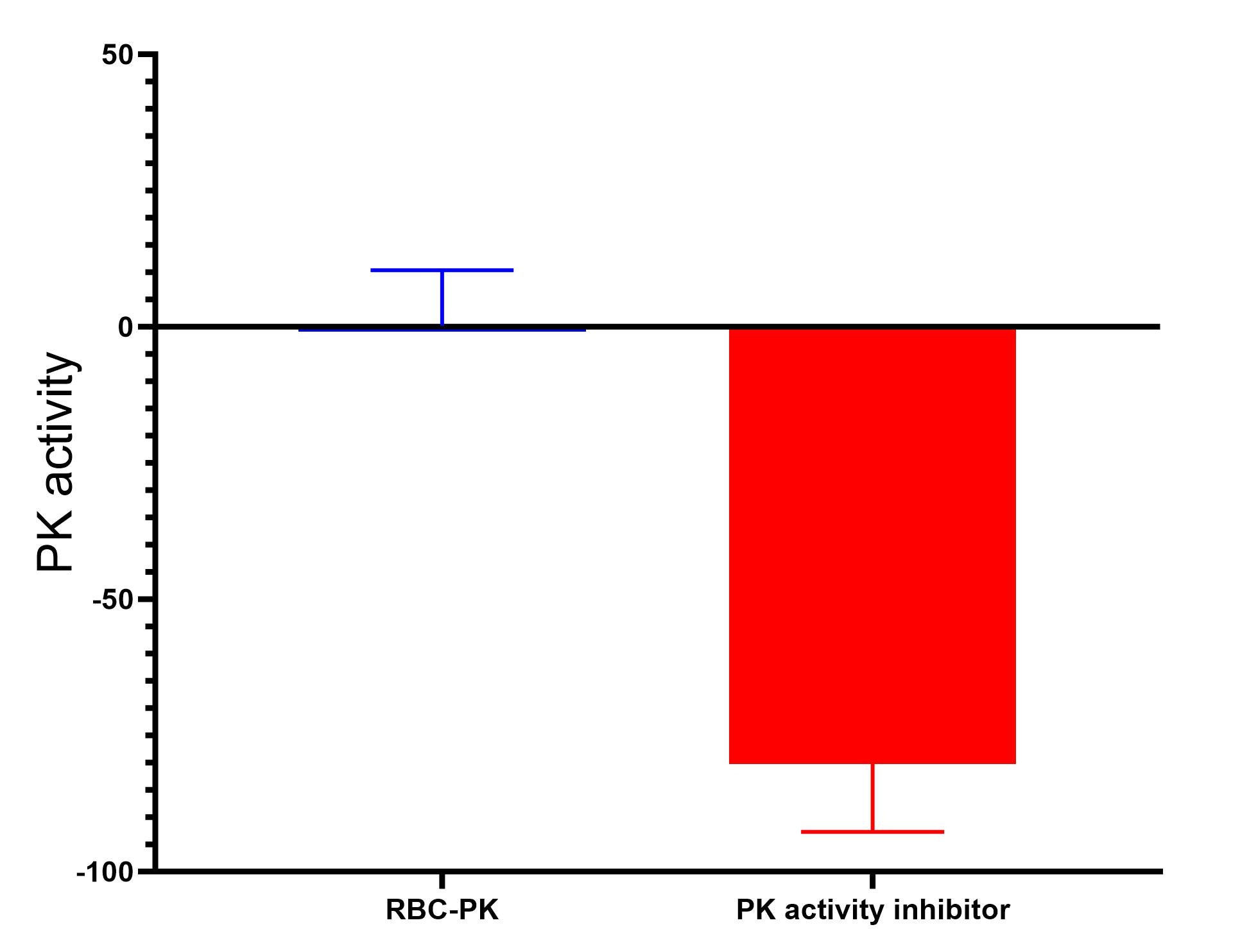
Showing
1
-
1 of
1 review
Showing All
Filter By:
-
Application: Enzymatic activity in vitroVerified Customer | Posted 01/27/2024

There are no reviews that match your criteria.
Protocols
View specific protocols for Recombinant Human PKLR Protein, CF (8569-PK):
Materials
- Assay Buffer: 0.1 M MES, 5 mM MgCl2, 20 mM KCl, pH 6.5
- Recombinant Human PKLR (rhPKLR) (Catalog # 8569-PK)
- Activator: D-Fructose 1,6-bisphosphate trisodium salt hyrate (Sigma, Catalog # F6803), 50 mM stock in deionized water
- Adenosine 5’-diphosphate sodium salt (ADP) (Sigma, Catalog # A2754), 200 mM stock in diH2O
- Phospho(enol)pyruvic acid monosodium salt hydrate (PEP) (Sigma, Catalog # P0564), 50 mM stock in deionized water
- Adenosine triphosphate (ATP) (Sigma, Catalog # A7699), 10 mM stock in deionized water
- Kinase Glo® Plus Luminescent Kinase Assay (Promega, Catalog # V3771)
- 96-well Solid White Plate (Corning Life Sciences, Catalog # 3912)
- Plate Reader (Model: Gemini EM by Molecular Devices) or equivalent
- Follow the Kinase Glo® Plus Luminescent Kinase Assay kit directions for preparing Kinase Glo® Plus Reagent. Use the reagent immediately or freeze aliquots at -20°C for future use. (Note: This assay measures an increasing luminescent signal, which is opposite of the traditional use of the kit).
- Dilute rhPKLR to 0.25 µg/mL in Assay Buffer.
- Dilute Activator to 0.133 mM in Assay Buffer.
- Stimulate enzyme by combining 40 µL of 0.25 µg/mL rhPKLR and 60 µL of 0.133 mM Activator. Replace enzyme with Assay Buffer for a Control.
- Incubate for 5 minutes at room temperature.
- Prepare a substrate mixture of 5 mM ADP and 4 mM PEP in Assay Buffer.
- Add 100 µL of the substrate mixture to incubated rhPKLR and Control. Mix briefly.
- Incubate all at room temperature for 15 minutes.
- Dilute ATP to 100 µM in Assay Buffer. This is the first point of the standard curve. Complete the curve by performing six two-fold dilutions of 100 µM ATP in Assay Buffer. The standard curve has a range of 0.078 to 5.0 nmol per well.
- Load 50 µL of each dilution of the standard curve in triplicate into a solid white plate. Include a curve blank containing 50 μL of Assay Buffer.
- After incubation (step 8), heat reactions and control at 90-100 °C for 1 minute to stop the reaction. Cool on ice and centrifuge briefly to collect any condensation.
- Load 50 µL of each reaction and control in triplicate into the same plate containing the standard curve.
- Add 50 µL of Kinase Glo® Plus Reagent to all wells used, including standard curve.
- Incubate at room temperature for 10 minutes in the dark.
- Read plate in Luminescence endpoint mode.
- Calculate specific activity:
|
Specific Activity (pmol/min/µg) = |
Adj. Luminescence* (RLU) x conversion factor** (nmol/RLU) x 1000 pmol/nmol |
| Incubation time (min) x amount of enzyme (µg) |
*Adjusted for Control.
**Derived from the ATP standard curve using linear fitting and adjusted for Curve Blank.
- rhPKLR: 0.0025 µg
- ADP: 1.25 mM
- PEP: 1.0 mM
- Activator: 20 µM
Loading...