
Recombinant human palmitoyl-protein thioesterase 1 (PPT1), also known as CLN1, is one of two PPT lysosomal thioesterase proteins that catalyze the hydrolysis of long-chain fatty acids (1, 2). While the two PPT enzymes share 18% identity and some overlap in functionality, their specificities differ; PPT1 is the key enzyme responsible for catalyzing the removal of palmitate from S-palmitoylated proteins to facilitate their degradation and clearance from the lysosome (2-4). PPT1 is a glycosylated, monomeric protein that contains a signal peptide, a canonical alpha / beta -hydrolase fold, a catalytic triad, and a fatty-acid hydrophobic groove binding site for palmitate (4). Mutations in PPT1 resulting in defects in activity lead to accumulation of lipid-modified proteins and cause fatal neurodegenerative lysosomal storage disorders known as neuronal ceroid lipofuscinoses (NCL) or Batten disease (4-6). As PPT1 plays a regulatory role in the autophagy-lysosome pathway, it is also a target for several types of cancer including hepatic, melanoma, and oral squamous cell carcinoma (7-10). Pharmacological methods for targeting of PPT1 via gene therapy, enzyme replacement therapy, or enzymatic-related inhibition are under investigation for the treatment of both NCLs and cancer (7, 8,11-13).
Recombinant Human PPT1 HA-tag His-tag Protein, CF
R&D Systems | Catalog # 11661-PT

Loading...
Key Product Details
- R&D Systems CHO-derived Recombinant Human PPT1 HA-tag His-tag Protein (11661-PT)
- Quality control testing to verify active proteins with lot specific assays by in-house scientists
- All R&D Systems proteins are covered with a 100% guarantee
Source
CHO
Accession Number
Applications
Enzyme Activity
Loading...
Product Specifications
Source
Chinese Hamster Ovary cell line, CHO-derived human PPT1 protein
Asp28-Gly306 with N-terminal HA (YPYDVPDYA) and 6-His tags
Asp28-Gly306 with N-terminal HA (YPYDVPDYA) and 6-His tags
Purity
>95%, by SDS-PAGE visualized with Silver Staining and quantitative densitometry by Coomassie® Blue Staining.
Endotoxin Level
<0.10 EU per 1 μg of the protein by the LAL method.
N-terminal Sequence Analysis
Tyr
Predicted Molecular Mass
33 kDa
SDS-PAGE
33-40 kDa, under reducing conditions
Activity
Measured by its ability to cleave the palmitoyl thioester linkage in 4-methylumbelliferyl-6-thio-palmitate-beta-D-glucopyranoside in a coupled reaction.
The specific activity is >250 pmol/min/μg, as measured under the described conditions.
Scientific Data Images for Recombinant Human PPT1 HA-tag His-tag Protein, CF
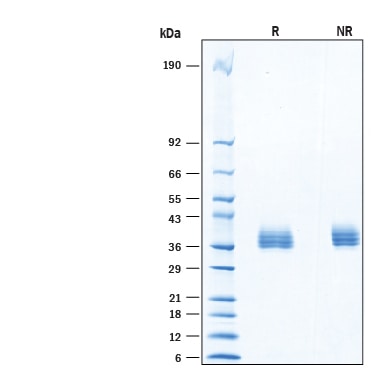
Recombinant Human PPT1 HA-tag His-tag Protein SDS-PAGE.
2 μg/lane of Recombinant Human PPT1 HA-tag His-tag Protein (Catalog # 11661-PT) was resolved with SDS-PAGE under reducing (R) and non-reducing (NR) conditions and visualized by Coomassie® Blue staining, showing bands at 33-40 kDa, under reducing conditions.Formulation, Preparation, and Storage
11661-PT
| Formulation | Supplied as a 0.2 μm filtered solution in Tris and NaCl. |
| Shipping | The product is shipped with polar packs. Upon receipt, store it immediately at the temperature recommended below. |
| Stability & Storage | Use a manual defrost freezer and avoid repeated freeze-thaw cycles.
|
Background: PPT1
References
- Lu, J.Y. et al. (1996) Proc. Natl. Acad. Sci. USA. 93:10046.
- Soyombo, A.A. and S.L. Hofman (1997) J. Biol. Chem. 272:27456.
- Verkruyse, L.A. et al. (1996) J. Biol. Chem. 271:15831.
- Bellizzi III, J.J. et al. (2000) J. Biol. Chem. 97:4573.
- Gupta, P. et al. (2001) Proc. Natl. Acad. Sci. USA. 98:13566.
- Mole, S.E. (1999) Lancet. 354:443.
- Koster, K.P. and A. Yoshii (2019) Front. Synaptic Neurosci. 11:25.
- Zhou, B. et al. (2023) Mol. Oncol. 17:3.
- Crissey, M.A.S. et al. (2024) Autophagy. 19:1.
- Luo, Q. et al. (2024) Curr. Cancer Drug Targets. 24:1047.
- Griffey, M.A. et al. (2006) Mol. Ther. 13:538.
- Dawson, G. et al. (2010) Biochem. Biophys. Res. Commun. 395:66.
- Hu, J. et al. (2012) Mol. Genet. Metab. 107:213.
Long Name
palmitoyl-protein thioesterase 1
Alternate Names
INCL
Gene Symbol
PPT1
UniProt
Additional PPT1 Products
Product Documents for Recombinant Human PPT1 HA-tag His-tag Protein, CF
Certificate of Analysis
To download a Certificate of Analysis, please enter a lot or batch number in the search box below.
Note: Certificate of Analysis not available for kit components.
Product Specific Notices for Recombinant Human PPT1 HA-tag His-tag Protein, CF
For research use only
Customer Reviews for Recombinant Human PPT1 HA-tag His-tag Protein, CF
There are currently no reviews for this product. Be the first to review Recombinant Human PPT1 HA-tag His-tag Protein, CF and earn rewards!
Have you used Recombinant Human PPT1 HA-tag His-tag Protein, CF?
Submit a review and receive an Amazon gift card!
$25/€18/£15/$25CAN/¥2500 for a review with an image
$10/€7/£6/$10CAN/¥1110 for a review without an image
Submit a review
Protocols
View specific protocols for Recombinant Human PPT1 HA-tag His-tag Protein, CF (11661-PT):
Materials
- Assay Buffer: 50 mM Sodium Citrate, 0.4% (v/v) Triton X-100, pH 4.0
- Stop Solution: 0.5 M Glycine, 0.3 M NaOH (~pH 10.0)
- Coupling Enzyme: Recombinant Human Cytosolic beta-Glucosidase/GBA3 (rhGBA3) (Catalog # 5969-GH)
- Recombinant Human PPT1 HA-tag His-tag (rhPPT1) (Catalog # 11661-PT)
- Substrate: 4-Methylumbelliferyl 6-thio-Palmitate-beta -D-Glucopyranoside, 10 mM in DMSO
- Black 96-Well Plate
- Plate Reader with Fluorescence Read Capability
- Dilute rhPPT1 to 1 µg/mL in Assay Buffer.
- Create a master mix containing 40 µg/mL rhGBA3 and 1 mM Substrate in Assay Buffer.
- Load 25 µL of 1 µg/mL rhPPT1 into wells of a plate and start the reactions by adding 25 μL of master mix. Include a Substrate Blank containing 25 µL of Assay Buffer and 25 µL of master mix.
- Seal plate and incubate on the bench top for 20 minutes.
- After incubation, stop the reactions by adding 50 µL of Stop Solution to each well.
- Read at excitation and emission wavelengths of 365 nm and 445 nm (top read) in endpoint mode.
- Calculate specific activity:
Specific Activity (pmol/min/µg) = | Adjusted Fluorescence* (RFU) x Conversion Factor** (pmol/RFU) |
| Incubation time (min) x amount of enzyme (µg) |
*Adjusted for Substrate Blank
**Derived using calibration standard 4-methylumbelliferone (4-MU)
Per Well:
- rhPPT1: 0.025 µg
- rhGBA3: 1 µg
- Substrate: 0.5 mM
Loading...