
Recombinant Human S100A8/S100A9 Heterodimer Protein, CF
R&D Systems | Catalog # 8226-S8

Loading...
Key Product Details
- Recombinant S100A8/A9 Protein supports inflammation and innate immune signaling studies.
- R&D Systems E. coli-derived Recombinant Human S100A8/S100A9 Heterodimer Protein (8226-S8)
- Quality control testing to verify active proteins with lot specific assays by in-house scientists
- All R&D Systems proteins are covered with a 100% guarantee
Source
E. coli
Accession Number
Structure / Form
Noncovalently-linked heterodimer
Applications
Binding Activity
Loading...
Product Specifications
Source
E. coli-derived human S100A8/S100A9 Heterodimer protein
Met1-Glu93 (S100A8) & Thr2-Pro114 (S100A9)
Met1-Glu93 (S100A8) & Thr2-Pro114 (S100A9)
Purity
>95%, by SDS-PAGE visualized with Silver Staining and quantitative densitometry by Coomassie® Blue Staining.
Endotoxin Level
<0.10 EU per 1 μg of the protein by the LAL method.
N-terminal Sequence Analysis
Met1 (S100A8) & Thr2 (S100A9)
Predicted Molecular Mass
11 kDa (S100A8) & 13 kDa (S100A9)
SDS-PAGE
9 kDa (S100A8) & 13 kDa (S100A9), reducing conditions
Activity
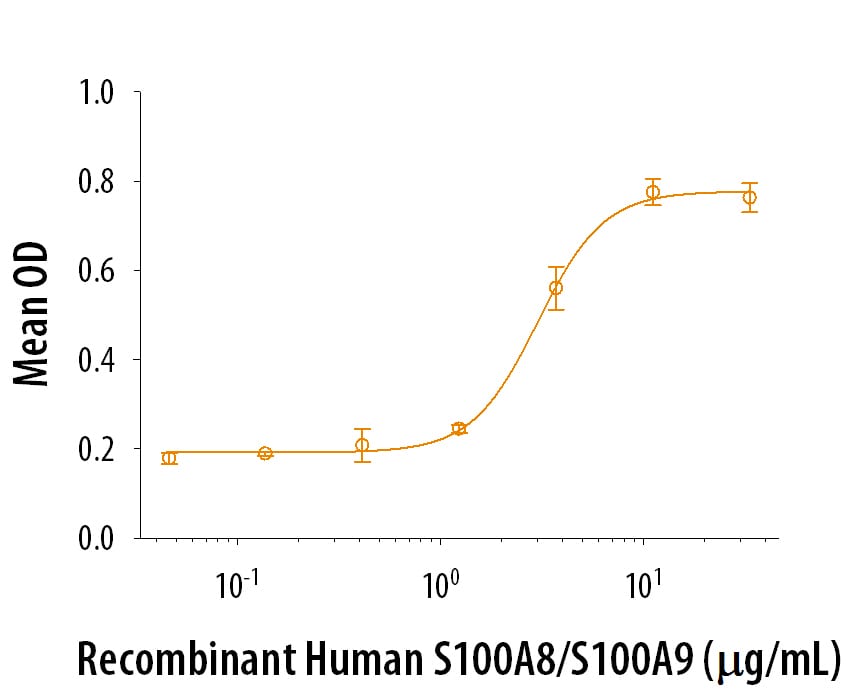
Measured by its ability to induce IL-6 secretion by A375 human melanoma cells. Hibino, T. et al. (2013) Cancer Res. 73:172.
The ED50 for this effect is 1.5-6 μg/mL.
The ED50 for this effect is 1.5-6 μg/mL.
Reviewed Applications
Read 1 review rated 5 using 8226-S8 in the following applications:
Scientific Data Images for Recombinant Human S100A8/S100A9 Heterodimer Protein, CF
Recombinant Human S100A8/S100A9 Heterodimer Protein Bioactivity
Recombinant Human S100A8/S100A9 Heterodimer (Catalog # 8226-S8) induces IL-6 secretion by A375 human melanoma cells. The ED50 for this effect is 1.5-6 μg/mL.Formulation, Preparation, and Storage
8226-S8
| Formulation | Lyophilized from a 0.2 μm filtered solution in PBS and DTT. |
| Reconstitution | Reconstitute at 500 μg/mL in sterile PBS.
Loading...
|
| Shipping | The product is shipped at ambient temperature. Upon receipt, store it immediately at the temperature recommended below. |
| Stability & Storage | Use a manual defrost freezer and avoid repeated freeze-thaw cycles.
|
Calculators
Background: S100A8/S100A9 Heterodimer
EF‑hand calcium binding motifs. Human S100A8 shares 57% and 61% amino acid (aa) sequence identity with mouse and rat S100A8, respectively. Human S100A9 shares 57% and 62% amino acid sequence identity with mouse and rat S100A9, respectively (6, 7). S100A8 and S100A9 are noncovalent homodimers that can also noncovalently heterodimerize; in the presence of calcium and zinc, the homodimer and heterodimers will form tetramers (8-10). The heterodimer additionally binds and sequesters manganese, thereby restricting the growth of Mn-dependent bacteria (11). The S100A8/A9 heterodimer exhibits functions beyond those performed by the individual proteins. These include binding to fatty acids such as arachidonic acid and promoting astrocyte proliferation (3, 12). S100A8, S100A9, and the heterodimer each promote neutrophil infiltration into sites of inflammation and inflammatory cytokine production by monocytes (4, 5, 9).
References
- Averill, M.M. et al. (2012) Arterioscler. Thromb. Vasc. Biol. 32:223.
- Vogl, T. et al. (2012) Int. J. Mol. Sci. 13:2893.
- Siegenthaler, G. et al. (1997) J. Biol. Chem. 272:9371.
- Sunahori, K. et al. (2006) Arthritis Res. Ther. 8:R69.
- Volz, H.C. et al. (2012) Basic Res. Cardiol. 107:250.
- Odink, K. et al. (1987) Nature 330:80.
- Dorin, J.R. et al. (1987) Nature 326:614.
- Teigelkamp, S. et al. (1991) J. Biol. Chem. 266:13462.
- Ryckman, C. et al. (2003) J. Immunol. 170:3233.
- Vogl, T. et al. (2006) Biochim. Biophys. Acta 1763:1298.
- Damo, S.M. et al. (2013) Proc. Natl. Acad. Sci. USA 110:3841.
- Ryu, M-J. et al. (2012) J. Biol. Chem. 287:22948.
Long Name
S100 Calcium Binding Protein A8/S100 Calcium Binding Protein A9
Alternate Names
Calprotectin
Entrez Gene IDs
6279 (Human)
Gene Symbol
S100A8
Additional S100A8/S100A9 Heterodimer Products
Product Documents for Recombinant Human S100A8/S100A9 Heterodimer Protein, CF
Certificate of Analysis
To download a Certificate of Analysis, please enter a lot or batch number in the search box below.
Note: Certificate of Analysis not available for kit components.
Product Specific Notices for Recombinant Human S100A8/S100A9 Heterodimer Protein, CF
For research use only
Citations for Recombinant Human S100A8/S100A9 Heterodimer Protein, CF
 Powered by Bioz
Customer Reviews for Recombinant Human S100A8/S100A9 Heterodimer Protein, CF (1)
5 out of 5
1 Customer Rating
Have you used Recombinant Human S100A8/S100A9 Heterodimer Protein, CF?
Submit a review and receive an Amazon gift card!
$25/€18/£15/$25CAN/¥2500 for a review with an image
$10/€7/£6/$10CAN/¥1110 for a review without an image
Submit a review
Customer Images
Showing
1
-
1 of
1 review
Showing All
Filter By:
-
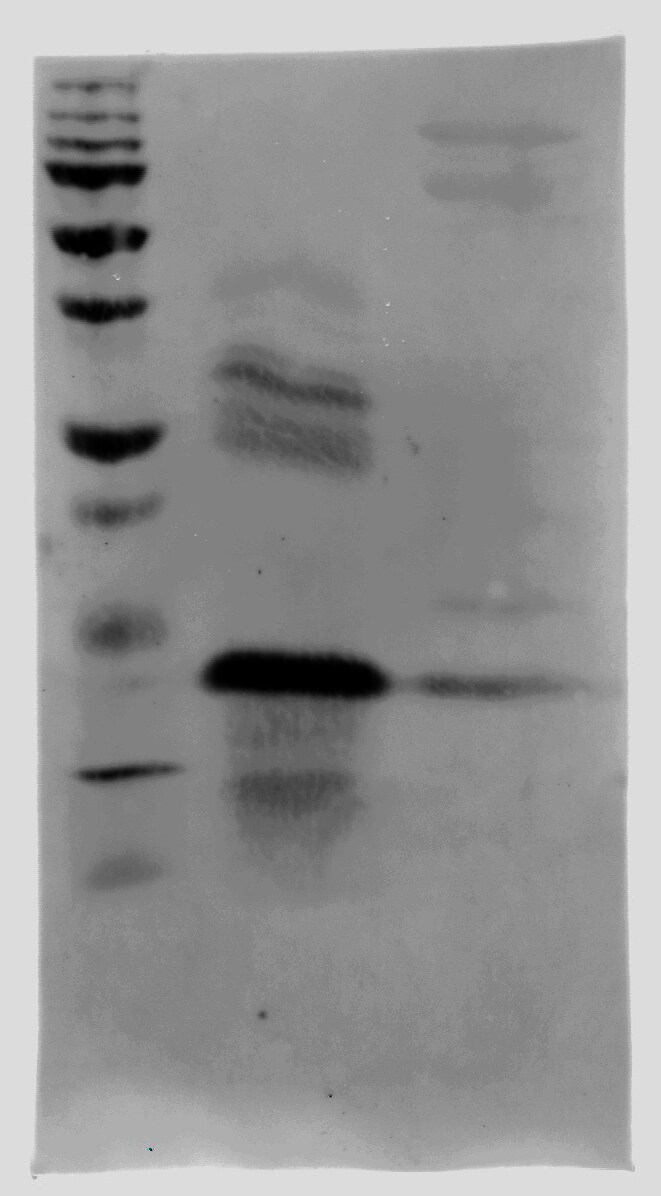
Application: Immunoassay StandardVerified Customer | Posted 06/24/2016

There are no reviews that match your criteria.
Loading...