
TSG-6 (TNF-stimulated gene 6; also TNFIP6) is a secreted, 35-39 kDa group A member of the LINK‑Module superfamily of proteins (1 - 4). Human TSG‑6 is synthesized as a 277 amino acid (aa) precursor. It contains a 17 aa signal sequence and a 260 aa mature region (5, 6). The mature region shows an N-terminal LINK module (aa 36-129) and a C-terminal CUB (C1s/C1r; urchin embryonic growth factor; BMP1) domain (aa 135-247). Link modules are alpha -helical, beta -sheet structures that bind hyaluronan (HA) and participate in extracellular matrix (ECM) assembly (7). Mature human TSG-6 shares 94% aa identity with both mouse and canine TSG-6. Cells reported to express TSG-6 include activated fibroblasts, synoviocytes, chondrocytes, neutrophils, proximal tubular epithelium, bronchial epithelium, endothelium, and visceral, plus vascular smooth muscle (2, 8). TSG-6 has multiple functions, many of which involve the ECM. It is suggested to stabilize HA-rich ECM. It does so by serving as an intermediary, or link, between the individual subunits of extracellular decameric pentraxin 3 and the surrounding hyaluronan matrix (9). It also provides structure and organization to hyaluronan. This is accomplished by a TSG-6 mediated transfer of an 80-85 kDa HC subunit from I alpha I (inter-alpha -inhibitor) to HA. I alpha I is a four-component, 225 kDa serine protease inhibitor. It contains a protease inhibitor subunit (bikunin), two independent, accompaning protein chains (HC1 and HC2), and a short chondroitin sulfate linking moiety. TSG-6 is a cation‑dependent catalyst for the removal, transfer, and subsequent covalent linkage of HC 1/2 to surrounding HA. This provides substance and reinforcement to the ECM (1, 2, 10, 11, 12). The disassembly of I alpha I also leads to free bikunin, which in the “free” state becomes a potent inhibitor of serine proteases (8).
Recombinant Human TSG-6 Protein, CF
R&D Systems | Catalog # 2104-TS

Loading...
Key Product Details
- R&D Systems NS0-derived Recombinant Human TSG-6 Protein (2104-TS)
- Quality control testing to verify active proteins with lot specific assays by in-house scientists
- All R&D Systems proteins are covered with a 100% guarantee
Source
NS0
Accession Number
Applications
Binding Activity
Loading...
Product Specifications
Source
Mouse myeloma cell line, NS0-derived human TSG-6 protein
Trp18-Leu277, with a C-terminal 10-His tag
Trp18-Leu277, with a C-terminal 10-His tag
Purity
>90%, by SDS-PAGE visualized with Silver Staining and quantitative densitometry by Coomassie® Blue Staining.
Endotoxin Level
<0.10 EU per 1 μg of the protein by the LAL method.
N-terminal Sequence Analysis
Trp18
Predicted Molecular Mass
30.5 kDa
SDS-PAGE
40 kDa, reducing conditions
Activity
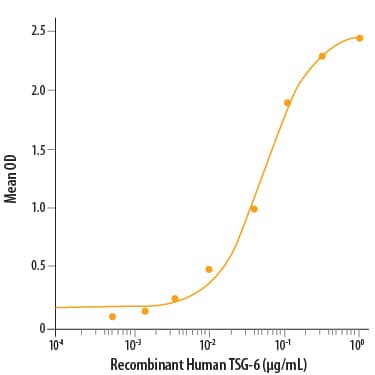
Measured by its binding ability in a functional ELISA.
When Recombinant Human TSG-6 is present at 0.5 μg/well, the concentration of biotinylated hyaluronan that produces 50% of the optimal binding response is found to be approximately 4-30 ng/mL.
When Recombinant Human TSG-6 is present at 0.5 μg/well, the concentration of biotinylated hyaluronan that produces 50% of the optimal binding response is found to be approximately 4-30 ng/mL.
Scientific Data Images for Recombinant Human TSG-6 Protein, CF
Recombinant Human TSG-6 Protein Binding Activity
Recombinant Human TSG-6 (Catalog # 2104-TS) binds hyaluronan in a functional ELISA. When Recombinant Human TSG-6 is present at 0.5 µg/mL, the concentration of biotinylated hyaluronan that produces 50% of the optimal binding response is approximately 4-30 ng/mL.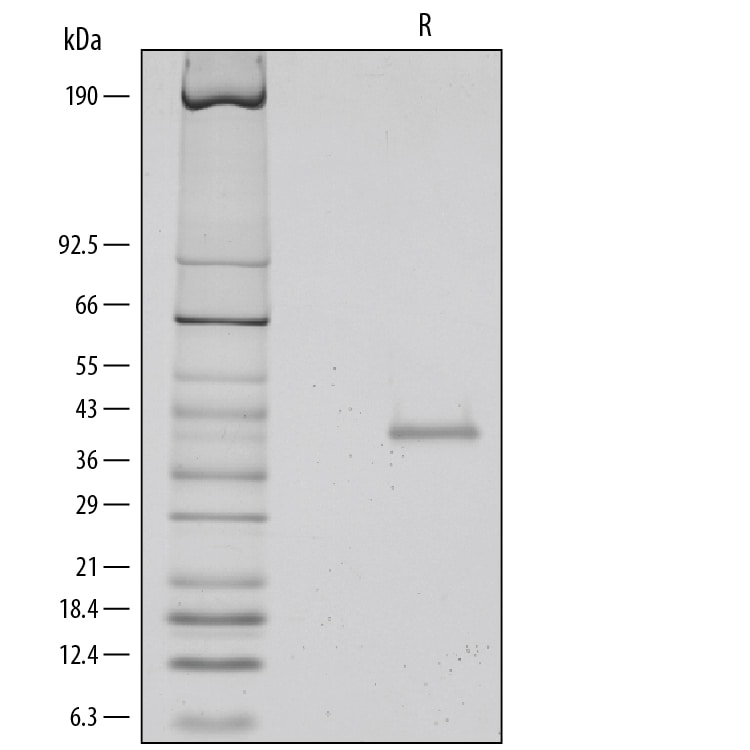
Recombinant Human TSG-6 Protein SDS-PAGE
1 μg/lane of Recombinant Human TSG-6 was resolved with SDS-PAGE under reducing (R) conditions and visualized by silver staining, showing a single band at 40 kDa.Formulation, Preparation, and Storage
2104-TS
| Formulation | Lyophilized from a 0.2 μm filtered solution in PBS. |
| Reconstitution | Reconstitute at 100 μg/mL in sterile PBS.
Loading...
|
| Shipping | The product is shipped with polar packs. Upon receipt, store it immediately at the temperature recommended below. |
| Stability & Storage | Use a manual defrost freezer and avoid repeated freeze-thaw cycles.
|
Calculators
Background: TSG-6
References
- Milner, C.M. et al. (2006) Biochem. Soc. Trans. 34:446.
- Milner, C.M. and A.J. Day (2003) J. Cell Sci. 116:1863.
- Wisnieewski, H-G. and J. Vilcek (2004) Cytokine Growth Factor Rev. 15:129.
- Blundell, C.D. et al. (2005) J. Biol. Chem. 280:18189.
- Lee, T.H. et al. (1990) Mol. Cell. Biol. 10:1982.
- Lee, T.H. et al. (1992) J. Cell Biol. 116:545.
- Kohda, D. et al. (1996) Cell 86:767.
- Forteza, R. et al. (2007) Am. J. Respir. Cell Mol. Biol. 36:20.
- Salustri, A. et al. (2003) Development 131:1577.
- Rugg, M.S. et al. (2005) J. Biol. Chem. 280:25674.
- Sanggaard, K.W. et al. (2006) Biochemistry 45:7661.
- Sanggaard, K.W. et al. (2005) J. Biol. Chem. 280:11936.
Long Name
Tumor Necrosis Factor-stimulated Gene Sequence 6
Alternate Names
TNFAIP6, TSG6
Gene Symbol
TNFAIP6
UniProt
Additional TSG-6 Products
Product Documents for Recombinant Human TSG-6 Protein, CF
Certificate of Analysis
To download a Certificate of Analysis, please enter a lot or batch number in the search box below.
Note: Certificate of Analysis not available for kit components.
Product Specific Notices for Recombinant Human TSG-6 Protein, CF
For research use only
Related Research Areas
Citations for Recombinant Human TSG-6 Protein, CF
 Powered by Bioz
Customer Reviews for Recombinant Human TSG-6 Protein, CF
There are currently no reviews for this product. Be the first to review Recombinant Human TSG-6 Protein, CF and earn rewards!
Have you used Recombinant Human TSG-6 Protein, CF?
Submit a review and receive an Amazon gift card!
$25/€18/£15/$25CAN/¥2500 for a review with an image
$10/€7/£6/$10CAN/¥1110 for a review without an image
Submit a review
Loading...