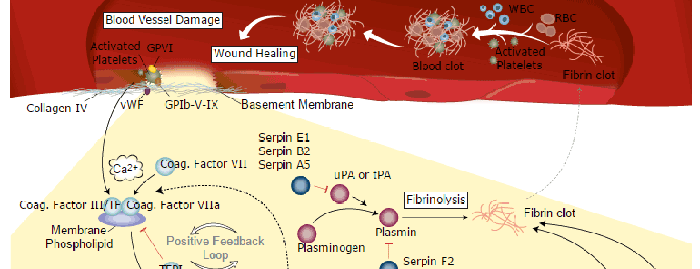
uPA is a serine protease with an extremely limited substrate specificity, cleaving the sequence Cys-Pro-Gly-Arg560-Val561-Val-Gly-Gly-Cys in plasminogen to form plasmin (1). uPA is a potent marker of invasion and metastasis in a variety of human cancers associated with breast, stomach, colon, bladder, ovary, brain and endometrium (2). For example, the combination (both low vs. either or both high) of uPA and its inhibitor, plasminogen activator inhibitor-1 (PAI-1), outperforms the single factors as well as other traditional prognostic factors with regard to risk group assessment for breast cancer, particularly in node-negative breast cancer (3). The human uPA is initially synthesized as 431 amino acid precursor with a N-terminal signal peptide (20 residues) (4‑6). The single chain molecule is processed into a disulfide-linked two-chain molecule. The B chain starting at Ile179 corresponds to the catalytic domain. Two forms of the A chain exist, one starting at Ser21 (the long form) and the other at Lys156 (the short form). The resulting two-chain forms have different molecular weights (MW). The B chain is common for both forms whereas the long and short A chains are unique to the high and low MW forms, respectively. The long A chain contains an EGF-like domain, which is responsible for binding of the uPA receptor (uPAR). Both high and low MW forms exist in the purified recombinant human uPA.
Recombinant Human u-Plasminogen Activator/Urokinase, CF
R&D Systems | Catalog # 1310-SE

Key Product Details
- R&D Systems NS0-derived Recombinant Human u-Plasminogen Activator/Urokinase (1310-SE)
- Quality control testing to verify active proteins with lot specific assays by in-house scientists
- All R&D Systems proteins are covered with a 100% guarantee
Source
Accession Number
Applications
Product Specifications
Source
Met1-Leu431 with a C-terminal 10-His tag
Purity
Endotoxin Level
N-terminal Sequence Analysis
Predicted Molecular Mass
SDS-PAGE
Activity
The specific activity is >2,000 pmol/min/µg, as measured under the described conditions.
Scientific Data Images for Recombinant Human u-Plasminogen Activator/Urokinase, CF
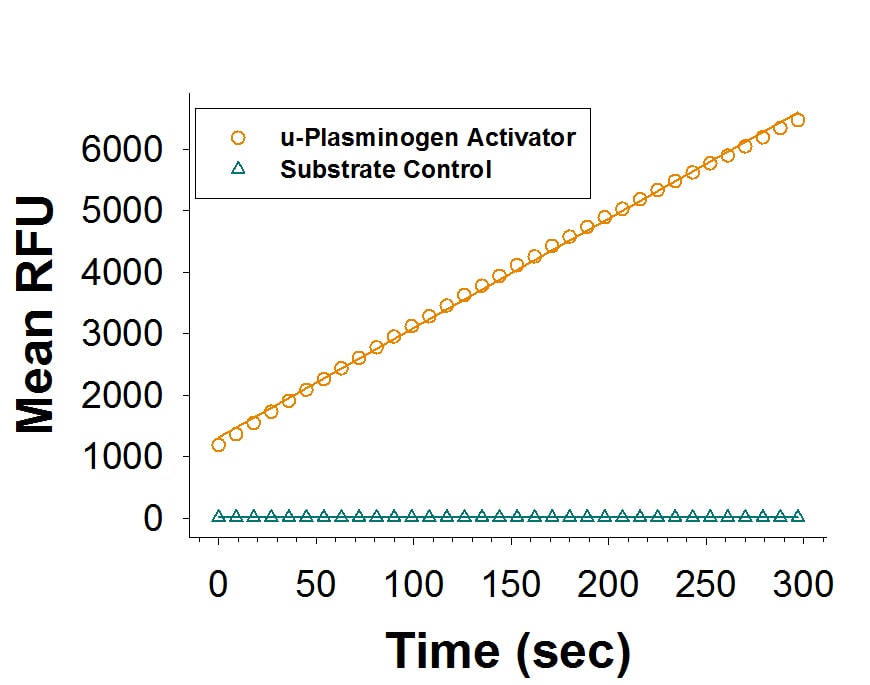
Recombinant Human u-Plasminogen Activator/Urokinase Enzyme Activity
Recombinant Human u-Plasminogen Activator/Urokinase (Catalog # 1310-SE) is measured by its ability to cleave a peptide substrate, N-carbobenzyloxy-Gly-Gly-Arg-7-amido-4-methylcoumarin (Z-GGR-AMC).Formulation, Preparation, and Storage
1310-SE
| Formulation | Supplied as a 0.2 μm filtered solution in HEPES, NaCl and CaCl2. |
| Shipping | The product is shipped with polar packs. Upon receipt, store it immediately at the temperature recommended below. |
| Stability & Storage | Use a manual defrost freezer and avoid repeated freeze-thaw cycles.
|
Background: u-Plasminogen Activator (uPA)/Urokinase
References
- Ellis, V. (2004) in Handbook of Proteolytic Enzymes. Barrett, A.J. et al. eds., Academic Press, San Diego, pp.1677.
- Duffy, M.J. (2002) Biochem. Soc. Trans. 30:207.
- Harbeck, N. et al. (2002) Clin. Breast Cancer 3:196.
- Riccio, A. et al. (1985) Nucleic Acids Res. 13:2785.
- Nagai, M. et al. (1985) Gene 36:183.
- Jacobs, P. et al. (1985) DNA 4:139.
Long Name
Alternate Names
Gene Symbol
UniProt
Additional u-Plasminogen Activator (uPA)/Urokinase Products
- All Products for u-Plasminogen Activator (uPA)/Urokinase
- u-Plasminogen Activator (uPA)/Urokinase Activity Assays
- u-Plasminogen Activator (uPA)/Urokinase cDNA Clones
- u-Plasminogen Activator (uPA)/Urokinase ELISA Kits
- u-Plasminogen Activator (uPA)/Urokinase Lysates
- u-Plasminogen Activator (uPA)/Urokinase Primary Antibodies
- u-Plasminogen Activator (uPA)/Urokinase Proteins and Enzymes
- u-Plasminogen Activator (uPA)/Urokinase Simple Plex
Product Documents for Recombinant Human u-Plasminogen Activator/Urokinase, CF
Certificate of Analysis
To download a Certificate of Analysis, please enter a lot or batch number in the search box below.
Note: Certificate of Analysis not available for kit components.
Product Specific Notices for Recombinant Human u-Plasminogen Activator/Urokinase, CF
For research use only
Citations for Recombinant Human u-Plasminogen Activator/Urokinase, CF
 Powered by Bioz
Customer Reviews for Recombinant Human u-Plasminogen Activator/Urokinase, CF
There are currently no reviews for this product. Be the first to review Recombinant Human u-Plasminogen Activator/Urokinase, CF and earn rewards!
Have you used Recombinant Human u-Plasminogen Activator/Urokinase, CF?
Submit a review and receive an Amazon gift card!
$25/€18/£15/$25CAN/¥2500 for a review with an image
$10/€7/£6/$10CAN/¥1110 for a review without an image
Submit a review
Protocols
View specific protocols for Recombinant Human u-Plasminogen Activator/Urokinase, CF (1310-SE):
- Assay Buffer: 50 mM Tris, 0.01% (v/v) Tween® 20, pH 8.5
- Recombinant Human u‑Plasminogen Activator (uPA)/Urokinase (rhuPA) (Catalog # 1310-SE)
- Substrate: Z-Gly-Gly-Arg-AMC (Bachem, Catalog # I-1140), 10 mM stock in DMSO
- F16 Black Maxisorp Plate (Nunc, Catalog # 475515)
- Fluorescent Plate Reader (Model: SpectraMax Gemini EM by Molecular Devices) or equivalent
- Dilute rhuPA to 1 ng/µL in Assay Buffer.
- Dilute Substrate to 200 µM in Assay Buffer.
- Load 50 µL of the 1 ng/µL rhuPA into a black well plate, and start the reaction by adding 50 µL of 200 µM Substrate. Include a Substrate Blank containing 50 µL Assay Buffer and 50 µL of 200 µM Substrate without any rhuPA.
- Read at excitation and emission wavelengths of 380 nm and 460 nm (top read), respectively, in kinetic mode for 5 minutes.
- Calculate specific activity:
|
Specific Activity (pmol/min/µg) = |
Adjusted Vmax* (RFU/min) x Conversion Factor** (pmol/RFU) |
| amount of enzyme (µg) |
*Adjusted for Substrate Blank
**Derived using calibration standard 7-amino, 4-Methyl Coumarin (Sigma, Catalog # A-9891)
- rhuPA: 0.05 µg
- Substrate: 100 µM
FAQs for Recombinant Human u-Plasminogen Activator/Urokinase, CF
-
Q: Has R&D Systems examined the binding ability of 1310-SE to uPAR?
A: In house, we measured the bioactivity of 1310-SE based on its ability to cleave the Z-GGR-AMC peptide substrate. While we did not measure the binding ability in this assay, we do offer the Recombinant Human uPAR Protein (Catalog # 807-UK), which has been tested in a functional ELISA binding assay with 1310-SE. We have found that the 1310-SE protein is able to bind to uPAR through this testing.
Associated Pathways