
Ubiquitin-activating Enzyme (UBE1), also known as Ubiquitin-like Modifier Activating Enzyme 1 (UBA1), is a 1058 amino acid (aa) canonical member of the Ubiquitin-activating (E1) enzyme family of proteins with a predicted molecular weight of 118 kDa. It is ubiquitously expressed and highly conserved; mouse and rat UBE1 share 95% and 96% aa sequence identity with the human UBE1 protein, respectively. UBE1 is found in the cytoplasm and nucleus, and contains a conserved active-site cysteine residue and ATP-binding site common to E1 enzymes (1-3). UBE1 is responsible for the first step in Ubiquitin-protein isopeptide bond formation (4,5). Ubiquitin is activated by UBE1 and thereafter linked to the side chain of a cysteine residue in UBE1, Cys632 in humans, yielding a Ubiquitin-UBE1 conjugate via a thioester bond (5-8). The activated Ubiquitin is then transferred to a lysine residue on the target protein via the Ubiquitin-conjugating – Ubiquitin ligase enzyme cascade. UBE1 is required for cell cycle progression and has been linked to cellular responses to DNA damage such as nucleotide excision repair (3,9,10). Mutations in UBE1 are associated with X-linked lethal infantile spinal muscular atrophy (11). UBE1 is a critical component for the initiation of in vitro ubiquitin conjugation reactions.
Best Seller
Recombinant Human Ubiquitin Activating Enzyme (UBE1), CF
R&D Systems | Catalog # E-305
Analyzed by SEC-MALS

Loading...
Key Product Details
- R&D Systems Sf 21 (baculovirus)-derived Recombinant Human Ubiquitin Activating Enzyme (UBE1) (E-305)
- Quality control testing to verify active proteins with lot specific assays by in-house scientists
- All R&D Systems proteins are covered with a 100% guarantee
Source
Sf 21 (baculovirus)
Accession Number
Applications
Enzyme Activity
Loading...
Product Specifications
Source
Spodoptera frugiperda, Sf 21 (baculovirus)-derived human Ubiquitin-activating Enzyme/UBE1 protein
Purity
>95%, by SDS-PAGE under reducing conditions and visualized by Colloidal Coomassie® Blue stain.
Predicted Molecular Mass
118 kDa
Activity
Recombinant Human Ubiquitin Activating Enzyme (UBE1) is a member of the Ubiquitin-activating (E1) enzyme family that is required for the first step of the enzymatic cascade that subsequently utilizes a Ubiquitin-conjugating (E2) enzyme and a Ubiquitin ligase (E3) to conjugate Ubiquitin to substrate proteins. Reaction conditions will need to be optimized for each specific application. We recommend an initial Recombinant Human Ubiquitin Activating Enzyme (UBE1) concentration of 50-200 nM.
Reviewed Applications
Read 2 reviews rated 5 using E-305 in the following applications:
Scientific Data Images for Recombinant Human Ubiquitin Activating Enzyme (UBE1), CF
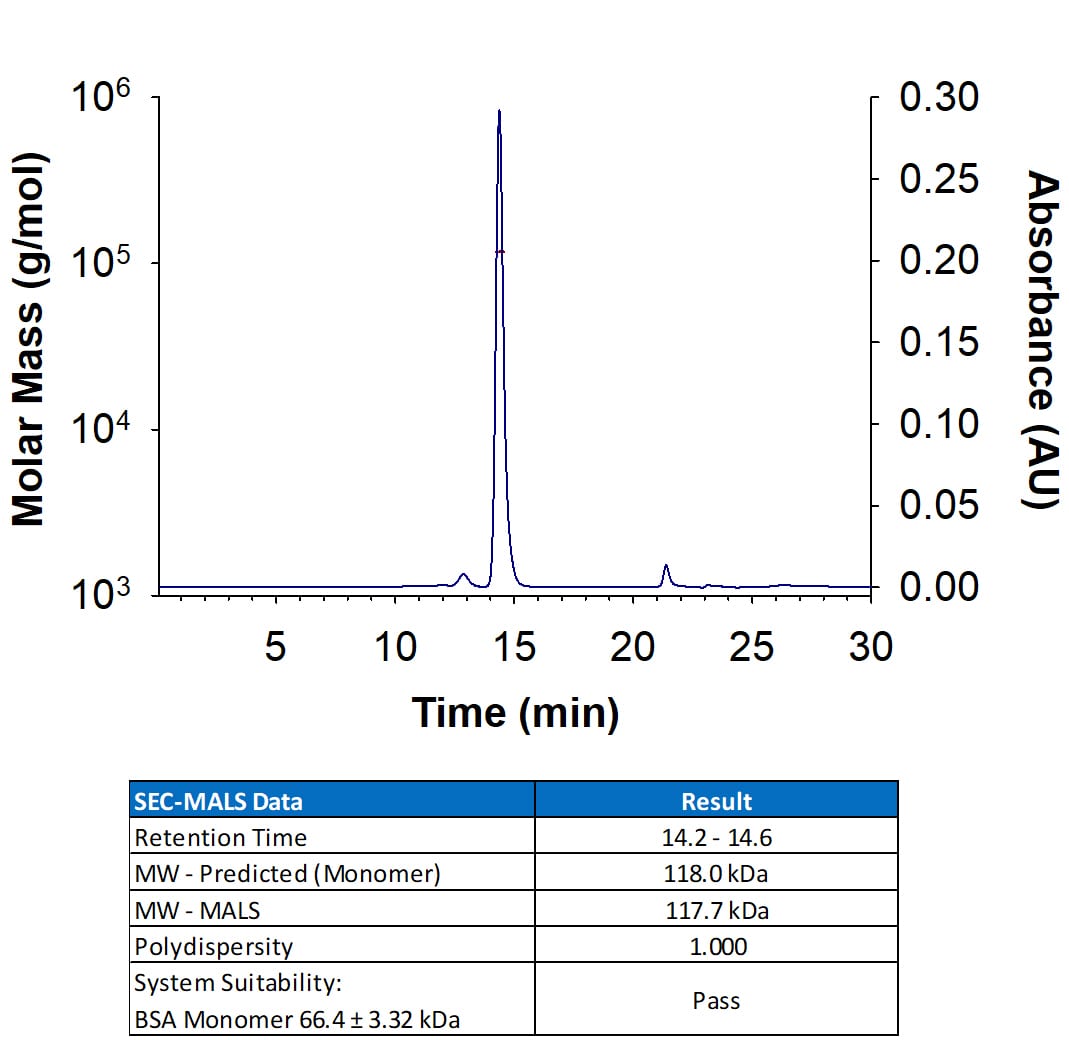
Recombinant Human Ubiquitin‑activating Enzyme/UBE1 Protein SEC-MALS.
Recombinant Human Ubiquitin‑activating Enzyme/UBE1 Protein (Catalog # E-305) has a molecular weight (MW) of 112-124 kDa as analyzed by SEC-MALS, suggesting that this protein is a monomer.Formulation, Preparation, and Storage
E-305
| Formulation | Supplied as a solution in HEPES, NaCl and TCEP. |
| Shipping | The product is shipped with dry ice or equivalent. Upon receipt, store it immediately at the temperature recommended below. |
| Stability & Storage | Use a manual defrost freezer and avoid repeated freeze-thaw cycles.
|
Background: Ubiquitin-activating Enzyme/UBE1
References
- Handley, P.M. et al. (1991) Proc. Natl. Acad. Sci. USA 88:258.
- Nagai, Y. et al. (1995) J. Cell Sci. 108:2145.
- Stephen, A.G. et al. (1996) J. Biol. Chem. 271:15608.
- Hershko, A. et al. (1983) J. Biol. Chem. 258:8206.
- Schulman, B.A. & J.W. Harper (2009) Nat. Rev. Mol. Cell Biol. 10:319.
- Haas, A.L. et al. (1982) J. Biol. Chem. 257:2543.
- Haas, A.L. & I.A. Rose (1982) J. Biol. Chem. 257:10329.
- Pickart, C.M. et al. (1994) J. Biol. Chem. 269:7115.
- Nouspikel, T. & P.C. Hanawalt (2006) Proc. Natl. Acad. Sci. USA 103:16188.
- Moundry, P. et al. (2012) Cell Cycle 11:1573.
- Ramser, J. et al. (2008) Am. J. Hum. Genet. 82:188.
Alternate Names
A1S9T, AMCX1, GXP1, POC20, SMAX2, UBA1, UBE1, Ubiquitinactivating Enzyme
Gene Symbol
UBA1
UniProt
Additional Ubiquitin-activating Enzyme/UBE1 Products
Product Documents for Recombinant Human Ubiquitin Activating Enzyme (UBE1), CF
Certificate of Analysis
To download a Certificate of Analysis, please enter a lot or batch number in the search box below.
Note: Certificate of Analysis not available for kit components.
Product Specific Notices for Recombinant Human Ubiquitin Activating Enzyme (UBE1), CF
For research use only
Related Research Areas
Citations for Recombinant Human Ubiquitin Activating Enzyme (UBE1), CF
 Powered by Bioz
Customer Reviews for Recombinant Human Ubiquitin Activating Enzyme (UBE1), CF (2)
5 out of 5
2 Customer Ratings
Have you used Recombinant Human Ubiquitin Activating Enzyme (UBE1), CF?
Submit a review and receive an Amazon gift card!
$25/€18/£15/$25CAN/¥2500 for a review with an image
$10/€7/£6/$10CAN/¥1110 for a review without an image
Submit a review
Customer Images
Showing
1
-
2 of
2 reviews
Showing All
Filter By:
-
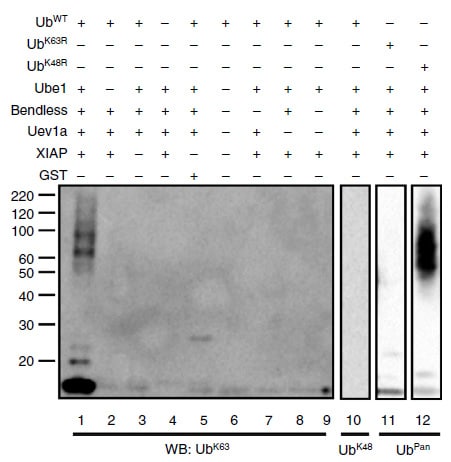
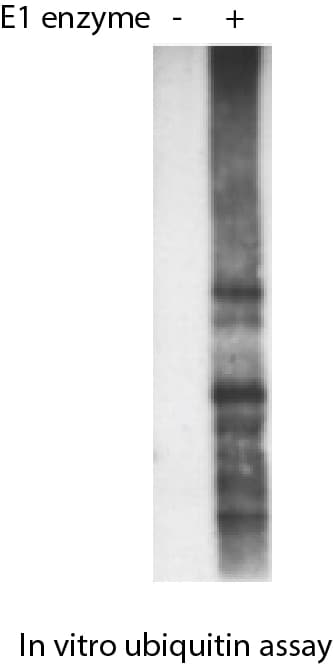
Application: Enzymatic activity in vitroVerified Customer | Posted 10/20/2017

-
Application: Enzymatic activity in vitroVerified Customer | Posted 08/17/2016
There are no reviews that match your criteria.
Loading...
Associated Pathways
