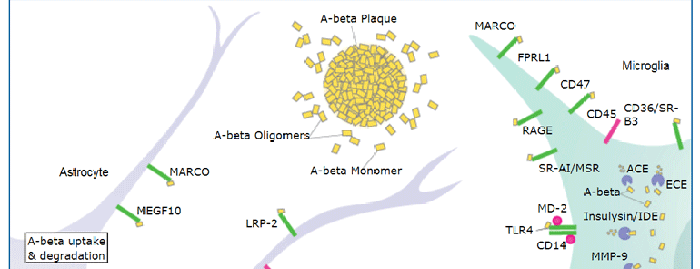
Fractalkine, designated CX3CL1 and also known as neurotactin, is the only member of the CX3C, or delta, chemokine subfamily (1 ‑ 4). Unlike most other chemokines, CX3CL1 is a type I transmembrane (TM) adhesion protein (1). The mouse CX3CL1 cDNA encodes 395 amino acids (aa), including a signal sequence (aa 1 ‑ 24), a chemokine domain (aa 25 ‑ 100), a mucin stalk region (aa 101 ‑ 336), a transmembrane segment (aa 337 ‑ 357), and a cytoplasmic tail (aa 358 ‑ 395). The chemokine domain contains binding and chemotactic determinants, while the mucin stalk appears to function only as a spacer (4, 5). Mouse CX3CL1 shares 85% and 78% aa sequence identity with rat and human CX3CL1, respectively, within the chemokine domain, but lower sequence identity within other domains. CX3CL1 is up‑regulated by pro‑inflammatory stimuli, especially IFN‑ gamma and TNF‑ alpha, on cell types including macrophages, dendritic cells, endothelium, neurons, smooth muscle and epithelium lining the intestines and other tubules (1, 8, 9). The 40 kDa, 7‑TM non‑glycosylated G‑protein coupled CX3CL1 receptor, CX3CR1, is expressed by cytotoxic effector cells and cytokine producers, including type I helper and cytotoxic T cells, gamma delta T cells, CD16+ NK cells, monocytes and microglia (1, 2). The 95 ‑ 100 kDa TM CX3CL1 can be inducibly cleaved near the TM segment by ADAM10 or ADAM17 to generate a 60 ‑ 80 kDa soluble form (6, 7). TM CX3CL1 functions as an adhesion molecule, while both forms are chemoattractants for target cells expressing CX3CR1 (1, 2). During extravasation, membrane‑bound CX3CL1 traps leukocytes, then is cleaved to allow diapedesis (6). In coronary artery disease, soluble CX3CL1 and CD8+ T cell CX3CR1 are overexpressed and appear to contribute to pathogenesis (1, 10). In the brain, CX3CL1/CX3CR1 interaction protects against microglial neurotoxicity (11). CX3CL1 also contributes to wound healing by recruiting macrophages, and to bone resorption by recruiting and mediating adhesion of osteoclast precursors (12, 13).
Recombinant Mouse CX3CL1/Fractalkine (Full Length) Protein
R&D Systems | Catalog # 472-FF

Key Product Details
- R&D Systems Sf 21 (baculovirus)-derived Recombinant Mouse CX3CL1/Fractalkine (Full Length) Protein (472-FF)
- Quality control testing to verify active proteins with lot specific assays by in-house scientists
- All R&D Systems proteins are covered with a 100% guarantee
Source
Accession Number
Applications
Product Specifications
Source
Gln25-Arg337, with a C-terminal 6-His tag
Purity
Endotoxin Level
N-terminal Sequence Analysis
Predicted Molecular Mass
SDS-PAGE
Activity
The ED50 for this effect is 0.2-0.6 µg/mL.
Measured by its ability to chemoattract BaF3 mouse pro‑B cells transfected with mouse CX3CR1.
The ED50 for this effect is 0.03-0.12 μg/mL.
Formulation, Preparation, and Storage
Carrier Free
What does CF mean?CF stands for Carrier Free (CF). We typically add Bovine Serum Albumin (BSA) as a carrier protein to our recombinant proteins. Adding a carrier protein enhances protein stability, increases shelf-life, and allows the recombinant protein to be stored at a more dilute concentration. The carrier free version does not contain BSA.
What formulation is right for me?In general, we advise purchasing the recombinant protein with BSA for use in cell or tissue culture, or as an ELISA standard. In contrast, the carrier free protein is recommended for applications, in which the presence of BSA could interfere.
Carrier: 472-FF
| Formulation | Lyophilized from a 0.2 μm filtered solution in PBS with BSA as a carrier protein. |
| Reconstitution | Reconstitute at 100 μg/mL in sterile PBS containing at least 0.1% human or bovine serum albumin. |
| Shipping | The product is shipped at ambient temperature. Upon receipt, store it immediately at the temperature recommended below. |
| Stability & Storage | Use a manual defrost freezer and avoid repeated freeze-thaw cycles.
|
Carrier Free: 472-FF/CF
| Formulation | Lyophilized from a 0.2 μm filtered solution in PBS. |
| Reconstitution | Reconstitute at 100 μg/mL in sterile PBS. |
| Shipping | The product is shipped at ambient temperature. Upon receipt, store it immediately at the temperature recommended below. |
| Stability & Storage | Use a manual defrost freezer and avoid repeated freeze-thaw cycles.
|
Calculators
Background: CX3CL1/Fractalkine
References
-
Stievano, L. et al. (2004) Crit. Rev. Immunol. 24:205.
-
Umehara, H. et al. (2004) Arterioscler. Thromb. Vasc. Biol. 24:34.
-
Rossi, D.L. et al. (1998) Genomics 47:163.
-
Mizoue, L.S. et al. (2001) J. Biol. Chem. 276:33906.
-
Harrison, J.K. et al. (2001) J. Biol. Chem. 276:21632.
-
Hundhausen, C. et al. (2007) J. Immunol. 178:8064.
-
Tsou, C. et al. (2001) J. Biol. Chem. 276:44622.
-
Tarozzo, G. et al. (2003) J. Neurosci. Res. 73:81.
-
Lucas, A.D. et al. (2001) Am. J. Pathol. 158:855.
-
Damas, J.K. et al. (2005) Arterioscler. Thromb. Vasc. Biol. 25:2567.
-
Cardona, A.E. et al. (2006) Nat. Neurosci. 9:917.
-
Koizumi, K. et al. (2009) J. Immunol. 183:7825.
-
Ishida, Y. et al. (2008) J. Immunol. 180:569.
Alternate Names
Gene Symbol
UniProt
Additional CX3CL1/Fractalkine Products
Product Documents for Recombinant Mouse CX3CL1/Fractalkine (Full Length) Protein
Certificate of Analysis
To download a Certificate of Analysis, please enter a lot or batch number in the search box below.
Note: Certificate of Analysis not available for kit components.
Product Specific Notices for Recombinant Mouse CX3CL1/Fractalkine (Full Length) Protein
For research use only
Related Research Areas
Citations for Recombinant Mouse CX3CL1/Fractalkine (Full Length) Protein
 Powered by Bioz
Customer Reviews for Recombinant Mouse CX3CL1/Fractalkine (Full Length) Protein
There are currently no reviews for this product. Be the first to review Recombinant Mouse CX3CL1/Fractalkine (Full Length) Protein and earn rewards!
Have you used Recombinant Mouse CX3CL1/Fractalkine (Full Length) Protein?
Submit a review and receive an Amazon gift card!
$25/€18/£15/$25CAN/¥2500 for a review with an image
$10/€7/£6/$10CAN/¥1110 for a review without an image
Submit a review
Associated Pathways