
Fas, also known as APO‑1 or CD95, belongs to the death receptor subfamily of the TNF receptor superfamily and is designated TNFRSF6 (1 ‑ 3). Mouse Fas cDNA encodes 327 amino acids (aa) that include a 21 aa signal peptide, a 148 aa extracellular domain (ECD) that contains three cysteine‑ich TNFR repeats, a 17 aa transmembrane sequence, and a 141 aa cytoplasmic domain containing a death domain (DD), which is required for transducing apoptotic signals (4). Mature mouse Fas ECD shares 68% aa sequence identity with rat Fas, and 53 ‑ 55% with human, feline, bovine and porcine Fas. One potentially secreted 63 aa isoform diverges at aa 61 (5). The Fas ligand (FasL, TNFSF6) is a type II transmembrane protein of the TNF family that can be expressed on activated T‑lymphocytes, NK cells and cells in immune privileged sites, or shed in soluble form (2). Polymorphisms of FasL impart differing activity of Fas depending on mouse strain (6). Engagement of FAS induces oligomerization of preformed Fas trimers (1, 2). The activated receptor recruits the adaptor molecule FADD to form the Death‑Inducing Signaling Complex (DISC). Upon activation, caspases in the DISC initiate the apoptotic signaling cascade (7). Fas is prominent in epithelial cells, hepatocytes, activated mature lymphocytes, virus‑transformed lymphocytes and tumor cells. It is an essential mediator in the activation‑induced death of T lymphocytes that terminates the immune reaction (1, 2, 8). In immune‑privileged tissues, infiltrating Fas‑bearing lymphocytes and inflammatory cells are killed by FasL engagement (9). Both humans and mice with genetic defects in Fas accumulate abnormal lymphocytes and develop systemic autoimmunity (1 ‑ 3). The Fas pathway also appears to cross‑communicate with the BIM (mitochondrial/intrinsic) apoptosis pathway (1).
Recombinant Mouse Fas/TNFRSF6/CD95 Fc Chimera Protein
R&D Systems | Catalog # 435-FA


Key Product Details
- R&D Systems Sf 21 (baculovirus)-derived Recombinant Mouse Fas/TNFRSF6/CD95 Fc Chimera Protein (435-FA)
- Quality control testing to verify active proteins with lot specific assays by in-house scientists
- All R&D Systems proteins are covered with a 100% guarantee
Source
Accession Number
Structure / Form
Applications
Product Specifications
Source
| Mouse FAS (Gly14 - Arg169) Accession # P25446 |
DIEGRMD | Human IgG1 (Pro100 - Lys330) |
6-His tag |
| N-terminus | C-terminus | ||
Purity
Endotoxin Level
N-terminal Sequence Analysis
Predicted Molecular Mass
SDS-PAGE
Activity
The ED50 for this effect is 0.03‑0.1 µg/mL in the presence of 20 ng/mL recombinant human Fas-ligand.
Reviewed Applications
Read 1 review rated 5 using 435-FA in the following applications:
Formulation, Preparation, and Storage
Carrier Free
What does CF mean?CF stands for Carrier Free (CF). We typically add Bovine Serum Albumin (BSA) as a carrier protein to our recombinant proteins. Adding a carrier protein enhances protein stability, increases shelf-life, and allows the recombinant protein to be stored at a more dilute concentration. The carrier free version does not contain BSA.
What formulation is right for me?In general, we advise purchasing the recombinant protein with BSA for use in cell or tissue culture, or as an ELISA standard. In contrast, the carrier free protein is recommended for applications, in which the presence of BSA could interfere.
Carrier: 435-FA
| Formulation | Lyophilized from a 0.2 μm filtered solution in PBS with BSA as a carrier protein. |
| Reconstitution | Reconstitute at 50 μg/mL in sterile PBS containing at least 0.1% human or bovine serum albumin. |
| Shipping | The product is shipped at ambient temperature. Upon receipt, store it immediately at the temperature recommended below. |
| Stability & Storage | Use a manual defrost freezer and avoid repeated freeze-thaw cycles.
|
Carrier Free: 435-FA/CF
| Formulation | Lyophilized from a 0.2 μm filtered solution in PBS. |
| Reconstitution | Reconstitute at 100 μg/mL in sterile PBS. |
| Shipping | The product is shipped at ambient temperature. Upon receipt, store it immediately at the temperature recommended below. |
| Stability & Storage | Use a manual defrost freezer and avoid repeated freeze-thaw cycles.
|
Calculators
Background: Fas/TNFRSF6/CD95
References
- Bouillet, P. and L.A. O’Reilly (2009) Nat. Rev. Immunol. 9:514.
- Strasser, A. et al. (2009) Immunity 30:180.
- Ashkenazi, A. and V. Dixit (1999) Curr. Opin. Cell Biol. 11:255.
- SwissProt accession P25446.
- NCBI accession NP_001140180.
- Kayagaki, N. et al. (1997) Proc. Natl. Acad. Sci. USA 94:3914.
- Thorburn, A. (2003) Cellular Signaling 16:139.
- Barreiro, R. et al. (2004) J. Immunol. 173:1519.
- Ferguson, T.A. and T.S Griffith (2006) Immunol. Rev. 213:228.
Long Name
Alternate Names
Entrez Gene IDs
Gene Symbol
UniProt
Additional Fas/TNFRSF6/CD95 Products
Product Documents for Recombinant Mouse Fas/TNFRSF6/CD95 Fc Chimera Protein
Certificate of Analysis
To download a Certificate of Analysis, please enter a lot or batch number in the search box below.
Note: Certificate of Analysis not available for kit components.
Product Specific Notices for Recombinant Mouse Fas/TNFRSF6/CD95 Fc Chimera Protein
For research use only
Citations for Recombinant Mouse Fas/TNFRSF6/CD95 Fc Chimera Protein
 Powered by Bioz
Customer Reviews for Recombinant Mouse Fas/TNFRSF6/CD95 Fc Chimera Protein (1)
Have you used Recombinant Mouse Fas/TNFRSF6/CD95 Fc Chimera Protein?
Submit a review and receive an Amazon gift card!
$25/€18/£15/$25CAN/¥2500 for a review with an image
$10/€7/£6/$10CAN/¥1110 for a review without an image
Submit a review
Customer Images
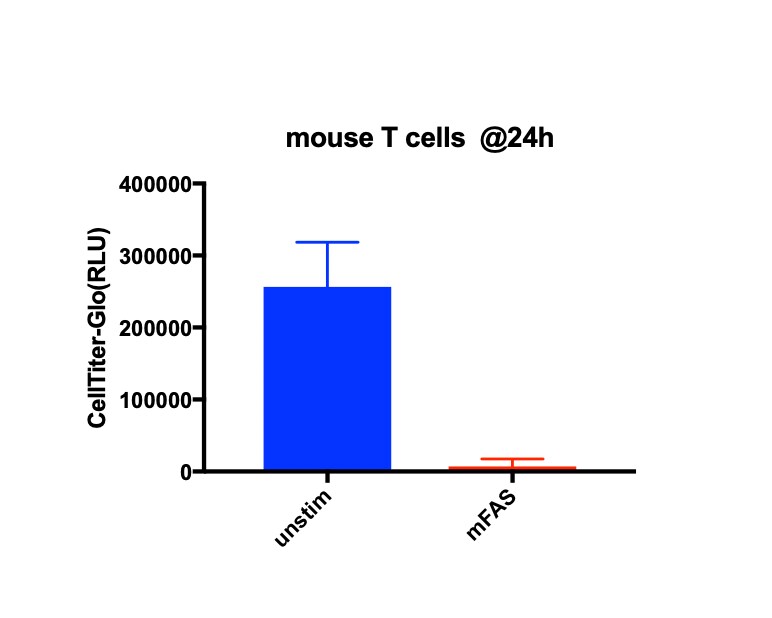
-
Application: Apoptosis assayVerified Customer | Posted 12/16/2019

There are no reviews that match your criteria.
Associated Pathways


