
Recombinant Mouse Lysosomal alpha-Glucosidase/GAA, CF
R&D Systems | Catalog # 11400-GH
His-tag

Loading...
Key Product Details
- R&D Systems CHO-derived Recombinant Mouse Lysosomal alpha-Glucosidase/GAA (11400-GH)
- Quality control testing to verify active proteins with lot specific assays by in-house scientists
- All R&D Systems proteins are covered with a 100% guarantee
Source
CHO
Accession Number
Applications
Enzyme Activity
Loading...
Product Specifications
Source
Chinese Hamster Ovary cell line, CHO-derived mouse Lysosomal alpha-Glucosidase protein
Glu70-Ser953 with a N-terminal 6-His tag
Glu70-Ser953 with a N-terminal 6-His tag
Purity
>95%, by SDS-PAGE visualized with Silver Staining and quantitative densitometry by Coomassie® Blue Staining.
Endotoxin Level
<0.10 EU per 1 μg of the protein by the LAL method.
N-terminal Sequence Analysis
His
Predicted Molecular Mass
99 kDa
SDS-PAGE
97-107 kDa, under reducing conditions
Activity
Measured by its ability to release glucose from starch.
The specific activity is >5000 pmol/min/μg, as measured under the described conditions.
The specific activity is >5000 pmol/min/μg, as measured under the described conditions.
Scientific Data Images for Recombinant Mouse Lysosomal alpha-Glucosidase/GAA, CF
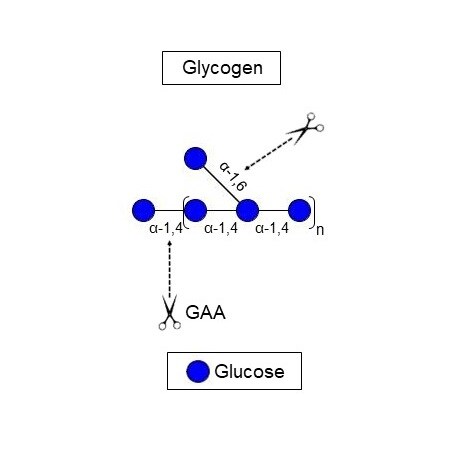
Recombinant Mouse Lysosomal alpha -Glucosidase His-tag Protein Enzyme Activity Diagram.
Recombinant Mouse Lysosomal alpha -Glucosidase His-tag Protein, CF (Catalog # 11400-GH) hydrolyses both alpha-1,4- and alpha-1,6-glucosidic linkages on glycogen to release terminal glucose.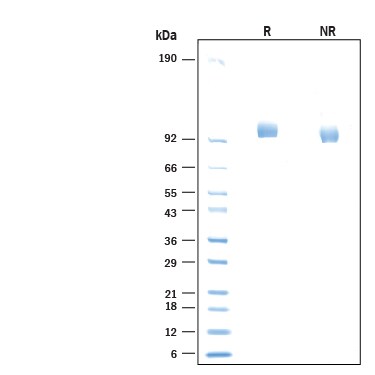
Recombinant Mouse Lysosomal alpha ‑Glucosidase His-tag Protein SDS-PAGE.
2 μg/lane of Recombinant Mouse Lysosomal alpha ‑Glucosidase His-tag Protein (Catalog # 11400-GH) was resolved with SDS-PAGE under reducing (R) and non-reducing (NR) conditions and visualized by Coomassie® Blue staining, showing bands at 97-107 kDa, under reducing conditions.Formulation, Preparation, and Storage
11400-GH
| Formulation | Supplied as a 0.2 μm filtered solution in Tris and NaCl. |
| Shipping | The product is shipped with polar packs. Upon receipt, store it immediately at the temperature recommended below. |
| Stability & Storage | Use a manual defrost freezer and avoid repeated freeze-thaw cycles.
|
Background: Lysosomal alpha-Glucosidase
References
- Hoefsloot, L.H. et. al. (1988) EMBO J. 7:1697.
- Roig-Zamboni, V. et. al. (2017) Nat. Commun. 8:1111.
- Wan, L. et. al. (2008) J. Neurol. 255:831.
- Fukuda, T. et. al. (2007) Curr. Neurol. Neurosci. Rep. 7:71.
- Van Gelder, C.M. et. al. (2014) J. Inherit. Metab. Dis. In press.
- Toscano, A. and B. Schoser. (2013) J. Neurol. 260:951.
- Porto, C. et. al. (2012) Mol. Ther. 20:2201.
- Parenti, G. et. al. (2015). Mol. Ther. 23:1138.
Long Name
Glucosidase, Alpha; Acid
Alternate Names
Acid alpha-Glucosidase, Acid Maltase, GAA, LYAG, Lysosomal alphaGlucosidase
Gene Symbol
GAA
UniProt
Additional Lysosomal alpha-Glucosidase Products
Product Documents for Recombinant Mouse Lysosomal alpha-Glucosidase/GAA, CF
Certificate of Analysis
To download a Certificate of Analysis, please enter a lot or batch number in the search box below.
Note: Certificate of Analysis not available for kit components.
Product Specific Notices for Recombinant Mouse Lysosomal alpha-Glucosidase/GAA, CF
For research use only
Related Research Areas
Customer Reviews for Recombinant Mouse Lysosomal alpha-Glucosidase/GAA, CF
There are currently no reviews for this product. Be the first to review Recombinant Mouse Lysosomal alpha-Glucosidase/GAA, CF and earn rewards!
Have you used Recombinant Mouse Lysosomal alpha-Glucosidase/GAA, CF?
Submit a review and receive an Amazon gift card!
$25/€18/£15/$25CAN/¥2500 for a review with an image
$10/€7/£6/$10CAN/¥1110 for a review without an image
Submit a review
Protocols
View specific protocols for Recombinant Mouse Lysosomal alpha-Glucosidase/GAA, CF (11400-GH):
Materials
- Assay Buffer: 0.1 M Sodium Acetate, pH 4.5
- Recombinant Mouse Lysosomal alpha-Glucosidase/GAA (rmGAA) (Catalog # 11400-GH)
- Substrate: Starch from potato, 2% (w/v) stock in deionized water
- Stop Solution: 4.4 mM Dinitrosalicylic Acid, 1 M Potassium Tartrate, 0.4 M Sodium Hydroxide in deionized water
- Maltose Standard, 20 mM stock in deionized water
- 96 well Clear Plate (Catalog # DY990)
- Plate Reader with Absorbance Read Capability
- Dilute 20 mM Maltose standard by adding 200 µL of 20 mM Maltose Standard to 600 µL of Assay Buffer for a 5 mM stock. This is the first point of the standard curve.
- Prepare the standard curve by performing five one-half serial dilutions of the 5 mM Maltose stock in Assay Buffer. Make sure there are 400 μL in each tube for each point of the curve (remove 400 μL from the last point of the curve). Prepare one tube with only 400 μL of Assay Buffer for the curve blank. The standard curve has a range of 19.5 to 625 nmol per well.
- Dilute rmGAA to 32 μg/mL in Assay Buffer.
- Dilute 2% starch to 1.5% in Assay Buffer.
- Prepare reactions by combining 20 μL of diluted rmGAA with 380 μL of 1.5% starch (step 4). Include a control by combining 20 μL of Assay Buffer with 380 μL of 1.5% starch.
- Vortex, spin, and then incubate reactions, control, and standard curve at 37 °C for 1 hour.
- Add 400 μL of Stop Solution to all vials, including standard curve.
- Heat all vials at 95-100 °C for 6 minutes. Then, cool on ice. Tip: Use lid-locks to keep vials closed when heating.
- Load 250 µL of each dilution of the standard curve, reactions, and controls to empty wells in clear plate.
- Read plate at 546 nm (absorbance) in endpoint mode.
- Calculate specific activity:
Specific Activity (pmol/min/µg) = | Adjusted glucose produced* (nmol) x (1000 pmol/nmol) |
| Incubation time (min) x amount of enzyme (µg) |
*Derived from the maltose standard curve using linear or 4-parameter fitting and adjusted for Control.
Per Well
- rmGAA: 0.2 μg
- Starch: 0.71%
Loading...
Associated Pathways
