


Loading...
Key Product Details
- R&D Systems NS0-derived Recombinant Mouse PIR-B Protein (2754-PB)
- Quality control testing to verify active proteins with lot specific assays by in-house scientists
- All R&D Systems proteins are covered with a 100% guarantee
Source
NS0
Accession Number
Applications
Bioactivity
Loading...
Product Specifications
Source
Mouse myeloma cell line, NS0-derived mouse PIR-B protein
Gly24-Gly635, with a C-terminal 6-His tag
Gly24-Gly635, with a C-terminal 6-His tag
Purity
>95%, by SDS-PAGE under reducing conditions and visualized by silver stain.
Endotoxin Level
<0.10 EU per 1 μg of the protein by the LAL method.
N-terminal Sequence Analysis
Gly24
Predicted Molecular Mass
69 kDa
SDS-PAGE
85-95 kDa, reducing conditions
Activity
Measured by its binding ability in a functional ELISA.
When biotinylated recombinant rat MAG/Siglec-4a Fc Chimera is catured on Streptavidin coated plate (Catalog # CP003), Recombinant Mouse PIR-B binds with an apparent Kd < 100 nM.
When biotinylated recombinant rat MAG/Siglec-4a Fc Chimera is catured on Streptavidin coated plate (Catalog # CP003), Recombinant Mouse PIR-B binds with an apparent Kd < 100 nM.
Reviewed Applications
Read 1 review rated 3 using 2754-PB in the following applications:
Formulation, Preparation, and Storage
2754-PB
| Formulation | Lyophilized from a 0.2 μm filtered solution in PBS with trehalose |
| Reconstitution | Reconstitute at 250 μg/mL in sterile PBS.
Loading...
|
| Shipping | The product is shipped at ambient temperature. Upon receipt, store it immediately at the temperature recommended below. |
| Stability & Storage | Use a manual defrost freezer and avoid repeated freeze-thaw cycles.
|
Calculators
Background: PIR-B
References
- Anderson, K.J. and R.L. Allen (2009) Immunology 127:8.
- Hayami, K. et al. (1997) J. Biol. Chem. 272:7320.
- Mitsuhashi, Y. et al. (2012) Blood 120:3256.
- Mori, Y. et al. (2008) J. Immunol. 181:4742.
- Pereira, S. et al. (2004) J. Immunol. 173:5757.
- Uehara, T. et al. (2001) J. Clin. Invest. 108:1041.
- Ujike, A. et al. (2002) Nat. Immunol. 3:542.
- Tedla, N. et al. (2003) Proc. Natl. Acad. Sci. USA 100:1174.
- Sloane, D.E. et al. (2004) Blood 104:2832.
- Atwal, J.K. et al. (2008) Science 322:967.
- Ma, G. et al. (2011) Immunity 34:385.
- Nakamura, A. et al. (2004) Nat. Immunol. 5:623.
- Endo, S. et al. (2008) Proc. Natl. Acad. Sci. USA 38:14515.
- Kubo, T. et al. (2009) J. Exp. Med. 206:1971.
- Fujita, Y. et al. (2011) Cell Death Dis. 2:e198.
Long Name
Paired-Ig-like Receptor B
Alternate Names
LILRB3, PIRB
Gene Symbol
PIRB
UniProt
Additional PIR-B Products
Product Documents for Recombinant Mouse PIR-B Protein, CF
Certificate of Analysis
To download a Certificate of Analysis, please enter a lot or batch number in the search box below.
Note: Certificate of Analysis not available for kit components.
Product Specific Notices for Recombinant Mouse PIR-B Protein, CF
For research use only
Related Research Areas
Customer Reviews for Recombinant Mouse PIR-B Protein, CF (1)
3 out of 5
1 Customer Rating
Have you used Recombinant Mouse PIR-B Protein, CF?
Submit a review and receive an Amazon gift card!
$25/€18/£15/$25CAN/¥2500 for a review with an image
$10/€7/£6/$10CAN/¥1110 for a review without an image
Submit a review
Customer Images
Showing
1
-
1 of
1 review
Showing All
Filter By:
-
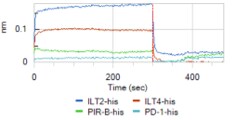
Application: Binding assay/Protein-protein interactionVerified Customer | Posted 09/01/2021Immobilize HLA-G and flow PIR-B

There are no reviews that match your criteria.
Loading...