
Slit2 has been shown to bind to multiple receptors including ROBO-1, -2, -3, and -4, Laminin-1, DAN, Gremlin, and Glypican-1 (1, 6-8). Depending upon the target, Slit2 can promote a number of diverse effects. Slit2 regulates axon guidance by binding to ROBO receptors and initiating axon repulsion (1, 5, 9-12). Slit2 has also been shown to induce growth cone collapse, inhibit oligodendrocyte precursor cell migration, and promote axon elongation, branch formation, and fasciculation (5, 13-16). Additionally, Slit2-N and Slit2-C have been shown to have distinct activities. Slit2-N binds to ROBO-1 and repels motor axon migration, while Slit2-C binds to
Glypican-1 and promotes motor axon migration (5). Outside the nervous system, Slit2 plays a role in a wide range of biological processes including cell adhesion and migration, tumor progression and metastasis, angiogenesis, lymphangiogenesis, HIV-1 replication, platelet function and thrombus formation, and stem cell senescence (1, 8, 17-30).
Recombinant Mouse Slit2 (aa 26-900) Protein, CF
R&D Systems | Catalog # 5444-SL


Loading...
Key Product Details
- R&D Systems CHO-derived Recombinant Mouse Slit2 (aa 26-900) Protein (5444-SL)
- Quality control testing to verify active proteins with lot specific assays by in-house scientists
- All R&D Systems proteins are covered with a 100% guarantee
Source
CHO
Accession Number
Applications
Bioactivity
Loading...
Product Specifications
Source
Chinese Hamster Ovary cell line, CHO-derived mouse Slit2 protein
Gln26-Gln900, with a C-terminal 10-His tag
Gln26-Gln900, with a C-terminal 10-His tag
Purity
>85%, by SDS-PAGE under reducing conditions and visualized by silver stain.
Endotoxin Level
<0.10 EU per 1 μg of the protein by the LAL method.
N-terminal Sequence Analysis
No results obtained; Gln26 predicted
Predicted Molecular Mass
99.7 kDa
SDS-PAGE
105-115 kDa, reducing conditions
Activity
Measured by its ability to enhance neurite outgrowth of dissociated E13 chick embryonic dorsal root ganglia (DRG) neurons.
Recombinant Mouse Slit2 immobilized at 3-12 μg/mL, is able to significantly induce neurite outgrowth.
Recombinant Mouse Slit2 immobilized at 3-12 μg/mL, is able to significantly induce neurite outgrowth.
Reviewed Applications
Read 2 reviews rated 5 using 5444-SL in the following applications:
Formulation, Preparation, and Storage
5444-SL
| Formulation | Lyophilized from a 0.2 μm filtered solution in MOPS and NaCl. |
| Reconstitution | Reconstitute at 100 μg/mL in sterile PBS.
Loading...
|
| Shipping | The product is shipped at ambient temperature. Upon receipt, store it immediately at the temperature recommended below. |
| Stability & Storage | Use a manual defrost freezer and avoid repeated freeze-thaw cycles.
|
Calculators
Background: Slit2
References
- Ypsilanti, A.R. et al. (2010) Development 137:1939.
- Itoh, A. et al. (1998) Brain Res. Mol. Brain Res. 62:175.
- Holmes, G.P. et al. (1998) Mech. Dev. 79:57.
- Chédotal, A. (2007) Adv. Exp. Med. Biol. 621:65.
- Nguyen Ba-Charvet, K.T. et al. (2001) J. Neurosci. 21:4281.
- Nguyen Ba-Charvet, K.T. et al. (2001) Mol. Cell. Neurosci. 17:1048.
- Hagino, S. et al. (2003) Glia 42:130.
- Chen, B. et al. (2004) J. Immunol. 173:5914.
- Yuan, W. et al. (1999) Dev. Biol. 212:290.
- Erskine, L. et al. (2000) J. Neurosci. 20:4975.
- Shu, T. et al. (2003) J. Neurosci. 23:8176.
- Kim, M. et al. (2014) Neural Dev. 9:17.
- Wang, K.H. et al. (1999) Cell 96:771.
- Wong, E.V. et al. (2004) J. Neurobiol. 59:66.
- Liu, X. et al. (2012) J. Biol. Chem. 287:17503.
- Jaworski, A. et al. (2012) Nat. Neurosci. 15:367.
- Guan, H. et al. (2003) J. Immunol. 171:6519.
- Liu, D. et al. (2006) Circ. Res. 98:480.
- Prasad, A. et al. (2007) J. Leukoc. Biol. 82:465.
- Tole, S. et al. (2009) J. Leukoc. Biol. 86:1403.
- Kim, H.K. et al. (2008) Neoplasia 10:1411.
- Prasad, A. et al. (2008) J. Biol. Chem. 283:26624.
- Tseng, R.C. et al. (2010) Cancer Res. 70:543.
- Alajez, N.M. et al. (2011) Cancer Res. 71:2381.
- Zhang, Q.Q. et al. (2015) Oncotarget 6:3123.
- Dunaway, C.M. et al. (2011) Mol. Cell. Biol. 31:404.
- Yang, X.M. et al. (2010) Biochem. Biophys. Res. Commun. 396:571.
- Anand, A.R. et al. (2011) AIDS 25:2105.
- Patel, S. et al. (2012) Circulation 126:1385.
- Harburg, G. et al. (2014) Stem Cell Reports 3:385.
Long Name
SLIT Homolog 2
Alternate Names
SLIL3
Gene Symbol
SLIT2
UniProt
Additional Slit2 Products
Product Documents for Recombinant Mouse Slit2 (aa 26-900) Protein, CF
Certificate of Analysis
To download a Certificate of Analysis, please enter a lot or batch number in the search box below.
Note: Certificate of Analysis not available for kit components.
Product Specific Notices for Recombinant Mouse Slit2 (aa 26-900) Protein, CF
For research use only
Citations for Recombinant Mouse Slit2 (aa 26-900) Protein, CF
 Powered by Bioz
Customer Reviews for Recombinant Mouse Slit2 (aa 26-900) Protein, CF (2)
5 out of 5
2 Customer Ratings
Have you used Recombinant Mouse Slit2 (aa 26-900) Protein, CF?
Submit a review and receive an Amazon gift card!
$25/€18/£15/$25CAN/¥2500 for a review with an image
$10/€7/£6/$10CAN/¥1110 for a review without an image
Submit a review
Customer Images
Showing
1
-
2 of
2 reviews
Showing All
Filter By:
-
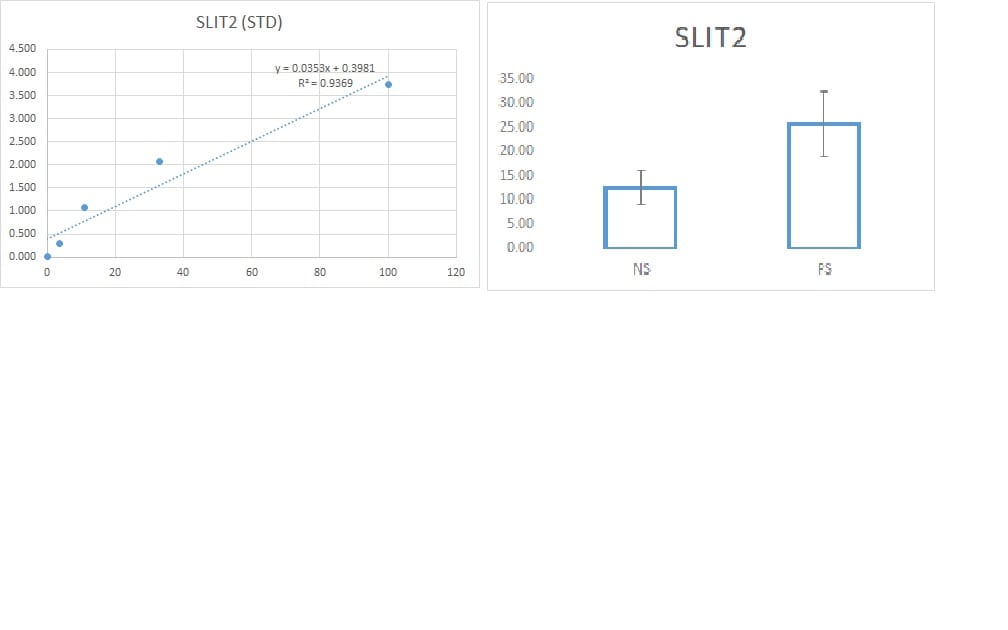
Application: Immunoassay StandardVerified Customer | Posted 10/04/2019We used this protein for a sandwich ELISA format in combination with mAb (5444)) and pAb (AF5444). This combination works well for detecting SLIT2 in human serum.

-
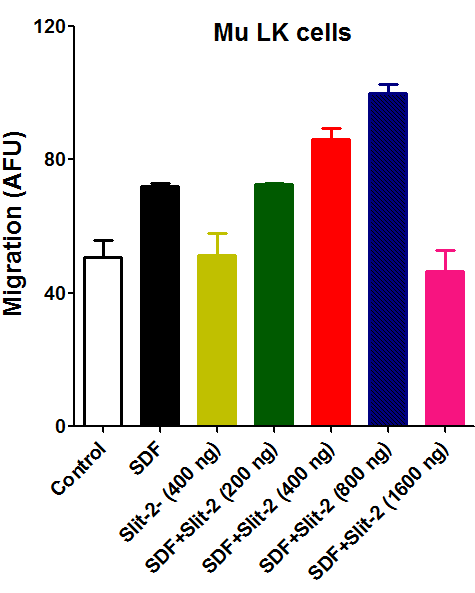
Application: Cell migration/motilityVerified Customer | Posted 08/08/2016
There are no reviews that match your criteria.
Loading...